Air India cadet pilot program fees: the official numbers, eligibility, and path
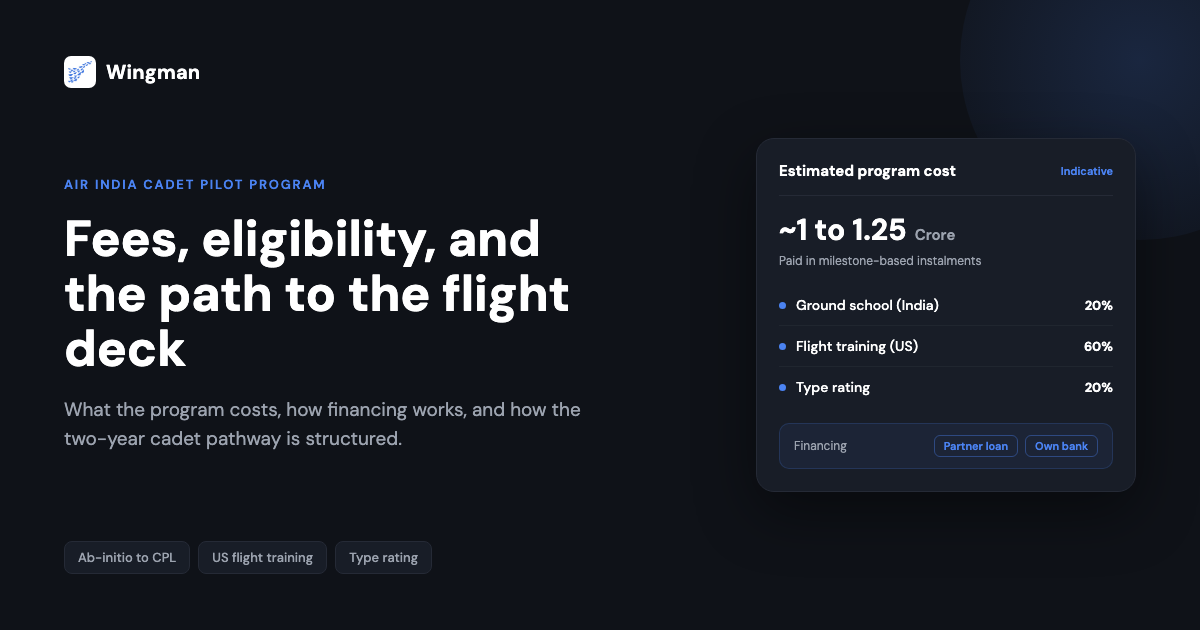
The Air India cadet pilot program costs about Rs 1.1 crore plus GST on the official numbers: that is Air India’s own published estimate for the path through its Flying Training Academy (AIFTA) at Amravati, itemised below. For the US partner-school path, Air India discloses the fee only after selection, with third-party estimates in the Rs 1 to 1.25 crore range. As of August 2026, applications are closed: the official portal at cadetpilot.airindia.com shows a stay-tuned notice while Air India expands its training infrastructure.
This guide leads with the fees because that is the question that matters most, then covers how payment and financing work, eligibility, the two training paths, the selection process, and what actually happens after training. Everything here is drawn from the official Air India cadet portal and the AIFTA academy page as of August 2026, with the few unpublished numbers clearly labelled as estimates.
The official fee breakdown (AIFTA path)
Air India publishes this estimated cost for the full program through its own academy, and it is the first time the program has had an official, itemised number:
| Component | Official estimated fee |
|---|---|
| Ground school (excl. GST) | Rs 3,27,000 |
| Flight training | Rs 76,00,000 |
| ATPL ground school (excl. GST, indicative) | Rs 1,25,000 |
| Type rating (excl. GST, indicative) | Rs 30,00,000 |
| Total | ~Rs 1,10,52,000 + GST |
Source: Air India Flying Training Academy, official fee estimate.
The flight-training component is paid in five instalments of Rs 15,20,000: the first on signing the training agreement, then at 3, 6, 9, and 12 months. Accommodation and transport during ground school, and flights to the training location, may sit outside the fee depending on the path, so confirm the inclusions in your enrolment paperwork.
For the US partner-school path, Air India’s official position is that training cost details are provided once a candidate is enrolled, before training begins, with instalments tied to training milestones. Widely circulated third-party estimates put that path at Rs 1 to 1.25 crore all-in; treat those as estimates, not quotes. The partner schools do publish inclusions: at Acron (Sanford, Florida) the package covers accommodation, local transport, US study-visa fees, equipment and uniforms, and FAA exam fees; AeroGuard (Phoenix, Arizona) similarly includes transport, accommodation, and immigration support.
Two smaller costs to know about: the selection process itself is paid (the payment link is shared once you meet eligibility), and financing is available through a financial institution Air India has partnered with, though you are free to arrange your own education loan and should compare both.
How it compares with IndiGo’s cadet program
The nearest comparison, IndiGo’s cadet program, runs through six partner schools at published fees of $127,500 to $132,000 abroad, or Rs 104 lakh at Chimes in India (the earlier CAE route and its Rs 97.7 lakh fee are closed), over 20 to 21 months ending as an A320 Junior First Officer. Air India’s program runs longer (24 to 26 months), costs about the same on the official AIFTA estimate, and ends with a Trainee Pilot offer at a group airline, with the aircraft type set by fleet requirement rather than guaranteed upfront.
Is the program open right now?
No. As of August 2026 the official portal shows “Stay tuned for upcoming opportunities” with no application window. Windows open periodically (the program launched in February 2024 and has run batches since), so the practical move is to check cadetpilot.airindia.com directly and prepare your eligibility paperwork in the meantime. One published rule worth knowing: a candidate must wait 3 months after a previous application before applying again.
Eligibility
- Citizenship: Indian citizens and OCI holders.
- Age: 18 to 30. You must have completed Class 12 to apply.
- Academics: 10+2 with 60% aggregate and 60% individually in English, Maths, and Physics. NIOS is accepted, and Commerce or Arts students can add Maths or Physics through NIOS.
- English: good written and spoken command.
- Medical: good physical and mental health; a DGCA Class 1 medical is required before flight training starts, not at application. Since it is the hard gate of the whole pathway, read our DGCA Class 1 medical guide and consider clearing it early.
- Flying experience: none required, since this is an ab-initio program.
The two training paths
Training runs roughly 24 to 26 months including the type rating, on one of two routes:
1. Air India Flying Training Academy (AIFTA), Amravati, about 26 months: 6 months of ground school in Gurugram (compulsory even if you have passed DGCA exams), 12 months of flying at Amravati, then licensing, ATPL ground school, and type rating. AIFTA is Air India’s own academy at Belora airport, Maharashtra, planned as South Asia’s largest flying school, with 34 trainer aircraft, a 180-cadet residential campus, and a target of 180 CPL graduates a year.
2. US partner schools, about 24 months total via AeroGuard Flight Training Center (Phoenix, Arizona) or Acron Aviation Academy (Sanford, Florida). Roughly 4 months of DGCA ground school in India, around 12 months of flying in the US to an FAA CPL, then DGCA licence conversion back in India, followed by ATPL ground school and type rating.
Type ratings happen at Air India-affiliated training organisations, including new simulator centres in Gurugram, on the aircraft type Air India’s fleet requires. The type is not guaranteed upfront, though the airline’s narrowbody induction has historically meant the A320 family for most cadets.
The selection process
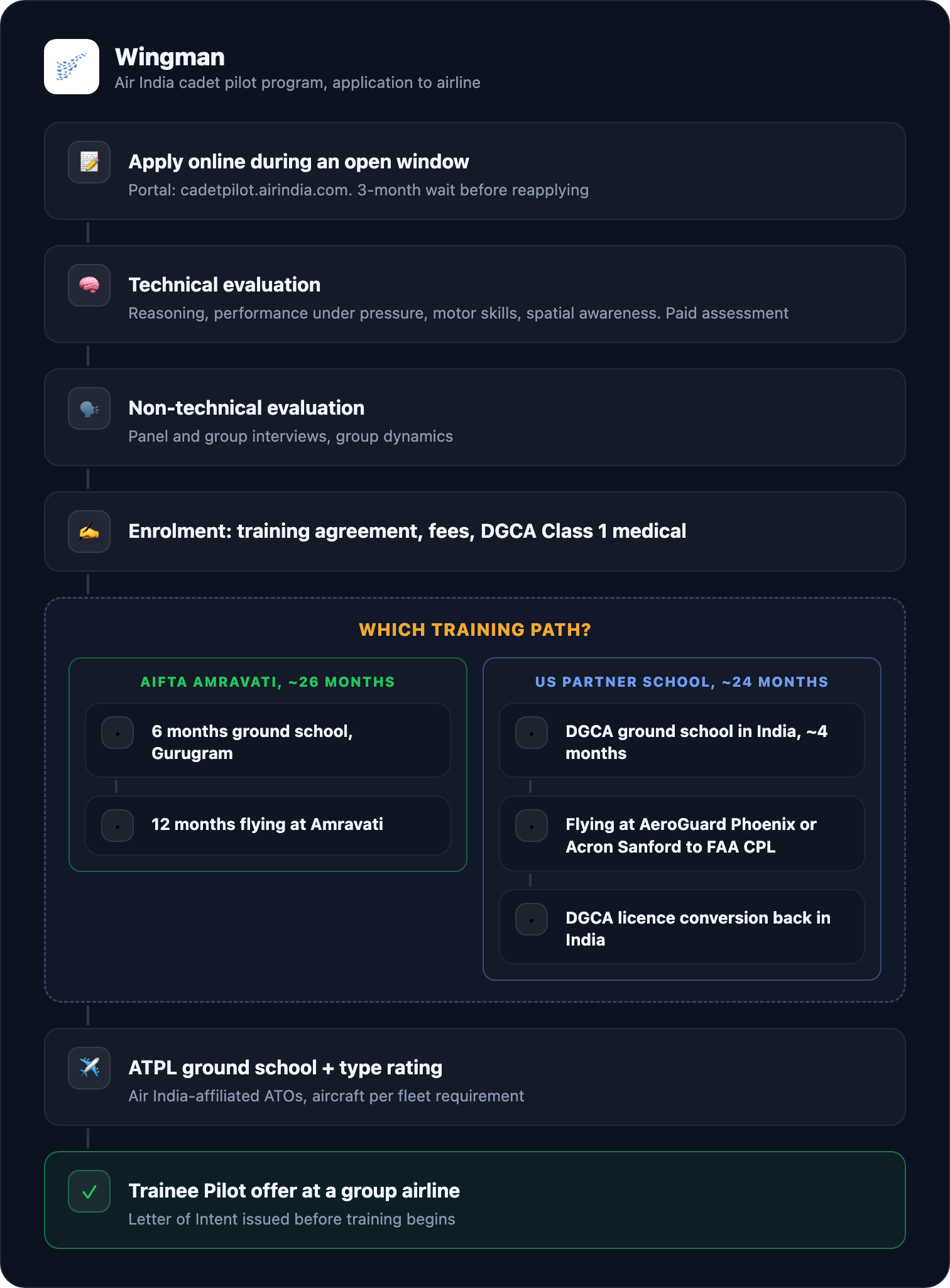
- Online application through the official portal during an open window.
- Technical evaluation: critical thinking, numerical reasoning, performance under pressure, motor skills, and spatial awareness.
- Non-technical evaluation: panel and group interviews, group dynamics.
- Enrolment: offer, training agreement, fee schedule, and the DGCA Class 1 medical before flying starts.
The assessment is paid, and there is no published timeline from application to enrolment; batches are matched to training capacity.
After training: what you are actually promised
Air India’s official wording is precise, and worth quoting rather than paraphrasing: based on its requirements, Air India will offer candidates who successfully complete the program employment as a Trainee Pilot with a group airline (Air India or Air India Express, since the Vistara merger in November 2024). Both US partner schools state that cadets receive a Letter of Intent from Air India before training begins.
What is not published anywhere official: bond or service-agreement terms, stipend during line training, and starting salary. Ask for these in writing at enrolment: the answers exist in the training agreement, just not on the website.
What changed from 2024 to 2026
If you researched this program when it launched, several things are different now:
- Official fees exist: the AIFTA fee table and instalment schedule above were first published in 2025; earlier, every number was a third-party estimate.
- A domestic path exists: AIFTA Amravati was announced in July 2024; the original program was US-only.
- Vistara merged into Air India (November 2024), so placement wording is now “a group airline.”
Keeping your records from day one
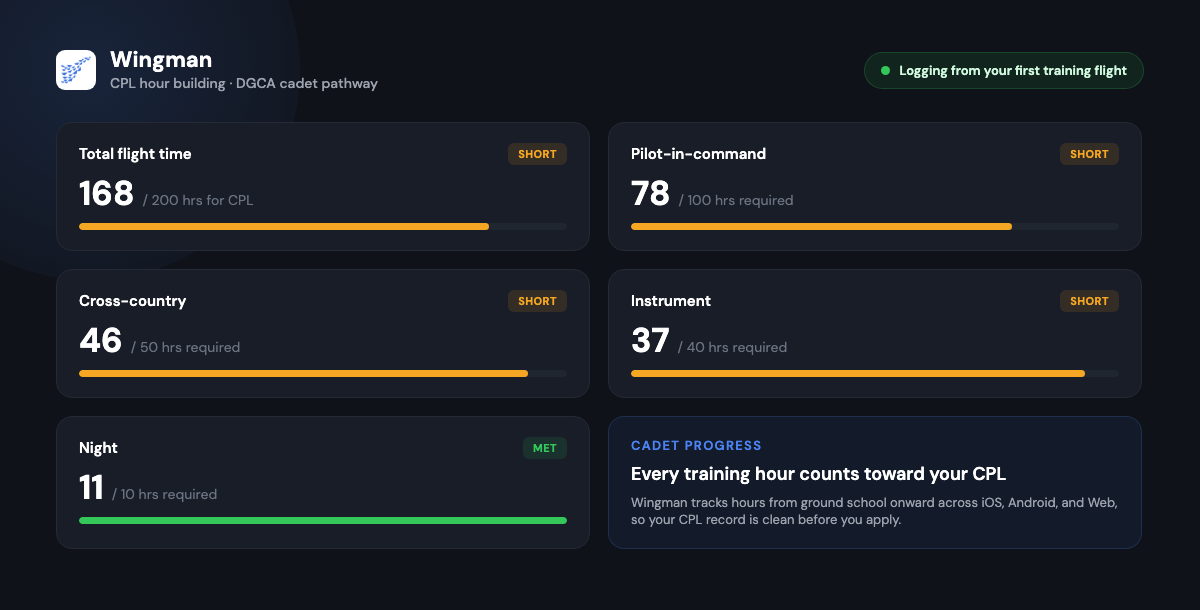
Once flight training starts, your logged hours become the backbone of your licence application and every job you apply for afterwards. Building a clean, accurate record from your very first training flight saves a lot of reconstruction later. A digital logbook is the simplest way to do that. Wingman is a pilot logbook used by 30,000+ pilots across 400+ airlines, and it keeps your hours, currency, and licence details in one place across iOS, Android, and Web.
Wingman is a global product rather than an India-only tool, and it produces regulator-compliant exports for the DGCA along with the FAA, EASA, UK CAA, GCAA, GACA, NZCAA, HKCAD, CASA, and CAAS. That cross-regulator support matters for a cadet who trains under FAA rules in the United States and then flies under the DGCA in India, because the same record set has to satisfy both. There is a free tier up to 250 logged hours, so you can start logging during ground school and early flight training without paying anything up front, and you can create an account and begin straight away.
If you want the India-specific detail, there is a focused walkthrough on keeping a DGCA pilot logbook in India that covers the format and fields the regulator expects.
Frequently asked questions
What are the Air India cadet pilot program fees?
On the official AIFTA estimate, about Rs 1.1 crore plus GST: Rs 3.27 lakh ground school, Rs 76 lakh flight training, Rs 1.25 lakh ATPL ground school, and Rs 30 lakh type rating. The US partner-school fee is disclosed after selection; third-party estimates put it at Rs 1 to 1.25 crore.
Is the Air India cadet pilot program open for applications?
As of August 2026, no: the portal shows a stay-tuned notice. Application windows open periodically, and there is a 3-month cooling period before reapplying.
How are the fees paid?
In instalments. The official AIFTA schedule is five instalments of Rs 15.2 lakh for the flight-training component: at signing, then 3, 6, 9, and 12 months. US partner schools set milestone-based plans at enrolment. Air India has a financing tie-up with a financial institution, and you are free to use your own bank instead.
What is the eligibility?
Indian citizens and OCI holders, aged 18 to 30, with 10+2 at 60% aggregate and 60% each in English, Maths, and Physics (NIOS accepted). Good English and health, and a DGCA Class 1 medical before flying starts. No prior flying experience is required.
How long does the program take?
About 24 months via the US partner schools (including DGCA conversion) and about 26 months via AIFTA Amravati, both ending with a type rating.
Does completing the program guarantee a job with Air India?
Air India’s official wording is that it will offer successful cadets a Trainee Pilot role at a group airline based on its requirements, and cadets receive a Letter of Intent before training begins. Bond terms and salary are not published, so get them in writing at enrolment.
← All articles