How to apply for a Flight Instructor's Rating (FIR) on eGCA
A Flight Instructor’s Rating (FIR) is what lets a licensed pilot in India train others. If you hold a CPL or ATPL and want to move into instructing, the FIR is the rating you apply for, and the application runs through eGCA, the Directorate General of Civil Aviation (DGCA) online licensing platform at https://egca.gov.in. This guide explains what you need before you apply, the FIR examination conducted by the CEO/DFT, and the exact eGCA steps for submitting your application.
Two things tend to confuse applicants. The first is that the FIR sits behind a separate oral or written examination, not just a form. The second is that the eGCA application checks your e-logbook and flying-training records closely, so they need to be accurate and approved before you start. Both are covered below.
What a Flight Instructor’s Rating is
An FIR is an endorsement on your flight crew licence that authorises you to give flying instruction. An Assistant Flight Instructor’s Rating (AFIR) is the entry-level version that lets you instruct under supervision, and the FIR is the fuller rating. In eGCA, both are handled under the same service: “Issuance/Renewal of AFIR/FIR.” [VERIFY]
The rating matters because instructing is one of the most common ways pilots build experience and stay in the cockpit between airline roles. Your instructional hours, like all your flight time, still need to be recorded in a logbook you can stand behind, which is where a digital e-logbook earns its place later in this guide.
Before you apply: the pre-requisites
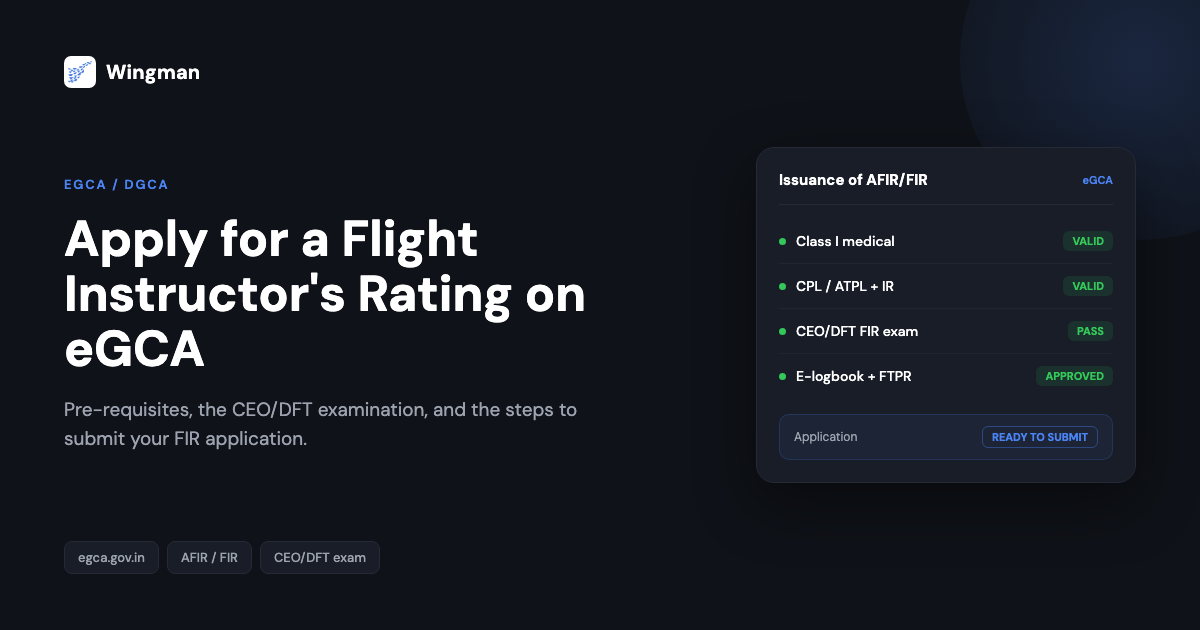
Before you open the eGCA application, confirm you meet the conditions for the rating. Missing one of these is the most common reason an application stalls. Here is the checklist.
- eGCA registration. You must be a registered user with a unique eGCA ID. If you have not set this up yet, our guides on how to get your eGCA ID and the wider pilot registration process with eGCA walk through it.
- Medical assessment. Hold a valid Class I medical assessment. [VERIFY]
- Licence and ratings. Hold a valid CPL(A/H) or ATPL(A/H), along with a valid FRTOL and RTR. [VERIFY]
- Instrument Rating. Hold a valid Instrument Rating (single or multi-engine). [VERIFY]
- Examination. Pass the oral or written FIR examination conducted by the CEO/DFT, following the syllabus prescribed by DGCA. [VERIFY]
- Flying experience. Meet the required flying experience and maintain a duly filled e-logbook with the necessary approvals. [VERIFY]
- Document verification. Make sure your personal and educational details on eGCA are accurate and verified before you apply.
If any item is incomplete, sort it out first. The eGCA form pulls from your existing record, so gaps in your profile show up as blocked or “not qualified” fields during the application.
The FIR examination: format, syllabus, and what to study
This is the part most candidates search for and the part the application depends on, so it is worth covering on its own. The FIR is gated by an examination conducted by the CEO/DFT (the Central Examination Organisation / Directorate of Flying Training) and held to the syllabus prescribed by DGCA. [VERIFY] You clear this examination before, or as part of, satisfying the eGCA pre-requisites above.
Format
The FIR examination is conducted in oral or written form by the CEO/DFT rather than through the Pariksha computer-based system used for the CPL and ATPL subject papers. [VERIFY] Because it is an instructor rating, the assessment focuses on your ability to teach, not only on whether you can fly to standard yourself. Expect to be examined on how you would explain, sequence, and brief exercises to a student.
What the syllabus covers
The prescribed syllabus is set by DGCA, so treat the official document as the source of truth. [VERIFY] In broad terms, candidates preparing for an instructor rating are typically examined across the following areas. [VERIFY]
- The principles and techniques of flight instruction, including how people learn and how to structure a lesson.
- Briefing and debriefing technique: long briefs, pre-flight briefs, and in-flight patter for each exercise.
- The standard exercises of the flying-training syllabus, from effects of controls through to advanced manoeuvres, and how to teach each one.
- Air regulation, airmanship, and the threat-and-error management that underpins safe instruction.
- Technical subjects relevant to the aircraft you will instruct on: aircraft general knowledge, aerodynamics, meteorology, navigation, and human performance.
How to prepare
Because the FIR assessment is oral or written and instruction-focused, rote answers are less useful than being able to teach a topic out loud. Practical preparation usually means working through each exercise in the training syllabus, writing your own briefs, and rehearsing how you would deliver them to a beginner. Confirm the current syllabus and examination arrangements directly with DGCA or your approved flying training organisation before you sit, since both can change. [VERIFY]
To plan the wider examination path that leads up to flying training, our guide on exams to be cleared in order to get CPL, PPL, ATPL sets out the subject papers behind your underlying licence.
How to apply for the FIR on eGCA
Once you meet the pre-requisites and have cleared the examination, the application itself runs through eGCA. Follow these steps with the portal open in another tab.
- Log in. Use your eGCA ID and password to sign in at https://egca.gov.in.
- Select the service. In the Services section on the left panel, choose “Issuance/Renewal of AFIR/FIR.” [VERIFY]
- Read the instructions screen. eGCA opens an instructions page before the form. Read it in full, because it lists the documents you will need to upload, such as your medical, licence, FTPR, and any clearance certificates, and the order in which the form expects them. Having these files ready as PDFs before you start saves you from abandoning a half-completed application. [VERIFY]
- Complete the application form. Verify and update your basic details (mobile number, email, addresses), confirm your education and examination details and upload any pending results, and provide your English Language Proficiency (ELP) certificate details if you hold one. [VERIFY]
- Enter the FIR-specific details. Choose the aircraft type and endorsement name from the DGCA common type rating list. Indian Defence personnel provide the required details and upload the NOC; foreign nationals upload a nationality certificate or attested passport copy. Then fill in your flying experience, making sure each parameter shows as “Qualified.” [VERIFY]
- Add training and experience records. Enter your ground training details, provide your flying-training hours and upload the Flying Training Progress Report (FTPR), declare any involvement in accidents or incidents with the relevant clearance certificates, and select how you will submit your original licence. [VERIFY]
- Pay and submit. Pay the required fee. On successful payment a receipt is generated, and the date of submission to DGCA marks the completion of your application. [VERIFY]
- Track the application. Download your payment receipt and follow progress through “License Request Details” on the portal. [VERIFY]
Application flow

If a field will not let you proceed, it is usually because the underlying record is incomplete: a parameter not marked “Qualified,” a missing FTPR, or an e-logbook entry awaiting approval. Fix the source record rather than working around the form.
Where your e-logbook fits in
Two of the eGCA steps above depend directly on your flight records: the flying-experience parameters that must read “Qualified,” and the e-logbook that needs to be duly filled and approved. If your hours are scattered across paper books and spreadsheets, assembling clean, verifiable totals for the application is slow and error-prone.
Wingman is a pilot logbook used by 30,000+ pilots across 400+ airlines, and it keeps your hours, currency, and licence details in one place across iOS, Android, and Web. It is a global product rather than an India-only tool, and it supports DGCA among regulators including the FAA, EASA, UK CAA, GCAA, GACA, NZCAA, HKCAD, CASA, and CAAS, with regulator-compliant exports. For India specifically, there is a focused walkthrough on keeping a DGCA pilot logbook in India.
There is a free tier up to 250 logged hours, so you can keep accurate totals while you build toward the rating, and once you start instructing, the same logbook records the instructional hours you accumulate. Having tidy, exportable totals makes the eGCA flying-experience section far quicker to complete than reconciling figures by hand.
After you submit
The date of submission to DGCA marks the completion of the application process; the rating is issued after DGCA reviews and approves it. Keep an eye on “License Request Details” for status changes, and respond promptly if the portal flags a document for correction. For the authoritative requirements, fees, and the FIR examination syllabus, always check the current DGCA guidance and the eGCA help material before you rely on anything here, since procedures are updated from time to time.
Frequently asked questions
Where do I apply for a Flight Instructor’s Rating in India?
You apply through eGCA, the DGCA online licensing platform at https://egca.gov.in, under the “Issuance/Renewal of AFIR/FIR” service. You need a registered eGCA ID first; our guide on getting your eGCA ID covers that. [VERIFY]
Is there an exam for the FIR, and who conducts it?
Yes. The FIR is gated by an oral or written examination conducted by the CEO/DFT, following the syllabus prescribed by DGCA. It is instruction-focused, assessing how you would teach and brief exercises rather than only how you fly. Confirm the current format and syllabus with DGCA before you sit. [VERIFY]
What do I need before I can apply?
In broad terms: a registered eGCA ID, a valid Class I medical, a valid CPL or ATPL with FRTOL and RTR, a valid Instrument Rating, a pass in the CEO/DFT FIR examination, the required flying experience, and a duly filled and approved e-logbook. Verify the exact current requirements against official DGCA guidance. [VERIFY]
What documents does the eGCA form ask me to upload?
The application typically asks for your medical, licence, examination results, ELP details if held, the Flying Training Progress Report (FTPR), an NOC for Defence personnel or nationality proof for foreign nationals, and any accident or incident clearance certificates. The instructions screen lists what is needed before the form, so prepare these as PDFs first. [VERIFY]
How do I track my FIR application after submitting?
Download the payment receipt generated on successful payment, then follow progress through the “License Request Details” option on eGCA. The date of submission to DGCA marks completion of the application; the rating is issued after review. [VERIFY]
← All articles