Are digital pilot logbooks accepted by Middle East aviation authorities? What you need to know
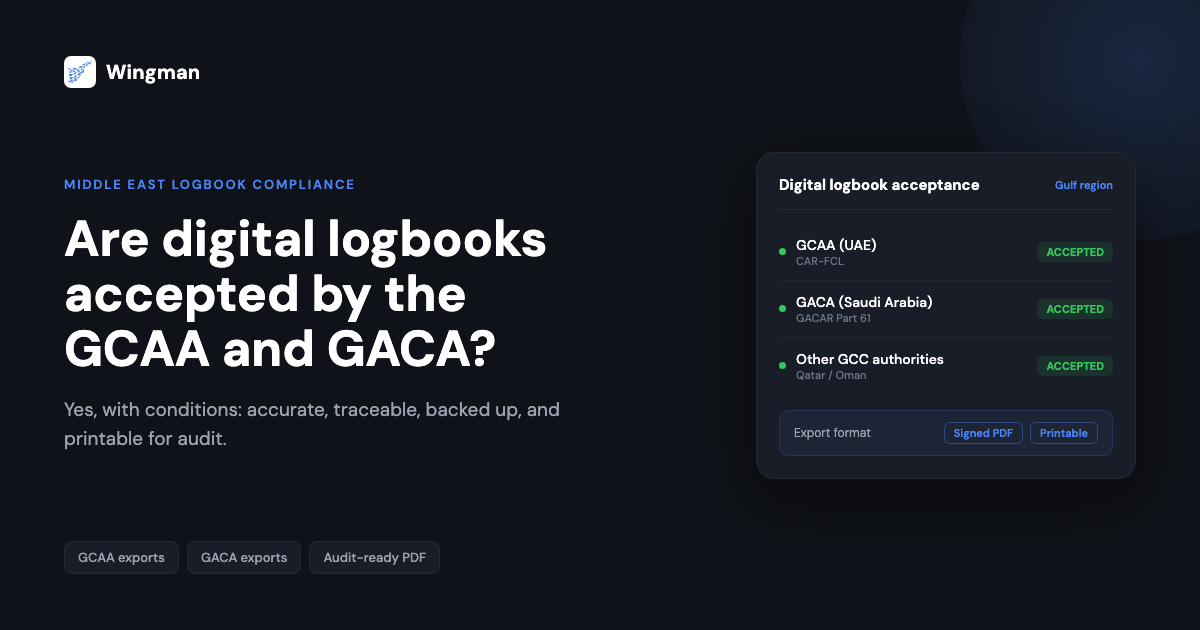
For pilots flying in the Middle East, the move from a paper logbook to a digital one raises a practical question before any feature comparison matters: will the regulator and your airline actually accept it? A logbook is a legal record. If a GCAA inspector, a GACA licensing officer, or an airline interview panel asks to see your hours and the format does not hold up, the convenience of an app counts for nothing.
The short answer is that digital pilot logbooks are accepted across the major Gulf authorities, but acceptance is conditional. Your records have to be accurate, traceable, exportable to a recognised format, and printable on request. This guide explains where the General Civil Aviation Authority (GCAA) of the UAE and the General Authority of Civil Aviation (GACA) of Saudi Arabia stand, what the other GCC regulators expect, and how to choose an electronic logbook that keeps you audit-ready rather than just tidy.
Are digital logbooks accepted in the Middle East?
Yes, with conditions. None of the major Gulf authorities mandate paper, and electronic flight records are routinely used by airline pilots across the region. What the regulators care about is not the medium but the integrity of the record: that the data is complete, that it can be verified, and that it can be produced in a readable, signed form when an inspector or examiner asks for it.
In practice that means a digital logbook is accepted when it can do three things reliably:
- Hold the full set of required flight fields (dates, route, aircraft type and registration, and the time breakdowns each authority expects).
- Produce a clean, authority-appropriate PDF export that can be printed and, where needed, endorsed.
- Demonstrate that entries have not been altered without trace, with backups so nothing is lost.
A spreadsheet or a folder of screenshots does not meet this bar reliably, which is why “I keep it in Excel” tends to cause problems at audit or interview. The rest of this guide looks at what each authority asks for.
UAE GCAA: position on electronic logbooks
The GCAA regulates flight crew licensing through its Civil Aviation Regulations, with flight crew licensing requirements set out in the CAR-FCL series. [VERIFY] The authority accepts digital pilot logbooks provided the record meets the conditions that apply to any logbook, namely that it is accurate, complete, and available for inspection.
For pilots in the UAE, the points that matter most are:
- The logbook must be readily printable for audit or verification. An inspector or licensing officer should be able to receive a clean printed record, not a screen they have to scroll through.
- Entries must be accurate and traceable, and the record should not be open to silent tampering. Edits should be attributable.
- You should retain backups so that a lost or wiped device does not mean a lost flight history.
- For licence issue or renewal, the logbook total may need to be signed or endorsed, whether by you, an instructor, or an examiner depending on the submission. [VERIFY]
The GCAA also publishes guidance that pilots typically reference for hour totals and licence applications. [VERIFY] The practical takeaway is that the GCAA is comfortable with electronic logbooks that behave like a controlled record: signed where required, printable on demand, and backed up. For a UAE-specific walkthrough, see the GCAA pilot logbook guide.
Saudi GACA: requirements for pilot logbooks
The GACA in Saudi Arabia recognises electronic flight records under its General Authority of Civil Aviation Regulations (GACAR), with pilot logging requirements set out under the flight crew licensing rules in GACAR Part 61. [VERIFY] As with the GCAA, the emphasis is on a complete and verifiable record rather than on paper.
A GACA-acceptable logbook is generally expected to:
- Record the flight time breakdowns the authority requires, including total time, pilot-in-command and second-in-command time, night time, instrument time, and the aircraft category and class. [VERIFY]
- Be presentable on request to the authority or to an employer.
- Be accurately maintained and legible, whether produced in print or held electronically.
- Reflect a verifiable flight history that holds up during an inspection or audit.
Saudi pilots converting from another authority or renewing an ATPL should pay particular attention to how their totals map onto the GACA fields, since a mismatch between roster history and logged time is a common source of friction. The GACA pilot logbook guide covers the Saudi specifics in more depth.
The other GCC authorities
Beyond the UAE and Saudi Arabia, the same principle holds across the region. The Qatar Civil Aviation Authority, the Civil Aviation Authority of Oman, Bahrain’s authority, and Kuwait’s regulator all work from logbooks that are complete, verifiable, and producible on request, and none of them require that the record be kept on paper. [VERIFY] The differences between them are mostly in the exact fields, endorsement practice, and renewal documentation rather than in whether digital is allowed at all.
Because those differences do matter when you change employer or convert a licence, it is worth reading the authority-by-authority breakdown in Middle East pilot logbook requirements: key differences between GCAA, GACA and other CAAs before you assume one country’s format will satisfy another.
What makes a digital logbook compliant in the Middle East
Not every logbook app is built to satisfy a regulator. To stay audit-ready across the GCC, the features that actually carry weight are:
- Authority-appropriate PDF exports. You want clean, structured exports you can print for a check or a licence submission, not a generic data dump.
- Secure cloud backups. The record should survive a lost phone, with your history stored safely rather than only on one device.
- Endorsement support. Instructor flights, line checks, and instrument renewals often need an endorsement, so the logbook should be able to capture them.
- Correct time handling. Many Middle East rosters cross time zones, so the logbook needs to handle local time and UTC correctly rather than leaving you to reconcile sectors by hand.
- Clear duty categorisation. PIC, SIC, instructor, night, and instrument time should be distinct and totalled correctly.
The common failures are the mirror image of that list: submitting screenshots or a spreadsheet instead of a structured export, manual entry errors that never get validated, and duty times that do not reconcile with the roster the airline holds. If you are still weighing the change itself, why Middle East pilots are ditching paper logbooks sets out the case in regional terms.
Is your digital logbook audit-ready?

Choosing the best electronic logbook for Middle East pilots
Once you know acceptance is conditional, “which logbook is best” becomes a question about which one keeps you on the right side of those conditions with the least manual effort. For a Middle East airline pilot, the criteria that separate a good electronic logbook from a merely tidy one are:
- Roster import that matches how Gulf carriers actually publish duties, so your hours come from the source rather than retyping.
- Exports that map onto GCAA and GACA expectations, plus the other regulators you may move between.
- Backups and traceability strong enough to satisfy an inspector, not just to reassure you.
- Platform coverage that fits how you work, across phone, tablet, and web.
Wingman is built around exactly those criteria and is used by 30,000+ pilots across 400+ airlines on iOS, Android, and Web. For Middle East pilots specifically, it imports rosters automatically from systems used across the region, including AIMS eCrew, NavBlue RAIDO, CAE Crew Access, ARMS, CESAR, Sabre, FLICA, and PDC CrewConnex, so your flight times come straight from the operator’s data rather than from manual entry. It produces regulator-compliant exports for the GCAA and GACA among others, including the FAA, EASA, UK CAA, DGCA, NZCAA, HKCAD, CASA, and CAAS, which matters when a Gulf career involves more than one authority over time.
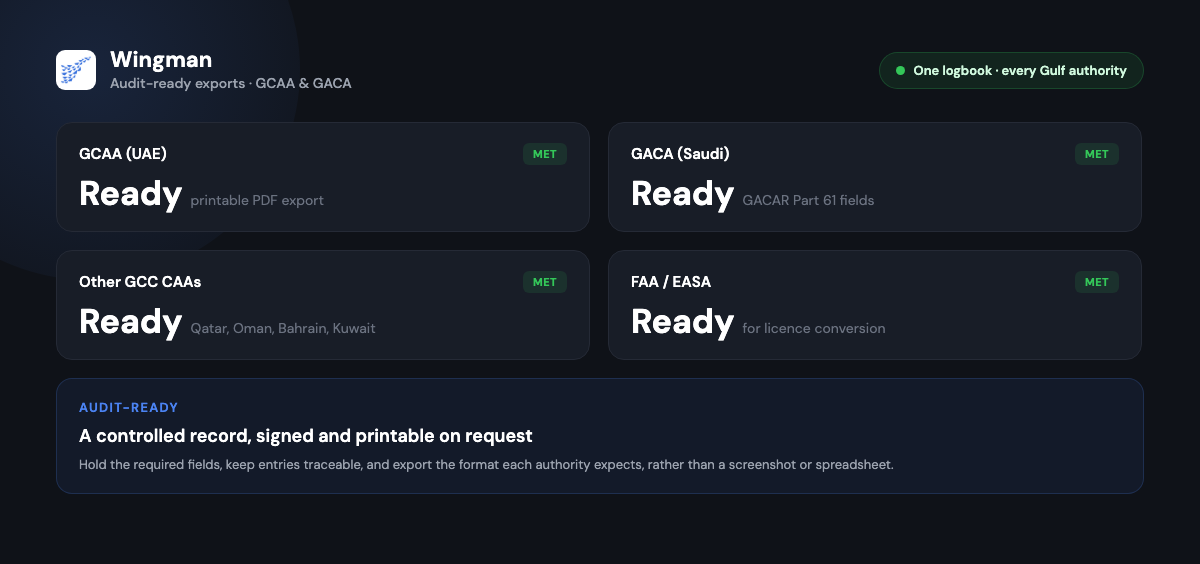
There is a free tier up to 250 logged hours, so you can move your records across and see how the exports look before committing. Pro is $59 per year (billed as $4.99 per month annually), which keeps the cost predictable against the value of a record that holds up at audit and interview. If you are comparing options head to head, the wider field is covered in top electronic pilot logbook apps for 2025.
What airlines and examiners expect in the region
Regulator acceptance is one half of the picture. Airline licensing departments and examiners apply their own expectations on top, and these surface most often at simulator checks, recurrent training, and interviews. In practice you should be ready to produce:
- A printed logbook summary on request, broken down by aircraft type, recency, and flight time limitation compliance.
- Logs that reconcile with the roster timeline the airline holds, so duty hours line up.
- Verified endorsements for line checks, instrument ratings, and recurrent training.
If you are applying to carriers such as Emirates, Etihad, Saudia, flydubai, Qatar Airways, or Oman Air, consistent formatting and a reliable export to an ICAO-style or authority-specific PDF is what turns your logbook from a personal record into something an employer can verify quickly. [VERIFY] When you can hand over a clean, signed, reconciled export, the logbook stops being a point of friction in the process.
Is a signature or stamp still required?
In most Middle East jurisdictions, yes, in some form. Digital signatures and instructor endorsements are generally valid, but for official submissions you may still be asked to produce a printout that is signed by the authority, an instructor, or an examiner. [VERIFY] Digital-only submission is accepted where traceability and data integrity can be demonstrated. The safe approach is to keep your record in a logbook that can both hold electronic endorsements and produce a printable, signable summary, so you are covered whichever route a given submission takes.
Frequently asked questions
Are digital pilot logbooks legally accepted by the GCAA and GACA?
Yes, both the UAE GCAA and the Saudi GACA accept electronic pilot logbooks, provided the record is accurate, traceable, backed up, and printable for inspection or licence submission. Acceptance is about the integrity and format of the record rather than whether it is kept on paper. [VERIFY]
What format does my logbook export need to be in for a Middle East audit?
You generally need a clean, structured PDF that lists the required flight fields and time breakdowns and that can be printed and, where required, signed or endorsed. A screenshot or spreadsheet is not a reliable substitute, because it does not present as a controlled record. [VERIFY]
Do I still need a signature or stamp if my logbook is digital?
Often, yes. Digital signatures and instructor endorsements are typically valid, but official submissions may require a printed summary signed by the authority, instructor, or examiner. Keep a logbook that can produce a printable, signable export so you are covered either way. [VERIFY]
Which is the best electronic logbook for pilots flying in the Middle East?
The best choice for a Gulf pilot is one that imports rosters from the systems your airline uses, produces GCAA and GACA compliant exports, backs your data up securely, and works across phone, tablet, and web. Wingman is built around those criteria and supports GCAA and GACA exports alongside the FAA, EASA, UK CAA, DGCA, and others, with a free tier up to 250 hours.
Will one logbook work if I move between Gulf authorities?
The core record carries over, but the required fields and endorsement practice differ between authorities, so you need a logbook that can export to each one. The differences are set out in the GCAA, GACA and other CAAs comparison.
← All articles