Are electronic pilot logbooks legal under FAA and EASA rules
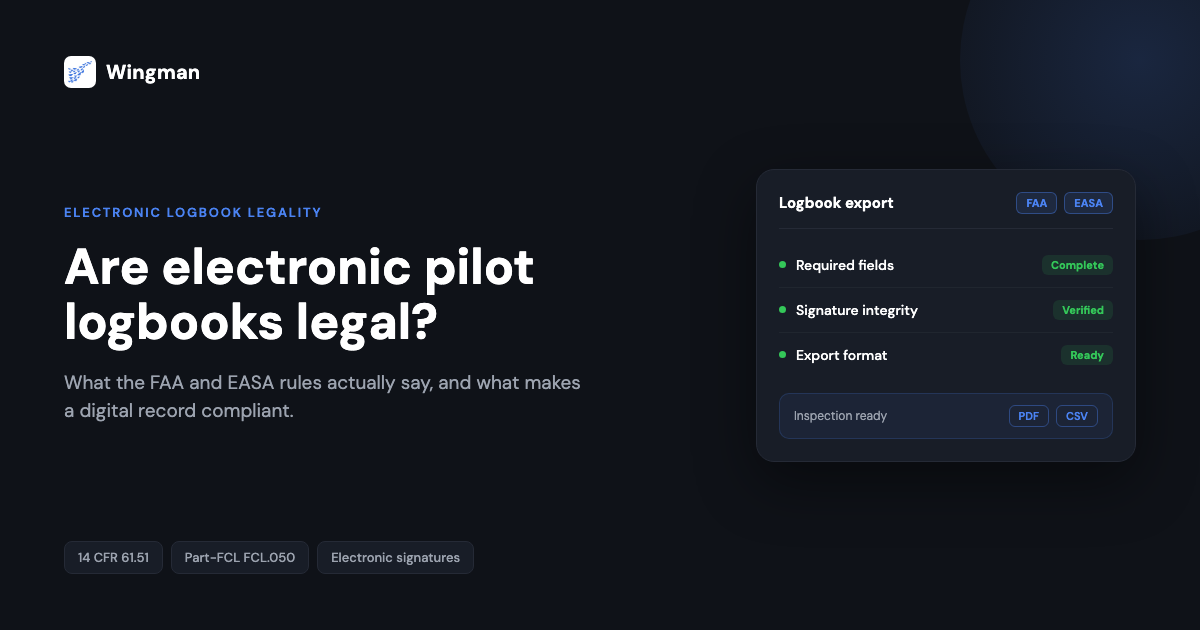
Short answer: yes. Both the FAA in the United States and EASA in Europe accept electronic pilot logbooks, and neither rulebook requires you to keep a paper one. What the regulations actually care about is not the medium but the record itself, that it is accurate, complete, reliable, and available when an inspector or examiner asks to see it. There is no federal law on electronic logbooks that bans them, and there is no EASA rule that mandates paper.
That said, “legal” is not the same as “automatic.” A digital logbook is compliant when it captures the required fields, preserves the integrity of signatures and endorsements, and can be produced in a form your authority will accept. This guide explains what the FAA and EASA rules say, keeps the two jurisdictions distinct because they differ in important ways, and covers the parts pilots most often get wrong, signature integrity and national-authority variations. Where a specific regulatory detail can change or carries a designation that may have been revised, it is tagged [VERIFY] so a human can confirm the current reference before you rely on it.
What the FAA rules actually say
In the United States, pilot recordkeeping is governed by 14 CFR 61.51. The rule sets out what must be recorded, the date, total flight time or lesson time, aircraft make and model or simulator identification, the location of departure and arrival, the type of pilot experience or training, and the conditions of flight such as night, instrument, or cross-country. Crucially, 61.51 describes what to log and in what categories, but it does not prescribe the physical form of the logbook. The regulation refers to records being kept “in a manner acceptable to the Administrator” rather than requiring a bound paper book. [VERIFY]
That is the legal basis people are looking for when they ask whether electronic logbooks are allowed under federal law. The FAA does not specify the medium, so an electronic record that contains the required information satisfies the recordkeeping requirement just as a paper one does. The flexibility is the point, the burden is on the pilot to keep the record reliably, not to keep it on paper.
On electronic records and electronic signatures more specifically, the FAA has published guidance in Advisory Circular 120-78, which addresses the acceptability of electronic recordkeeping systems and electronic signatures, including criteria around integrity, traceability, and the ability to detect alteration. The exact circular number and revision (for example AC 120-78A or a later revision) should be confirmed, as advisory circulars are periodically updated and superseded. [VERIFY] An advisory circular is guidance rather than regulation, so it shows an acceptable means of compliance rather than the only one, but it is the document most often cited when a system’s electronic signatures need to stand up to scrutiny.
A practical wrinkle remains around instructor endorsements. Many instructors and examiners still prefer to provide certain endorsements on paper or as a verifiable digital signature with traceable metadata, then have the pilot retain that record. The endorsement has to be attributable to the person who gave it and resistant to undetected change, which is why a scanned, dated, metadata-preserved endorsement, or a proper electronic signature, matters more than where the rest of the logbook lives.
What the EASA rules actually say
In the European system, the logging of flight time falls under Part-FCL, specifically FCL.050, which requires a pilot to keep a reliable record of the details of all flights flown. The associated Acceptable Means of Compliance, AMC1 FCL.050, sets out the format and the fields a logbook should contain, and it explicitly contemplates records kept in an electronic format as well as on paper. The exact wording and current revision of FCL.050 and its AMC should be checked against the latest consolidated Part-FCL, because EASA’s Easy Access Rules are revised over time. [VERIFY]
The principle in Europe mirrors the FAA’s in spirit. The regulation cares that the record is reliable, that it contains the required details, and that it can be presented when required. An electronic logbook that meets those conditions is acceptable. EASA guidance also recognises that electronic documents, including logbooks, can be carried and presented during checks, provided their authenticity and integrity are preserved. [VERIFY]
Where Europe differs from the United States is the role of the national aviation authority. EASA sets the common framework, but individual member-state authorities, the NAAs, administer licensing and can apply additional expectations about format, certification, or how records are presented for a licence application or proficiency check. This is the single most important caveat for European pilots, the EASA framework permits electronic logbooks, but your specific NAA may have its own guidance on top of it.
Why the FAA and EASA frameworks are not interchangeable
It is tempting to treat “FAA and EASA both allow electronic logbooks” as one fact, but the two systems should be kept distinct.
| Topic | FAA (United States) | EASA (Europe) |
|---|---|---|
| Primary rule | 14 CFR 61.51 recordkeeping | Part-FCL FCL.050 logging of flight time |
| Medium | Not prescribed, paper or electronic both accepted [VERIFY] | Electronic format contemplated by AMC1 FCL.050 [VERIFY] |
| Electronic signatures | Addressed in AC 120-78 guidance [VERIFY] | Authenticity and integrity must be preserved [VERIFY] |
| Local variation | Largely uniform across the US | NAA, member-state, guidance can add requirements |
| What an inspector wants | Required fields, available on request | Required fields, reliable and presentable on request |
The shared thread is that neither authority is checking the format for its own sake. Both want a complete, attributable, tamper-evident record. The differences sit in the references you cite and, for EASA pilots, in the extra layer of national guidance.
Signature and endorsement integrity
This is where compliance is won or lost, regardless of jurisdiction. A logbook entry that records the flight is straightforward. An endorsement, a sign-off, or an examiner’s certification carries legal weight, and that weight depends on three things:
- Attribution. The signature must be tied to the person who actually gave it, with their certificate or credential details where required.
- Integrity. It must be possible to tell whether an entry was changed after it was signed. Tamper-evidence, not just storage, is the point.
- Availability. The signed record must be reproducible later, in a form the authority will accept, sometimes years after the fact.
A well-built electronic logbook supports this through proper electronic signatures, audit trails, and exports that preserve the signed state. Where an instructor still prefers paper, a scan with preserved date and metadata kept alongside the digital record is a reasonable bridge. The goal is a record that an examiner can trust, not the appearance of one.
National-authority and member-state variations
Even though the FAA and EASA both accept electronic logbooks, the authority you answer to determines the practical details. A few examples of where this matters:
- An EASA member-state NAA may want a particular layout or a printed, signed summary for a licence or rating application. [VERIFY]
- An FAA checkride or 8710 submission has its own expectations for how experience is presented and totalled.
- Pilots who fly under more than one authority, or who move between carriers and jurisdictions, need a record that exports into each authority’s expected format rather than a single fixed layout.
This is why “can produce the right export” matters as much as “is digital.” A logbook that holds your hours but cannot generate what your authority expects at renewal or upgrade is only half the job.
How a compliant digital logbook handles this
Wingman is built so the record meets these requirements rather than leaving them to you. It is used by 30,000+ pilots across 400+ airlines, runs on iOS, Android, and Web, and produces regulator-compliant exports for the FAA, EASA, UK CAA, GCAA, DGCA, GACA, NZCAA, HKCAD, CASA, and CAAS, so the same flight history can be presented in the format a given authority expects.
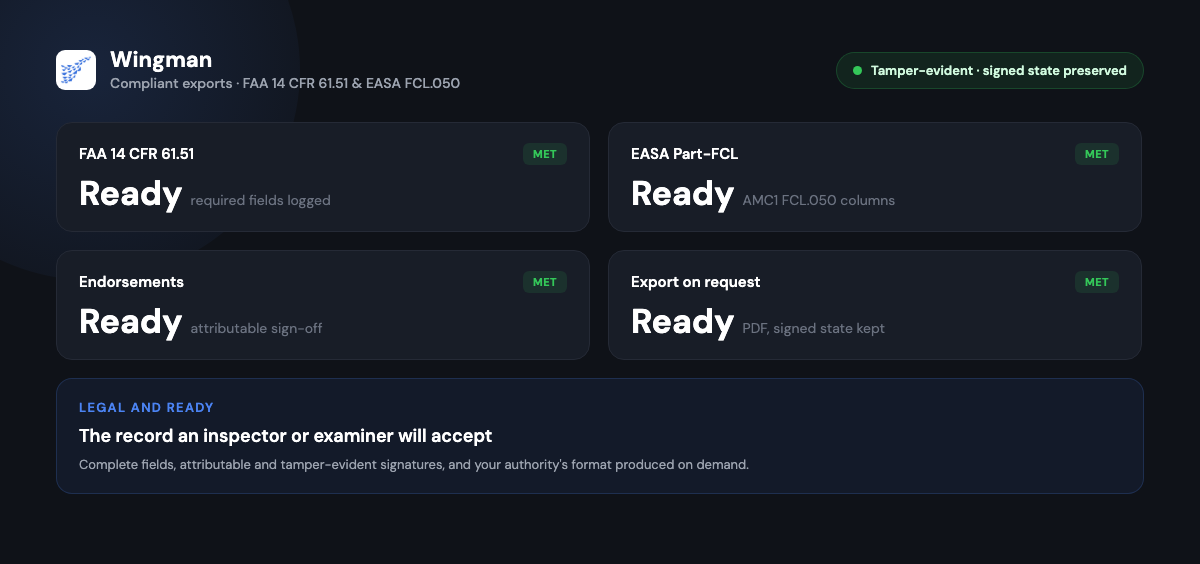
For the parts that actually decide compliance, it captures the fields the rules require, supports instructor and examiner sign-off with traceable records, and keeps exports that preserve the signed state for inspections, checkrides, and licence applications. Roster import from AIMS eCrew, NavBlue RAIDO, CAE Crew Access, ARMS, CESAR, Sabre, FLICA, and PDC CrewConnex keeps the underlying record accurate, which is the foundation everything else rests on, because a tidy export of an incomplete logbook still fails an audit.
There is a free tier up to 250 logged hours, so you can keep a compliant record from training onward, and Pro is $59 per year internationally ($4.99 per month billed annually, or ₹4,499 per year in India). For format-specific detail, see the FAA pilot logbook guide and the EASA digital logbook guide. If you are weighing options, the best digital pilot logbook app comparison puts the main tools side by side. You can start in the browser at app.wingmanlog.com.
Staying compliant: a short checklist

In plain terms: record everything the rule asks for, keep endorsements attributable and tamper-evident, make sure you can produce your authority’s format on request, and confirm any national extras that apply to you.
Frequently asked questions
Are electronic pilot logbooks legal under FAA rules?
Yes. 14 CFR 61.51 sets out what must be recorded but does not require a paper logbook, so an electronic record that contains the required information satisfies the rule. FAA guidance such as Advisory Circular 120-78 addresses acceptable electronic recordkeeping and electronic signatures. Confirm the current circular revision before relying on it. [VERIFY]
Are electronic logbooks accepted under EASA rules?
Yes. Part-FCL FCL.050 requires pilots to keep a reliable record of flights, and its Acceptable Means of Compliance contemplates electronic as well as paper formats, provided the record is reliable, complete, and can be presented when required. Individual national authorities may add their own expectations. [VERIFY]
Is there a federal law that bans electronic logbooks?
No. There is no FAA regulation that prohibits electronic logbooks. The recordkeeping rule is about content and reliability, not medium, so paper and electronic records are both acceptable when they meet the requirements. [VERIFY]
Do electronic signatures and instructor endorsements hold up?
They can, when the signature is attributable to the person who gave it and the entry is tamper-evident so any later change is detectable. Some instructors still prefer paper or a verifiable digital signature with preserved metadata. Keeping that signed record alongside your digital logbook is a sound approach.
Can one electronic logbook work across both FAA and EASA?
Yes, if it can produce the format each authority expects. The underlying record is the same, but FAA and EASA cite different rules and may want different presentations, and an EASA national authority may add requirements. A logbook that exports into multiple regulator formats, rather than one fixed layout, covers pilots who fly across jurisdictions.
The bottom line
Electronic pilot logbooks are legal under both FAA and EASA rules. The FAA’s 14 CFR 61.51 defines what to record without mandating paper, and EASA’s Part-FCL FCL.050 requires a reliable record that its guidance allows to be kept electronically. Compliance comes down to the same things in both systems, complete and accurate fields, attributable and tamper-evident signatures, and the ability to produce your authority’s format on request, with an extra check on national requirements for EASA pilots. A digital logbook built around those requirements lets you log with confidence rather than hope.
← All articles