DGCA ATPL requirements: the real hours table, exams, and 2026 changes
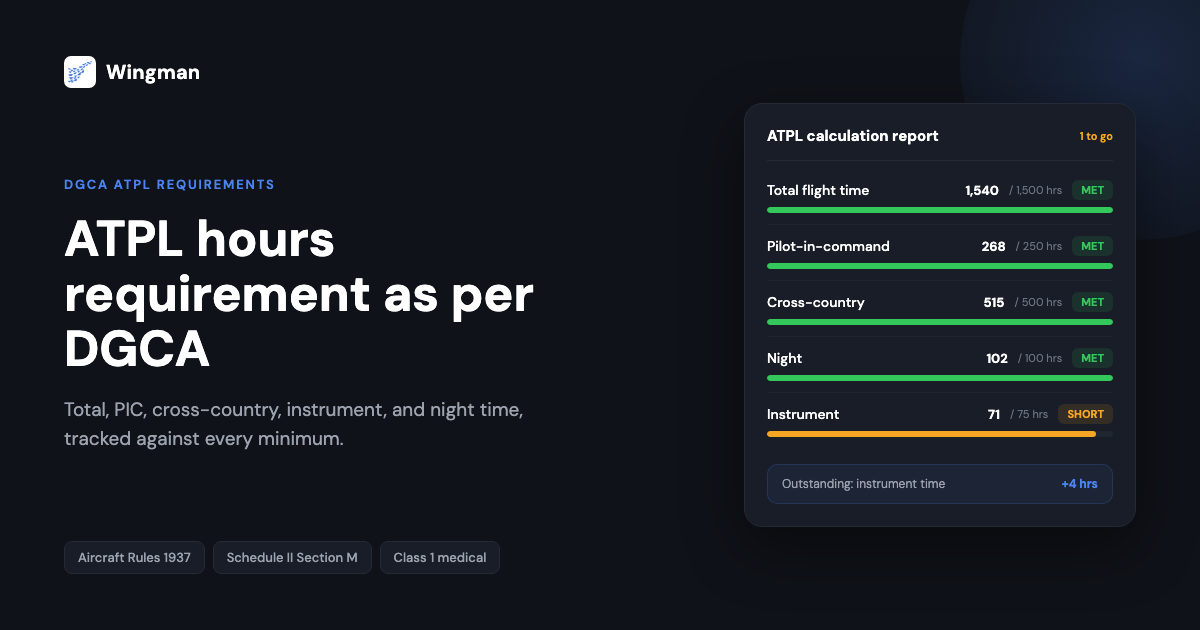
The DGCA requires 1,500 hours of flight time for an ATPL, but the total is the easy part. Schedule II, Section M of the Aircraft Rules, 1937 sets category minimums that each have to be met independently: 500 hours as PIC or PICUS, 1,000 hours of cross-country, 100 hours at night, and 100 hours of instrument time of which at least 50 in actual flight, plus recency of 150 hours in the preceding 12 months.
A caution before the table: many pages, including earlier versions of this one, quote 250 hours PIC and 75 hours instrument. Those are FAA and ICAO figures, not DGCA’s. Everything below comes from Section M itself, with the sub-paragraph cited so you can verify each line.
The DGCA ATPL hours table (Schedule II, Section M)
| Requirement | Minimum | Section M ref |
|---|---|---|
| Total flight time as pilot of an aeroplane | 1,500 h | 1(e) |
| …of which in the preceding 12 months | 150 h | 1(e) |
| PIC, or PICUS (co-pilot acting as PIC under check-pilot supervision) | 500 h | 1(e)(i) |
| …within that block: cross-country | 200 h | 1(e)(i) |
| …within that cross-country: night | 50 h | 1(e)(i) |
| Cross-country, total | 1,000 h | 1(e)(ii) |
| Night flying | 100 h | 1(e)(iii) |
| Instrument time (actual or simulated) | 100 h | 1(e)(iv) |
| …of which in actual flight | 50 h | 1(e)(iv) |
| Recent experience | 10 h in preceding 6 months | 1(e)(v) |
Read it as gates, not a sum: a First Officer can sit at 2,500 total hours and still be ineligible on a single short category. The categories your hours are logged under matter exactly as much as the hours themselves.
How co-pilot and PICUS time count
Section M’s crediting note is where most airline pilots’ arithmetic goes wrong, so here it is precisely:
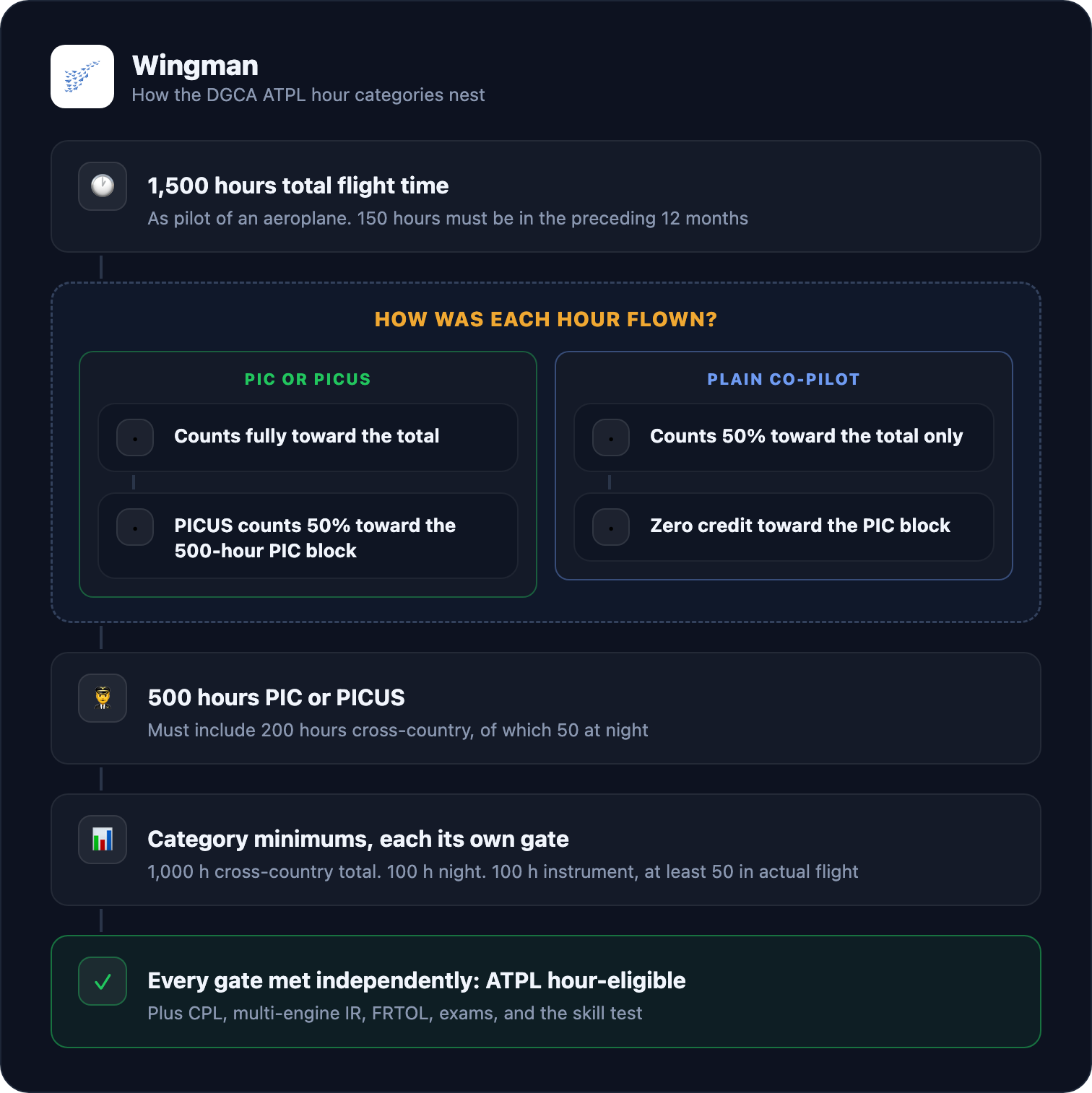
- Plain co-pilot time: credited at 50% toward the 1,500-hour total. It does not count toward the 500-hour PIC block at all.
- PICUS time (performing the duties and functions of pilot-in-command under the supervision of a pilot qualified as a check pilot): credited at 50% toward the 500-hour PIC block, and at 100% toward the 1,500-hour total.
A worked example: an FO with 2,000 hours of plain co-pilot time and 400 hours of PICUS holds, for ATPL purposes, 1,000 + 400 = 1,400 hours toward the total and 200 hours toward the PIC block. The same pilot logging future supervised sectors as PICUS, with the check-pilot evidence to support it, converts flying they are already doing into eligibility they currently are not getting.
How the hour categories relate
Everything besides the hours
- Age: at least 21. Education: 10+2 with Physics and Maths. Medical: Class 1.
- Licences held: a current CPL (or SCPL), a current instrument rating on a multi-engine aircraft, and a current FRTOL. Armed Forces pilots have an exemption path from the CPL prerequisite.
- Written exams (for a CPL holder): Air Navigation, Aviation Meteorology, and Radio Aids and Instruments, with a 70% pass mark in each. Passes are valid 5 years for ATPL issue. Papers are sat through the DGCA’s Pariksha portal in four regular sessions a year plus monthly on-demand (OLODE) sessions.
- Oral exam: after passing Air Navigation and Radio Aids and Instruments at 70%, a viva before a DGCA board, also at a 70% standard. A failed oral allows two further attempts within two years of the written result; failing all three sends you back to the written paper. Orals are conducted at Delhi, Mumbai, and Chennai.
- Skill test: competency by day and by night on the multi-engine type applied for, within the preceding 6 months; DGCA can permit the test on an approved Level D full-flight simulator. One notable line from the eligibility CAR: an ATPL is not issued on a single-engine aircraft.
What changed from 2023 to 2026
- Licence validity doubled to 10 years (Aircraft Rules amendment, October 2023). The document lasts 10 years; the privileges still ride on your current medical, 6-monthly proficiency check, IR, and recency.
- OLODE on-demand exams: monthly computer-based sessions now run alongside the four regular sessions, so a missed session no longer costs a quarter.
- CPL to ATPL auto profile update (effective 2 February 2026): Pariksha now updates a pilot’s exam category automatically from the licence record, removing a manual step for FOs becoming exam-eligible.
- Electronic Personnel Licence for ATPL (21 January 2026): the ATPL is now issued as an ICAO-aligned digital licence in the eGCA app, with QR and real-time server verification. Airlines and regulators can verify instantly; the paper booklet is no longer the operative document.
From ATPL to the left seat
The licence alone does not put you in command of an airliner. Section M’s privileges clause requires, for PIC of an aeroplane above 5,700 kg: 100 hours as co-pilot on the type, followed by 10 consecutive satisfactory route checks (at least 5 by night) under a check pilot, reduced to 6 route checks (3 by night) for pilots with prior command time on large aeroplanes, plus a proficiency check within the preceding 6 months.
Age limits frame the far end: from 60, commercial air transport only in a multi-crew cockpit where the other pilot is under 60; at 65, ATPL privileges reduce to those of a PPL.
Proving your 1,500 hours on eGCA
DGCA does not take your totals on trust: eGCA compares your submitted records category by category, and the most common ATPL setbacks are record problems rather than experience problems. Practitioner experience points to a consistent set: CA-39 totals that do not match eGCA’s computed record, block time confused with flight time, PICUS logged as plain PIC (or without the check-pilot supervision evidence to support it), cross-country time not identifiable as cross-country, and instrument time not split between actual and simulated even though Section M requires at least 50 hours actual. Our guide to CA-39 mistakes that get DGCA logbooks rejected covers the failure modes, and the eGCA auto-update and your records post explains why clean categories now matter even more: since 2026, eGCA’s automated comparison updates your profile only when every category is already right.
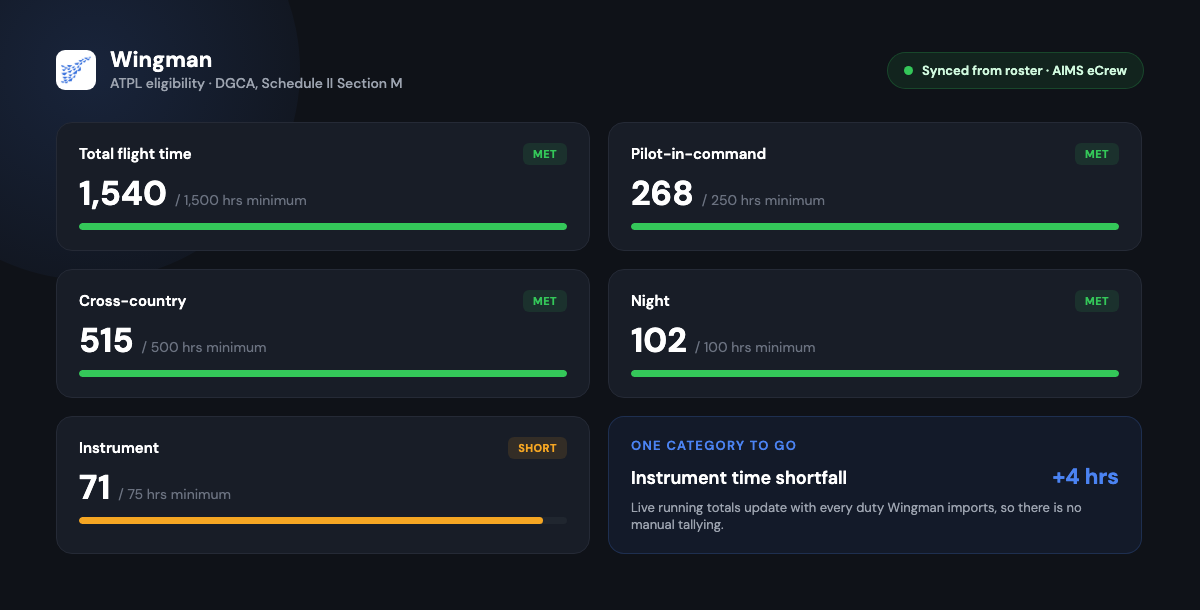
This is where a structured logbook earns its keep. Wingman, the pilot logbook used by 30,000+ pilots across 400+ airlines, imports your roster from systems like AIMS eCrew and keeps night, instrument, cross-country, and PICUS fields populated per flight, so your running totals stay shaped the way Section M counts them. It exports DGCA-compliant records alongside the FAA, EASA, UK CAA, GCAA, and other regulators, and the free tier covers your first 250 logged hours at app.wingmanlog.com.
Frequently asked questions
What are the DGCA ATPL hour requirements?
1,500 hours total as pilot of an aeroplane, including 500 hours PIC or PICUS (with 200 hours cross-country of which 50 at night inside that block), 1,000 hours total cross-country, 100 hours night, and 100 hours instrument of which at least 50 in actual flight, plus 150 hours in the preceding 12 months and 10 in the preceding 6. Source: Schedule II, Section M, Aircraft Rules 1937.
Are DGCA ATPL requirements the same as FAA or EASA?
No. The 250-hour PIC and 75-hour instrument figures widely quoted online are FAA and ICAO minimums. DGCA requires 500 hours PIC or PICUS, 1,000 hours cross-country, and 100 hours instrument with at least 50 actual.
How does co-pilot time count toward a DGCA ATPL?
Plain co-pilot time counts 50% toward the total only. PICUS time counts 50% toward the 500-hour PIC block and 100% toward the total, and needs check-pilot supervision evidence behind it.
Which exams are needed for a DGCA ATPL?
For a CPL holder: Air Navigation, Aviation Meteorology, and Radio Aids and Instruments, each at a 70% pass mark, then an oral before a DGCA board. Written passes stay valid 5 years for licence issue; the oral allows three attempts within two years of the written result.
How long is a DGCA ATPL valid?
10 years since the October 2023 amendment, though exercising the privileges requires a current Class 1 medical, 6-monthly proficiency checks, a current multi-engine IR, and recency. Commercial flying is restricted from age 60 (multi-crew, other pilot under 60) and ends at 65.
What is the Electronic Personnel Licence for ATPL?
Since 21 January 2026, the ATPL is issued as a digital licence in the eGCA mobile app with QR and real-time verification, replacing dependence on the paper booklet.
← All articles