ATPL renewal in India: a step-by-step eGCA guide
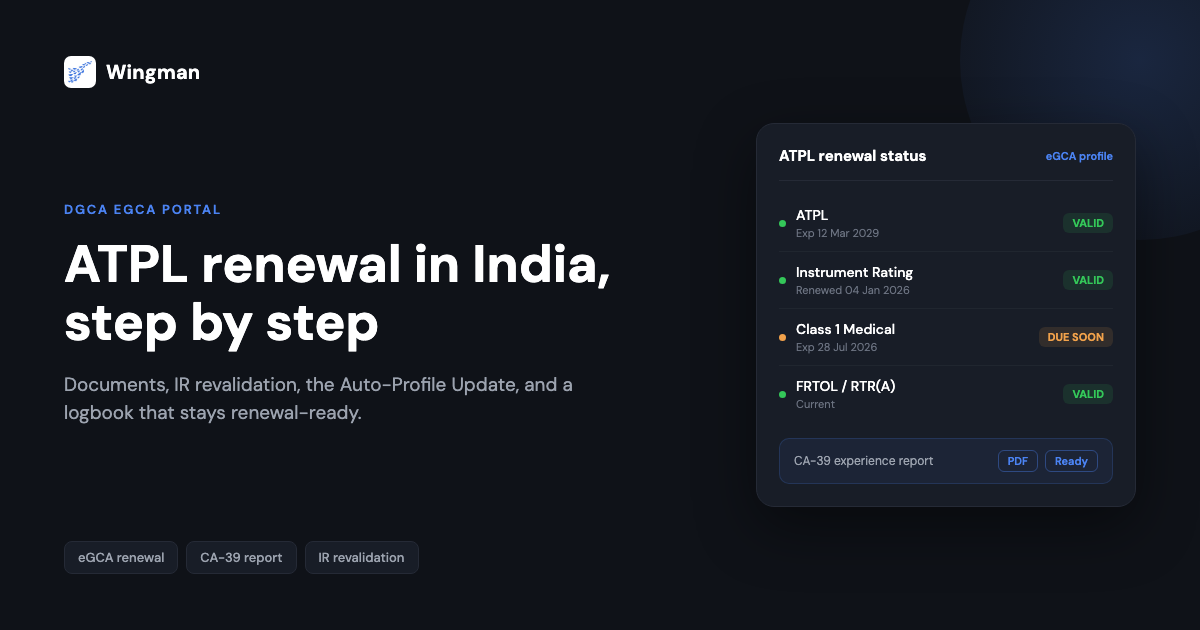
Your Airline Transport Pilot License (ATPL) is the highest pilot licence issued by the Directorate General of Civil Aviation (DGCA) in India, and keeping it current is what protects your command privileges. This guide walks through ATPL renewal through the eGCA portal: the documents you need, Instrument Rating (IR) revalidation, how the 2026 Auto-Profile Update system reads your logbook, and how a digital logbook keeps your eGCA data renewal-ready. The steps are written so you can follow them with the portal open in another tab.
What ATPL renewal involves
An ATPL is the most senior flight crew licence issued by DGCA under the Aircraft Rules, 1937. It authorises the holder to act as Pilot-in-Command (PIC) on multi-crew commercial aircraft. Like the CPL, it is not a permanent document: it has to be renewed at prescribed intervals, along with the Instrument Rating and other associated ratings. Flying as PIC on a scheduled commercial operation with a lapsed ATPL is treated as a serious regulatory matter, so most pilots plan the renewal well ahead.
ATPL renewal in India typically brings together several moving parts:
- Renewal of the ATPL itself through the eGCA portal
- Revalidation of the Instrument Rating endorsed on the ATPL
- A current DGCA Class 1 Medical Certificate
- Currency of your FRTOL / RTR(A) and English Language Proficiency (ELP)
This post focuses on the renewal process. If you are trying to work out how long your licence stays current and when the clock resets, that is a separate question covered in our guide to the validity of a DGCA ATPL in India. Renewal and validity are distinct topics, so it is worth reading both rather than treating them as one.
ATPL renewal timeline at a glance
The ATPL, the Instrument Rating, and your Class 1 Medical each run on their own clock, and they rarely expire on the same day. The IR generally carries a shorter validity than the licence, and the medical is shorter still. Because of this, the practical trigger for a renewal is usually whichever rating expires first, not the ATPL booklet date. For the exact periods that apply to your licence, cross-reference the current DGCA Civil Aviation Requirements (CARs), circulars, and your own eGCA profile, since these are subject to revision. [VERIFY] Our validity of a DGCA ATPL and validity of Instrument Rating guides go into the detail.
The eGCA Auto-Profile Update system
DGCA introduced an Auto-Profile Update system within the eGCA portal in early 2026. [VERIFY] The system is designed to flag a pilot’s eligibility status automatically once eGCA detects the required hours and qualifying records in the profile. In practice the automation works both ways. A profile with accurate, complete, and current eGCA logbook data tends to move faster, while a profile with logbook discrepancies or stale records can sit in a pending state until the data is corrected.
Common reasons an Auto-Profile Update can stall include:
- A mismatch between Block Time and Flight Time in the eGCA logbook, where your airline logs one figure and your eGCA entry shows another
- An expired Class 1 Medical, which can freeze eligibility status until the renewal is uploaded [VERIFY]
- An expired RTR(A) or FRTOL, since the system cross-checks sub-rating validity
- Exam results sitting outside their validity window [VERIFY]
The takeaway is straightforward: a clean digital logbook is now closely tied to how smoothly your renewal moves. A logbook mismatch does not only slow a renewal, it can also hold up a command upgrade at a point when Indian carriers are actively running captaincy programmes.
ATPL renewal eligibility checklist
Confirm each of the following before you apply for renewal on eGCA:
| Requirement | What to check |
|---|---|
| Valid ATPL, or within the renewal window | Licence has not lapsed beyond any applicable renewal window [VERIFY] |
| Valid DGCA Class 1 Medical | Current at the time of submission |
| Instrument Rating revalidated | IR is current on each endorsed type |
| Valid FRTOL / RTR(A) | Sub-ratings are current |
| Valid ELP | As endorsed on the licence, if applicable |
| eGCA logbook data current and accurate | Totals match your physical or digital logbook |
Documents required for ATPL renewal
Prepare these before you log in to the eGCA portal. Files should be clear, complete scans in PDF or JPG format.
- Current ATPL, including all endorsement pages
- Valid DGCA Class 1 Medical Certificate
- Valid Instrument Rating test report (GFT or proficiency check)
- Valid FRTOL / RTR(A) certificate
- CA-39 experience report covering the renewal period
- ELP endorsement documentation, if a renewal is due
- Government-issued photo ID such as Aadhaar or Passport
- Recent passport-size photograph on a white background
- Renewal fee payment confirmation
Step by step: ATPL renewal on the eGCA portal
Step 1: Log in to eGCA
Open the official DGCA eGCA portal at https://www.dgca.gov.in/digigov-portal/. Select eGCA Login and enter your eGCA ID and password. The portal uses multi-factor authentication, so you may be asked to enter one-time passwords sent to your registered mobile and email before you reach the dashboard. [VERIFY]
Step 2: Open your licence details
From your pilot profile dashboard, navigate to your licence section and choose the ATPL renewal option. Your current ATPL record is displayed with aircraft endorsements, IR details, ELP status, FRTOL records, and validity dates. According to the eGCA user manual, a pilot holding a higher-category licence is not required to separately fill in details of lower-category licences, so an ATPL holder generally does not need to update CPL details as part of this process. [VERIFY]
Step 3: Review and update your ATPL record
Before submitting, make sure every detail is accurate. For each aircraft type endorsed on your ATPL, confirm the endorsement date, the initial IR issuance date, the latest IR renewal date, and the latest IR validity. Aircraft class is auto-populated by the system for listed types.
If you have completed an IR revalidation since your last eGCA update, enter the latest renewal date now. The eGCA user manual draws a distinction between Save and Update Details, which preserves your changes, and Submit for Validation, which finalises them. Use Save and Update Details while you are still working, and only submit for validation once every section is complete. [VERIFY]
Step 4: Update ELP details if due
If your English Language Proficiency endorsement is due, update it in the ELP section before submission. If ELP has not been endorsed on your licence by DGCA, it does not need updating here.
Step 5: Upload documents
In the licence records section, attach your full ATPL copy (all pages, not only the front page), GFT or IR proficiency check report, Class 1 Medical Certificate, FRTOL / RTR(A) certificate, CA-39 experience report, and any applicable AFIR, FIR, or open rating documents.
Step 6: Save and submit for validation
Select Save and Update Details to confirm your changes. When every section is complete, select Submit for Validation. After submission, fields become non-editable and a temporary ID is generated for tracking. You can follow the application through the eGCA dashboard.
Step 7: Respond to any shortfall
If DGCA identifies a discrepancy, a shortfall notice is sent to your registered email and mobile, and the application unlocks for editing. Make the corrections set out in the notice and resubmit. The most frequent ATPL renewal shortfalls reported by pilots are a Block Time versus Flight Time mismatch, an IR renewal date not updated before submission, an incomplete licence upload missing endorsement pages, an out-of-date medical, and an expired FRTOL or RTR(A). [VERIFY]
Step 8: Receive your EPL
DGCA has been moving licence issuance onto the Electronic Personnel License (EPL) framework, aligned with ICAO standards. Once approved, your renewed ATPL is issued as a digital EPL accessible through the DGCA-authorised application. [VERIFY]
Renewal flow at a glance

IR revalidation for ATPL holders
The Instrument Rating endorsed on your ATPL has to be revalidated before the renewal application. Broadly, this means completing the required recency flying, undergoing an IR renewal test (GFT) at a DGCA-approved Flying Training Organisation, and having that test conducted by a DGCA-approved examiner who did not conduct your training. The governing provisions sit within the Aircraft Rules and the relevant CARs, which you should check for the current detail. [VERIFY] Once the test is complete, update the IR latest renewal date in the eGCA portal under the aircraft endorsement and rating details.
DGCA permits IR renewal tests on simulators in certain circumstances, including, for aircraft above a defined weight, on simulators located outside India where suitable facilities are not available domestically, subject to written DGCA permission. [VERIFY] For most airline pilots, revalidation on an airline-approved simulator at an approved training centre is the standard route. For more on the rating itself, see our guide to the validity of an Instrument Rating in India.
Class 1 Medical renewal
A current Class 1 Medical is required for ATPL renewal, and an expired medical in your eGCA profile can freeze your eligibility status under the Auto-Profile Update system. To renew, log in to eGCA, open the medical section, apply for the relevant approval, book an appointment with a DGCA-approved examiner, attend the examination, and wait for the result to be processed. [VERIFY] A practical habit many pilots follow is to book the medical renewal several weeks before expiry to allow for processing and any additional tests.
Fees and what happens if your ATPL lapses
Renewal fees are prescribed under the Aircraft Rules and paid through the eGCA portal, with endorsement renewal fees applying per aircraft type. Verify the current fee schedule at the time of application, as the figures are revised from time to time. [VERIFY] If documents are returned due to a shortfall, fees already paid can usually be adjusted against the resubmission.
A licence that has lapsed beyond its renewal window is handled differently from a routine renewal and may involve refresher training, simulator sessions, and further DGCA evaluation. [VERIFY] That route is more involved and takes longer, which is the main reason pilots aim to renew with a clear margin before any rating expires.
How Wingman keeps your eGCA data renewal-ready
Because the Auto-Profile Update system reads your eGCA logbook directly, accurate hours matter more than ever at renewal time. Wingman is a pilot logbook used by 30,000+ pilots across 400+ airlines, with apps on iOS, Android, and Web. It is a global product rather than an India-only tool, and it produces regulator-compliant exports for DGCA alongside the FAA, EASA, UK CAA, GCAA, GACA, NZCAA, HKCAD, CASA, and CAAS. There is a free tier up to 250 logged hours, so you can keep your logbook current without committing anything up front.
A few features map directly onto the renewal process:
- CA-39 and experience reports for any date range. The CA-39 is the DGCA experience report required for ATPL renewal, broken down by year, month, and aircraft type. DGCA may ask for a specific period such as the preceding twelve months, the last few years, or your full career total. In Wingman you set the start and end dates, choose a yearly, monthly, or aircraft-wise summary, and download the PDF, with no manual tallying.
- Roster import from major systems. Wingman imports flights automatically from AIMS eCrew, NavBlue RAIDO, CAE Crew Access, ARMS, CESAR, Sabre, FLICA, and PDC CrewConnex, covering Indian and international carriers. Each flight is logged with block time, aircraft registration, and day or night hours calculated from almanac data, so your eGCA logbook stays current between renewals rather than only at the deadline.
- Bulk migration of historical data. If your earlier flights live in a paper logbook, a spreadsheet, or another logbook app, the Wingman team can migrate them, carrying across totals and type-specific PIC, SIC, night, instrument, and simulator hours. This matters most for ATPL holders carrying thousands of hours across several years of records.
- Expiry reminders. Wingman tracks your ATPL, IR renewal date, Class 1 Medical, and FRTOL expiry and sends advance reminders, so you have time to schedule a GFT, book a medical, and start the eGCA renewal before a rating lapses.
For an India-specific walkthrough of keeping your logbook in order, see our DGCA pilot logbook guide. When you are ready, you can start logging in the app.
ATPL renewal quick-reference checklist
- Class 1 Medical is valid and reflected on eGCA
- IR renewal test (GFT) is complete and the IR date is updated on eGCA
- FRTOL / RTR(A) is current
- ELP is valid and endorsed, if applicable
- All aircraft endorsements and type ratings are correct on eGCA
- eGCA logbook data is uploaded and accurate, with no Block Time versus Flight Time mismatch
- CA-39 experience report is generated and its totals match eGCA data
- Documents are scanned clearly in PDF or JPG
- The full ATPL copy (all pages) is ready to upload
- Renewal fees are arranged
- Application is submitted and the temporary ID is noted
Frequently asked questions
How is ATPL renewal different from CPL renewal?
The eGCA process is structurally similar, and the main difference is that an ATPL holder generally does not separately update CPL or FRTOL-R details, since the ATPL is the superior licence. [VERIFY] ATPL renewal also interacts with the Auto-Profile Update system, which puts more weight on eGCA data accuracy. If you also hold a CPL, our CPL renewal in India guide covers that process.
Can I fly as PIC while my ATPL renewal is being processed?
Only while your current ATPL and ratings remain valid. If you apply before expiry there is no gap. If the licence expires during processing, you cannot exercise PIC privileges until the renewal is issued, which is why most pilots apply with a clear margin.
My eGCA logbook does not match my physical logbook. What should I do?
Resolve the discrepancy before applying, because a mismatch can trigger a shortfall under the current system. Reconcile your records first, and if the gap is large, a bulk data review and migration can bring the two into line.
Do I need a separate renewal for each aircraft type on my ATPL?
Each aircraft type endorsement carries its own IR validity, so make sure every endorsed type’s IR is current before you submit the ATPL renewal.
What is the CA-39 and is it needed for ATPL renewal?
The CA-39 is the DGCA-prescribed experience report summarising your flying hours, and it is required for ATPL renewal. In Wingman you set any date range and download the PDF, covering exactly the period DGCA asks for.
Summary
ATPL renewal in India runs through the eGCA portal and pulls together your medical, IR, sub-ratings, and logbook data into one submission. The move toward the Electronic Personnel License framework and the Auto-Profile Update system has made digital logbook accuracy central to a smooth renewal. Keep your Class 1 Medical current, complete your IR revalidation, update every detail on eGCA, upload your CA-39 and supporting documents, and submit with enough lead time. Wingman handles the logbook, CA-39, and reporting side, so when renewal arrives your data is already in order.
Always verify current requirements, validity periods, and fee schedules with the official DGCA website (dgca.gov.in) and the eGCA portal. DGCA regulations and procedures are subject to change.
← All articles