Bahrain CAA pilot licensing: from initial licence to renewals
If you are training toward a flying career in Bahrain, or moving an existing licence into the Kingdom, the authority you deal with is Bahrain Civil Aviation Affairs (CAA). It sits under the Ministry of Transportation and Telecommunications and is responsible for issuing pilot licences, approving training, overseeing medical certification, and keeping Bahrain aligned with International Civil Aviation Organization (ICAO) standards. This guide walks through the full path: the licence types the Bahrain CAA issues, the eligibility and medical requirements, how to convert a foreign ICAO licence, the route to an ATPL with type ratings, and what it takes to keep a licence current through renewals.
The aim is to give you a plain map of the process so you know which step comes next, rather than discovering each requirement one form at a time. Where a specific figure or procedure should be confirmed against the current Bahrain CAA rules before you rely on it, that is flagged in the text.
What Bahrain Civil Aviation Affairs regulates
Bahrain Civil Aviation Affairs is the civil aviation regulator for the Kingdom of Bahrain. Its remit covers licensing of flight crew, oversight of aviation safety, approval of training organisations, and compliance with the standards published by ICAO. In practice that means the CAA controls who can hold a Bahraini pilot licence, what training and testing they must complete, and the medical standards they must keep meeting over a career.
Two official resources are worth knowing about from the start. The CAA publishes an Aeronautical Information Publication (AIP) for the Bahrain Flight Information Region, accessible through the Aeronautical Information Management section, and it maintains an Aeronautical Information Service Manual that sets out information procedures and quality standards. Licence application forms and the current fee schedule are published on the CAA licences and applications pages. Because portal labels and document links change over time, always start from the official CAA site rather than a cached link.
Bahrain holds an FAA International Aviation Safety Assessment (IASA) Category 1 rating, which reflects that its civil aviation oversight meets ICAO standards. [VERIFY] For pilots, the practical effect is that a Bahraini licence built on ICAO requirements travels well when you later convert or validate it elsewhere.
Pilot licence types issued by the Bahrain CAA
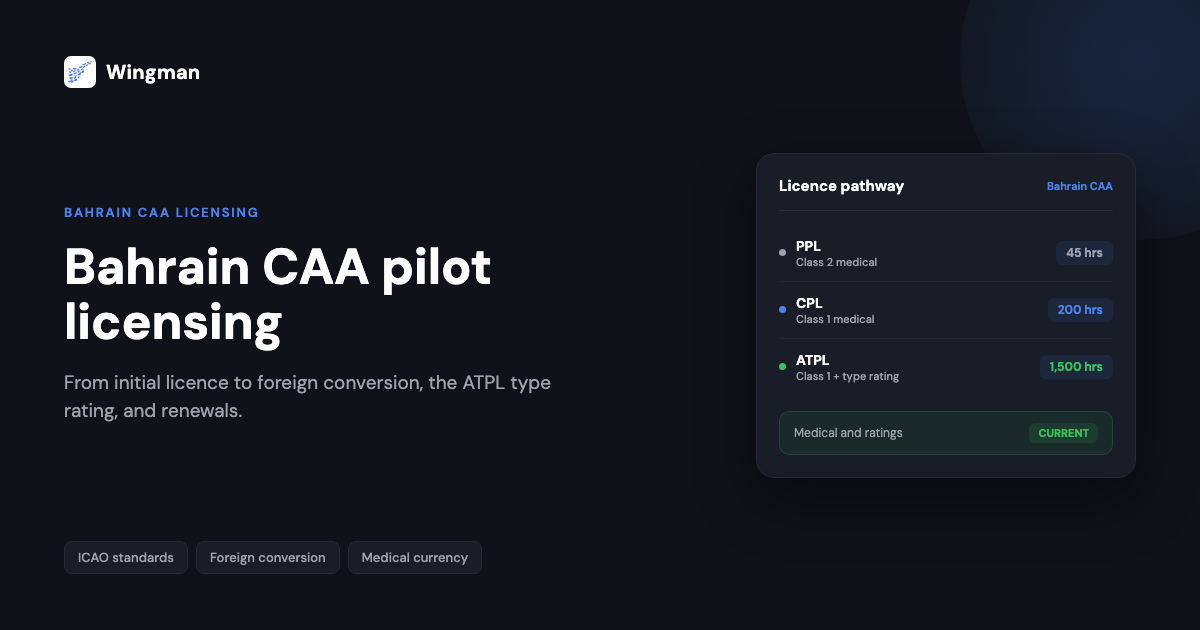
The Bahrain CAA issues the standard ICAO ladder of flight crew licences. The figures below follow ICAO minimums and the requirements commonly applied in Bahrain, but confirm the current numbers on the CAA application pages before you plan around them, because national rules can add to the ICAO baseline.
Private Pilot Licence (PPL)
- Minimum age: 17 [VERIFY]
- Medical: Class 2 medical certificate
- Flight time: a minimum in the region of 45 hours [VERIFY]
- Privileges: non-commercial flying, with cost sharing permitted within the rules
Commercial Pilot Licence (CPL)
- Minimum age: 18 [VERIFY]
- Medical: Class 1 medical certificate
- Flight time: a minimum in the region of 200 hours [VERIFY]
- Privileges: paid flying, including charter and commercial operations within the licence limits
Airline Transport Pilot Licence (ATPL)
- Minimum age: 21 [VERIFY]
- Medical: Class 1 medical certificate
- Flight time: a minimum of 1,500 hours [VERIFY]
- Privileges: pilot-in-command of multi-pilot aircraft, once the relevant type rating is held
Each step also carries theoretical knowledge examinations and a practical skill test with an examiner. The exact subject list and pass standards are set by the CAA, so treat them as part of your training plan rather than an afterthought.
Eligibility and medical certification
Beyond age and flight time, applicants need to meet education and language requirements. A solid grounding in English, mathematics, and physics supports the ground exams, and ICAO English language proficiency is required for radio communication. The CAA confirms eligibility through a combination of training records, examination passes, and the practical test.
Medical fitness runs in parallel with everything else, and it is the requirement most pilots underestimate over a full career. Medical certificates are issued by a CAA-approved aviation medical examiner, and they have to be renewed on a schedule that tightens with age:
- Class 1 (CPL and ATPL): valid 12 months, reducing to 6 months once you pass the age threshold the CAA applies for older commercial pilots. [VERIFY]
- Class 2 (PPL): valid 24 months, reducing to 12 months above the CAA age threshold. [VERIFY]
Letting a medical lapse suspends the privileges of the licence until it is renewed, so the medical expiry date is one of the dates worth tracking as carefully as any licence date. Plan the examination before the certificate expires rather than on the day it runs out, because any follow-up tests take time.
How to convert a foreign licence to a Bahraini licence
A large share of pilots arriving in Bahrain already hold an ICAO-compliant licence issued elsewhere and want it recognised locally. The CAA has a conversion route for this. The exact documents and tests depend on the licence you hold and the privileges you want, so confirm the current requirements with the CAA before you submit, but the path generally runs as follows.
-
Verify your existing licence. The Bahrain CAA confirms the authenticity and standing of your licence directly with the issuing authority. You start this by submitting your licence details and a verification request so the CAA can write to the original regulator. [VERIFY]
-
Obtain a Bahrain-accepted medical certificate. Hold a current Class 1 (for commercial privileges) or Class 2 (for private privileges) medical from a CAA-approved examiner, or have your existing ICAO medical accepted, depending on the CAA rules in force. [VERIFY]
-
Pass the Bahrain Air Law examination. Conversion candidates sit the air law and regulations paper so that your knowledge matches local procedures and the Bahrain AIP. [VERIFY]
-
Complete a skill or proficiency test if required. Depending on your licence, ratings, and recency, the CAA may require a practical flight check with an examiner before the Bahraini licence is issued. [VERIFY]
-
Submit the application and supporting documents. File the licence application form with proof of identity, your logbook, training records, examination passes, and the medical certificate, then pay the applicable fee. [VERIFY]
Throughout this process, your logbook is the evidence base. Verification, recency checks, and the proficiency test all lean on a clean, complete record of your hours, types, and currency. Keeping that record in order before you apply removes most of the friction from a conversion.

The ATPL and type-rating path
An ATPL is the licence that lets you act as pilot-in-command of a multi-pilot aircraft, but the licence alone does not let you fly a specific aircraft. That comes from a type rating. The route most airline pilots in Bahrain follow is to build hours and qualifications toward the ATPL while adding the type rating for the aircraft their operator flies.
In practice the sequence usually looks like this. You complete CPL training and the ATPL theory examinations, build the required flight time toward the 1,500-hour ATPL minimum [VERIFY], and obtain a multi-engine instrument rating. The type rating itself is delivered through an approved training organisation and combines ground school, full-flight simulator sessions, and a type-rating skill test on the specific aircraft, for example a particular Airbus or Boeing variant. The type rating is then endorsed on your licence and must be kept current through recurrent training and proficiency checks. [VERIFY]
For a pilot converting an existing licence that already carries a type rating, the CAA will look at whether that rating can be carried across or whether recurrent training is needed to revalidate it locally. [VERIFY] Either way, accurate records of your type-rating training, checks, and recency are what the CAA assesses, which is another reason to keep your logbook current rather than reconstructing it at application time.
Renewals and keeping a licence current
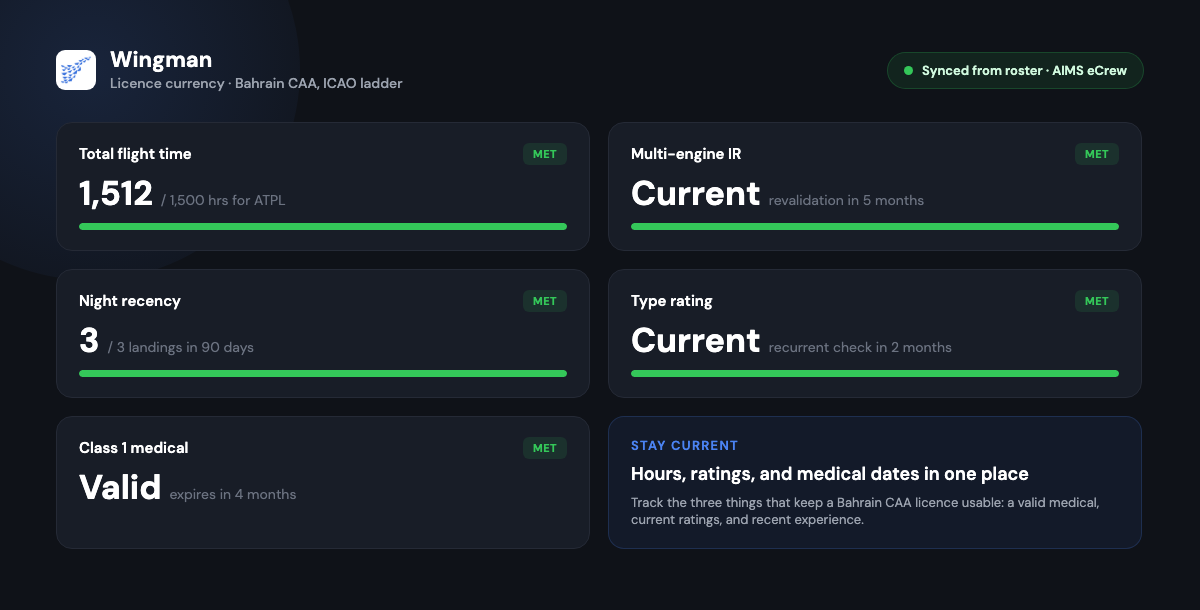
A Bahraini pilot licence is not a one-time issue. Keeping it usable means staying inside three overlapping requirements: a valid medical certificate, current ratings, and recent flying experience.
- Medical currency. Renew the Class 1 or Class 2 medical on schedule, as set out above, so the licence privileges stay active.
- Recency of experience. Meet the CAA recent-experience requirements for the privileges you exercise, for example a minimum number of take-offs and landings within a defined period for carrying passengers, or pass a proficiency check if you fall short. [VERIFY]
- Rating revalidation. Keep instrument and type ratings valid through the recurrent checks the CAA requires within each validity window. [VERIFY]
Missing any one of these can ground you even when the others are in order, so the renewals side of licensing is really an exercise in date tracking. The cleaner your record of hours, landings, checks, and medical dates, the easier it is to prove currency when an operator or the CAA asks.
Logging the hours behind every Bahrain CAA licence
Every stage above, from initial issue to conversion to renewal, rests on an accurate logbook. Wingman is a digital pilot logbook used by 30,000+ pilots across 400+ airlines, and it keeps your hours, currency, ratings, and medical dates in one place across iOS, Android, and Web. It is a global product rather than a single-country tool, which suits Bahrain pilots who often hold or convert ICAO licences across the Gulf and beyond.
For pilots flying in the Middle East, Wingman produces regulator-compliant exports for authorities including the GCAA and GACA alongside FAA, EASA, UK CAA, DGCA, NZCAA, HKCAD, CASA, and CAAS, and it keeps records in ICAO-standard form, which is the basis the Bahrain CAA works from. [VERIFY] If your airline runs a crew roster system, Wingman imports duty automatically from platforms such as AIMS eCrew, NavBlue RAIDO, CAE Crew Access, ARMS, CESAR, Sabre, FLICA, and PDC CrewConnex, so your flight record builds itself rather than being typed in after each trip.
There is a free tier up to 250 logged hours, so you can start while you are still training toward a PPL or CPL. The Pro plan is $59 a year (billed annually, around $4.99 a month) for unlimited logging, exports, and roster import once your career and your hours grow.
Frequently asked questions
Who issues pilot licences in Bahrain?
Pilot licences in Bahrain are issued by Bahrain Civil Aviation Affairs (CAA), which sits under the Ministry of Transportation and Telecommunications. The CAA handles licensing, medical certification standards, training approval, and compliance with ICAO standards. Applications and forms are published on the official CAA licences and applications pages.
Can I convert a foreign pilot licence to a Bahraini one?
Yes. If you hold an ICAO-compliant licence, the Bahrain CAA has a conversion route. It generally involves the CAA verifying your licence with the issuing authority, holding a Bahrain-accepted medical certificate, passing the Bahrain Air Law examination, and completing a skill or proficiency test if required, before you submit the full application. [VERIFY] Confirm the exact documents with the CAA, because requirements depend on your licence and ratings.
What medical certificate does each licence need?
A PPL needs a Class 2 medical certificate and a CPL or ATPL needs a Class 1. Class 1 certificates are typically valid for 12 months, dropping to 6 months for older commercial pilots, and Class 2 for 24 months, dropping to 12 months above the CAA age threshold. [VERIFY] Medicals are issued by a CAA-approved aviation medical examiner.
How many flight hours do I need for a Bahrain ATPL?
An ATPL follows the ICAO minimum of 1,500 hours of flight time, alongside the ATPL theory examinations, an instrument rating, and the type rating for the aircraft you will fly. [VERIFY] Always confirm the current totals and any additional national requirements with the Bahrain CAA before planning your hour building.
How do I keep my Bahraini licence current?
Keep three things valid at once: your medical certificate, your ratings, and your recent flying experience. Renew the medical on schedule, complete the recurrent checks that revalidate your instrument and type ratings, and meet the CAA recent-experience requirements for the privileges you exercise or pass a proficiency check instead. [VERIFY] Tracking these dates in a single logbook is the simplest way to stay ahead of them.
← All articles