Cadet pilot programs in India: the 2026 guide to airline cadet schemes
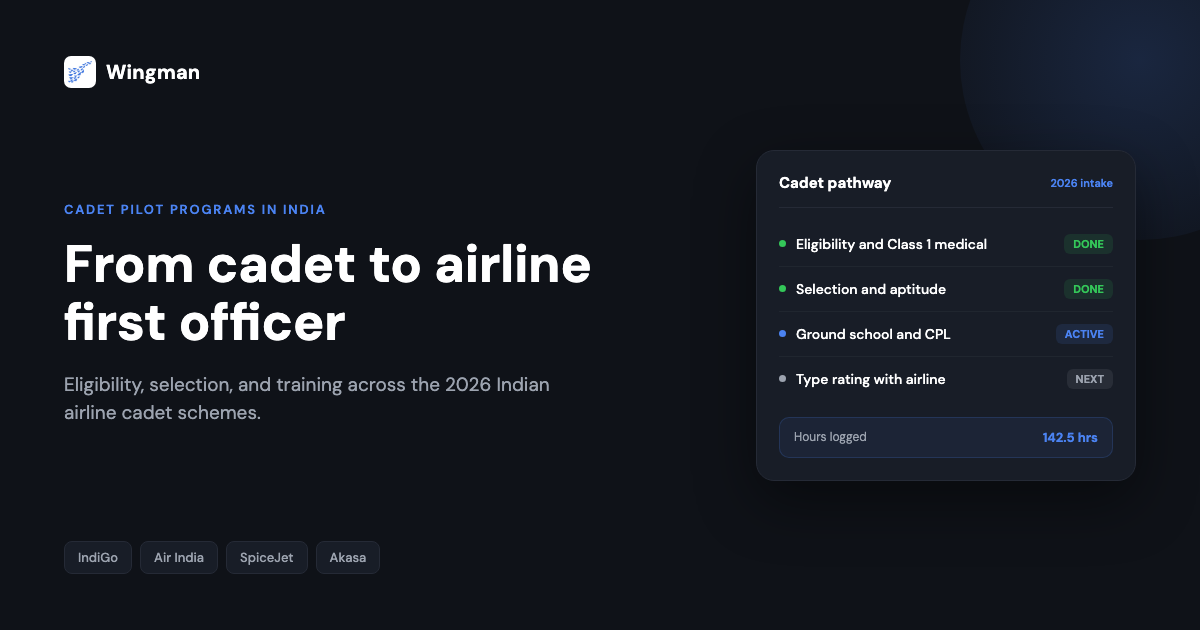
A cadet pilot program is one of the most direct routes from no flying experience to a first officer seat with an Indian airline. Instead of arranging your own training school, funding, and job hunt separately, a cadet scheme bundles the training pathway and ties it to a specific airline that wants new pilots. For many aspiring aviators in India, this is the clearest way to turn a plan to fly into an actual airline career.
This guide is a hub. It explains what a cadet pilot program is, who can apply, how selection works, and what the training covers. It then walks through the airline programs available in India as of 2026, with links to our detailed breakdowns where we have them. Use it to get your bearings, then follow the deeper guides for the airline you are targeting.
What a cadet pilot program is
A cadet pilot program is a structured training pathway designed to take someone with little or no flying experience and prepare them for a career as a commercial airline pilot. These programs are usually run by an airline, often in partnership with a flight training organisation, and they follow a defined curriculum that combines ground school, flight training, simulator sessions, and supervised practical experience.
The distinguishing feature of a cadet scheme is the connection to a hiring airline. Rather than training in isolation and then applying for jobs, a cadet trains within a pathway that is built around a particular carrier’s requirements. Successful cadets are commonly offered an interview or a first officer position with that airline on completion, subject to the airline’s needs and the cadet meeting all licensing standards. [VERIFY]
Who is eligible
Eligibility criteria differ between programs and can change between intakes, so always confirm the current requirements on the airline’s official page before applying. That said, the common baseline for Indian cadet schemes looks like this:
- Age: most programs accept candidates from around 18 years upward, with an upper age limit that varies by scheme. [VERIFY]
- Education: a 10+2 (or equivalent) pass with physics, chemistry, and mathematics is generally required. Candidates who did not take these subjects can often complete them through the National Institute of Open Schooling. [VERIFY]
- Medical: you must be able to obtain and maintain a DGCA Class 1 Medical Certificate. It is sensible to clear the medical before committing to a program, because it is a hard requirement.
- English: a strong command of English is expected, in line with the language proficiency standards applied to flight crew.
Because the financial and time commitment is significant, treat eligibility as the first gate. Confirm the medical and the academic prerequisites before you spend on application fees or assessments.
How the selection process works
Selection for cadet programs is competitive and usually runs across several stages. The exact format varies by airline and training partner, but candidates can generally expect a mix of the following:
- Aptitude and written testing covering areas such as mathematics, physics, English, and general reasoning.
- Pilot aptitude or psychometric assessment, sometimes computer-based, measuring hand-eye coordination, spatial awareness, and decision-making.
- An interview, where assessors look at communication, motivation, and suitability for airline operations.
- A medical assessment confirming you can hold a Class 1 Medical Certificate.
Some programs charge an assessment fee and run intakes only at set times of the year, so it is worth tracking the official channels of the airline you are targeting rather than relying on second-hand dates.
What the training covers
Once selected, a cadet works through a curriculum that builds from classroom theory to airline-ready flying. The structure generally includes:
- Ground school: instruction in air regulation, meteorology, navigation, aircraft technical subjects, and air navigation, aligned to the DGCA examination syllabus. Our overview of the exams to be cleared in order to get CPL, PPL, ATPL explains the written papers that sit behind this stage.
- Flight training: hands-on flying in single-engine and then multi-engine aircraft, covering takeoff, landing, navigation, instrument flying, and emergency procedures, building the hours toward a Commercial Pilot Licence.
- Simulator sessions: practice of normal and abnormal scenarios in a controlled environment, which sharpens procedures and decision-making before they are needed in the aircraft.
- Type rating: training specific to the aircraft type the cadet will fly in airline service, completed toward the end of the pathway.
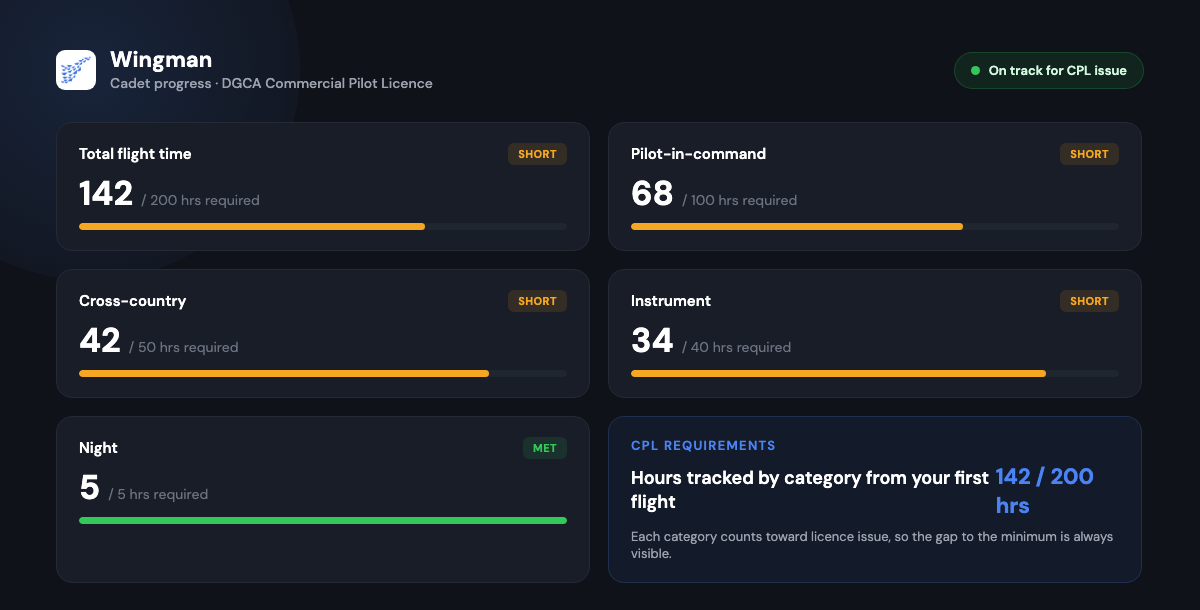
Throughout training, accurate record keeping matters. Every flight has to be logged, and those hours and currency details feed directly into your licence application and your value to an airline.
The cadet pathway at a glance

Cadet pilot programs in India in 2026
India’s major airlines have moved steadily toward cadet schemes as a way to secure a pipeline of pilots. Below is the current picture. Programs open and close intakes, change training partners, and revise terms, so use the airline’s official page as the source of truth and our detailed guides for the deeper analysis.
IndiGo cadet pilot programme
IndiGo, India’s largest carrier, runs a cadet pilot programme delivered with a flight training partner that takes ab-initio candidates through to a first officer pathway. It is one of the most established schemes in the country and one of the most sought after, given the airline’s fleet size and recruitment volume. [VERIFY] For eligibility, cost, the selection process, and the finer details, read our dedicated guide on the IndiGo cadet pilot program eligibility, cost, and requirements.
Air India cadet pilot programme
Air India launched a cadet pilot programme to train ab-initio pilots and feed its expanding fleet. The program marked the airline’s entry into structured cadet training and gave aspiring pilots another large carrier to target. [VERIFY] We cover the background and what applicants should know in all you need to know about the Air India cadet pilot program.
SpiceJet (Spice Star Academy)
SpiceJet has offered a cadet pathway under its Spice Star Academy, providing flight training, simulator sessions, and theory toward a first officer route with the airline. As with all these schemes, confirm whether intakes are currently open and what the present terms are directly with the airline before applying. [VERIFY]
Akasa Air
Akasa Air, one of the newer entrants to Indian aviation, has moved into cadet training as part of building its pilot pipeline alongside fleet growth. If you are considering Akasa, check the airline’s official careers and cadet channels for the current intake status, eligibility, and training partner, because details for newer programs change as they mature. [VERIFY]
Air India Express
Air India Express, the low-cost arm within the Air India group, has also been associated with cadet and ab-initio pilot intake as the group expands its narrow-body operations. Treat the group’s official recruitment pages as the reference for whether an Air India Express specific cadet route is open, since group programs can be consolidated or run jointly. [VERIFY]
Vistara: now part of Air India
Vistara historically did not run a cadet program and recruited pilots through conventional hiring. Vistara has since been merged into Air India, and its operations have been integrated under the Air India brand. [VERIFY] If you have been searching for a Vistara cadet pilot program, the practical route now is the Air India group’s cadet pathway covered above. This is the single biggest change to the Indian cadet landscape in recent years, so adjust your search accordingly.
Logging your hours once you start flying
A cadet program gets you into the cockpit, but from your first training flight onward you are responsible for an accurate, complete logbook. Those hours, ratings, and currency details follow you from CPL through your airline career, and they are checked. Wingman is a pilot logbook used by 30,000+ pilots across 400+ airlines, keeping hours, currency, and licence details in one place across iOS, Android, and Web.
Wingman is a global product rather than an India-only tool, and it supports DGCA among regulators including the FAA, EASA, UK CAA, GCAA, GACA, NZCAA, HKCAD, CASA, and CAAS. For the Indian specifics, there is a focused walkthrough on keeping a DGCA pilot logbook in India. There is a free tier up to 250 hours, so you can start logging while you are still a cadet without committing anything up front, and you can open the app when you are ready to record your first flight.
Frequently asked questions
What is a cadet pilot program in India?
It is a structured training pathway run by an Indian airline, often with a flight training partner, that takes a candidate with little or no flying experience through ground school, flight training, simulator work, and a type rating toward a first officer role with that airline. The defining feature is the link to a specific hiring carrier.
Which Indian airlines offer cadet pilot programs?
As of 2026, the main schemes are associated with IndiGo, Air India, SpiceJet through Spice Star Academy, Akasa Air, and the Air India group including Air India Express. Vistara has merged into Air India, so a separate Vistara cadet program no longer applies. Always confirm current intake status on each airline’s official page. [VERIFY]
Does Vistara have a cadet pilot program?
Vistara did not run a cadet program and has since merged into Air India. If you were looking for a Vistara cadet route, the relevant pathway now is the Air India group’s cadet pilot programme. [VERIFY]
What are the basic eligibility requirements?
Common requirements are a 10+2 pass with physics, chemistry, and mathematics, the ability to hold a DGCA Class 1 Medical Certificate, strong English, and meeting the program’s age range. Exact criteria vary by scheme, so check the official page before applying. [VERIFY]
How long does a cadet program take?
Timelines vary by airline, training partner, and intake, covering ground school, flight training to CPL, multi-engine and instrument work, and a type rating. Because the duration depends on the specific program and your progress, treat published timelines as a guide and confirm the current schedule with the airline. [VERIFY]
← All articles