Chimes Aviation Academy: courses, fees, eligibility and the IndiGo cadet pilot route
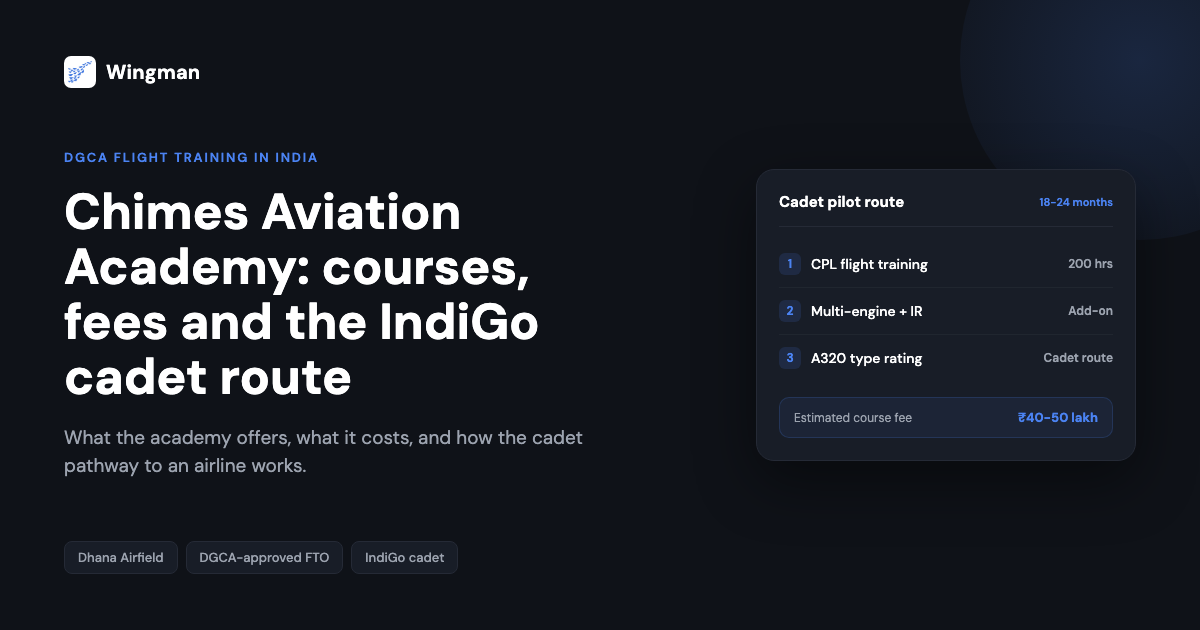
Chimes Aviation Academy (CAA) is one of the better known flying training organisations in India, and it comes up early for most people researching how to start a pilot career at home rather than training abroad. The academy is based at Dhana Airfield in the Sagar district of Madhya Pradesh, and it is best known today for its tie-up with IndiGo on a cadet pilot programme. This guide pulls together the concrete details aspiring pilots actually search for: what courses are offered, the rough fees and durations, eligibility, the DGCA approval status, and how the IndiGo cadet route works.
The aim here is to give you a factual starting point so you can plan your own due diligence. Course fees, batch dates, and airline programme terms change from year to year, so treat the figures below as a guide and confirm the current numbers directly with the academy and the airline before you commit any money.
What Chimes Aviation Academy is
Chimes Aviation Academy is the flight training arm of the Chimes Group and began operating in 2008. [VERIFY] It runs an integrated flying school out of Dhana Airfield, a dedicated training airfield spread across roughly 100 acres, with its own runway, hangars, classrooms, simulators, and on-campus residential facilities. [VERIFY] Because it operates from a non-congested airfield rather than sharing a busy commercial airport, students can generally build flying hours with fewer scheduling delays, which is one of the main reasons applicants look at a dedicated FTO setup.
For an Indian pilot career, the single most important attribute of any flight school is whether it is an approved Flying Training Organisation. Chimes Aviation Academy operates as a DGCA-approved FTO, which means the hours you log there count toward an Indian Commercial Pilot Licence. [VERIFY] You should always confirm the current approval status on the DGCA list of approved FTOs before enrolling, since approvals are reviewed periodically.
Courses offered at Chimes Aviation Academy
The academy runs the standard ladder of DGCA pilot training, the same set of licences and ratings you need to move from zero experience toward an airline cockpit.
- Student Pilot Licence (SPL): the entry permit that lets you begin dual flying instruction. It is the first formal step rather than a full licence.
- Private Pilot Licence (PPL): covers the core skills to fly single-engine aircraft privately. It is an intermediate milestone on the way to a commercial licence.
- Commercial Pilot Licence (CPL): the career licence. This is the programme most cadets enrol for, combining ground school for the DGCA examinations with the flying hours required for a CPL.
- Instrument Rating (IR): trains you to fly by reference to instruments in cloud and low-visibility conditions, which is mandatory for airline flying.
- Multi-Engine Rating (ME): adds the privilege to fly multi-engine aircraft, usually taken alongside the instrument rating as a combined CPL-MEIR package.
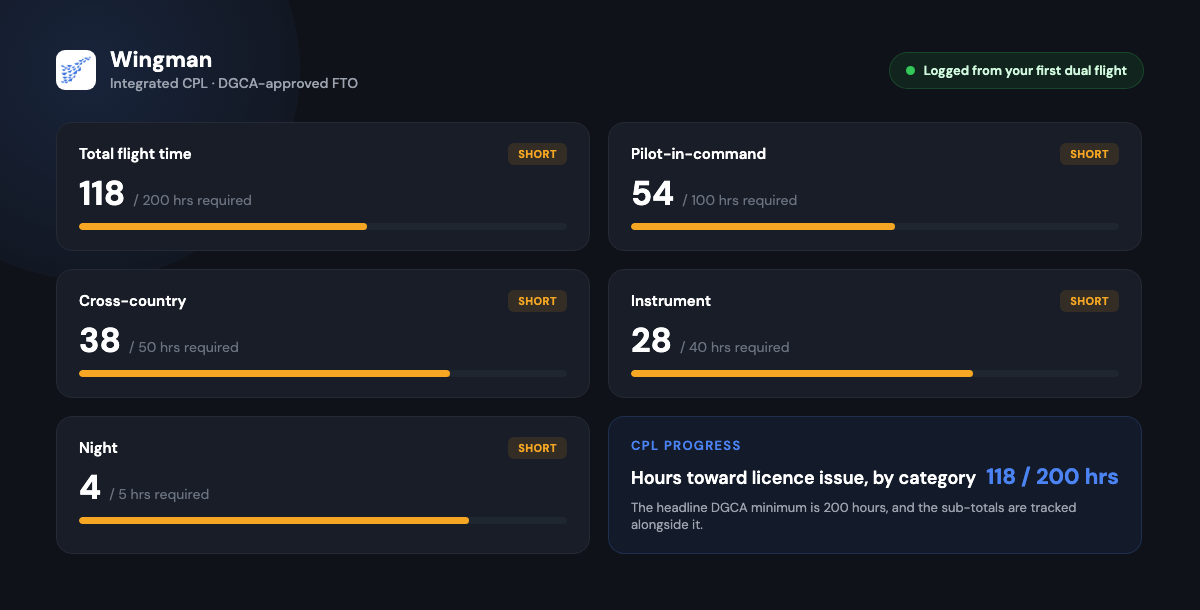
Most career-focused students enrol on an integrated CPL course that bundles the SPL, the flying hours toward CPL, the instrument rating, and the multi-engine rating into one programme. The headline DGCA requirement for a CPL is a minimum of 200 hours of flight time, of which a set portion must be pilot-in-command and cross-country flying. [VERIFY]
Fees and course duration
Integrated CPL training in India typically costs in the region of ₹40 to ₹50 lakh end to end, and Chimes Aviation Academy sits broadly within that national range. [VERIFY] The exact figure depends on the aircraft type you fly, fuel costs in a given year, any type-rating add-on, and whether accommodation and examination fees are bundled or charged separately. Because of that, the academy publishes fees on a per-batch basis rather than as a single fixed number, and you should ask for an itemised, current fee schedule in writing.
On timing, an integrated CPL programme generally takes around 18 to 24 months from the first ground class to licence issue, assuming reasonable weather and aircraft availability. [VERIFY] Weather, serviceability, and the pace at which you clear the DGCA written examinations all affect the real-world duration, so the calendar can stretch beyond the brochure estimate.
Eligibility
The eligibility criteria for the CPL track at Chimes follow the DGCA national standard rather than anything unique to the academy:
- Age: you must be at least 17 to hold a Student Pilot Licence and 18 to be issued a CPL. [VERIFY]
- Education: a 10+2 (or equivalent) pass with physics and mathematics. Candidates from other streams can usually add these subjects through the National Institute of Open Schooling before applying. [VERIFY]
- Medical: a DGCA Class 2 medical to begin training and a Class 1 medical for the CPL. Getting the Class 1 done early is sensible, because a medical issue is the one thing that can stop a career before it starts.
- English: a working standard of English, since all aviation communication and examinations are in English.
If you meet these, the next administrative steps are typically opening your DGCA records. Our walkthroughs on how to apply for a DGCA computer number and the full set of exams to be cleared in order to get CPL, PPL, ATPL explain the paperwork and theory papers you will need regardless of which FTO you choose.
The IndiGo cadet pilot programme
The reason Chimes Aviation Academy gets searched for so heavily is its cadet pilot programme with IndiGo. Under this arrangement, the airline and the academy run a structured route designed to take selected candidates from ab-initio training through to a type rating and, on successful completion and subject to vacancies, a junior first officer position with IndiGo. [VERIFY]
In broad terms the cadet route works like this. Candidates apply and sit a selection process that usually includes aptitude testing, a pilot-aptitude screening, and an interview. Those selected complete their CPL training at the academy, then move on to a multi-engine instrument rating and an A320 type rating before joining the airline as a junior flying officer. [VERIFY] The appeal of a cadet programme over open-market training is the defined pathway and the line of sight to an airline cockpit, but the trade-off is that the total cost, including the type rating, is borne by the cadet, and a place at the airline is conditional rather than guaranteed.

Because programme structure, intake dates, selection criteria, and cost can change between cohorts, the current terms should be confirmed directly with IndiGo and Chimes Aviation Academy before you apply. [VERIFY] Treat the steps above as the shape of the route rather than a fixed contract.
How to do your own due diligence
Whichever flight school you are weighing up, a few checks separate a confident decision from an expensive guess. Confirm the current DGCA FTO approval status on the official DGCA list. Ask for the fleet size and serviceability, because flying hours depend on aircraft actually being available. Ask how many hours the average student logs per month, since that drives how long your course really takes. Get the fee schedule itemised in writing, including what happens to your money if you leave partway through.
It is also worth understanding how the rest of the DGCA system works in parallel with your flying, because licensing is not handled by the academy. Licence and related processes run through eGCA, and our guides on how to get your eGCA ID and the pilot registration process with eGCA explain how to register and what to expect. Knowing how these systems fit together keeps your records straight from your first lesson through to licence issue.
Logging your hours from day one
From your very first dual flight, every hour you fly has to be recorded accurately, and that record follows you for the rest of your career. DGCA, employers, and your own licence renewals all depend on a clean logbook, so it is worth starting one properly on day one rather than reconstructing it later. This is where a digital logbook earns its place. Wingman is a pilot logbook used by 30,000+ pilots across 400+ airlines, and it keeps your hours, currency, and licence details in one place across iOS, Android, and Web. It is a global product rather than an India-only tool, and it produces regulator-compliant exports for DGCA alongside the FAA, EASA, UK CAA, GCAA, GACA, NZCAA, HKCAD, CASA, and CAAS, so the same logbook keeps working if your career later takes you to a Gulf or international carrier. For the India-specific setup there is a focused walkthrough on keeping a DGCA pilot logbook in India. There is a free tier up to 250 logged hours, which comfortably covers the early training stage, so you can start logging while you are still a cadet without paying anything up front.
Frequently asked questions
Is Chimes Aviation Academy DGCA approved?
Chimes Aviation Academy operates as a DGCA-approved Flying Training Organisation, which is what makes the hours you fly there count toward an Indian CPL. [VERIFY] Approvals are reviewed periodically, so always check the current status on the official DGCA list of approved FTOs before you enrol.
How much does the CPL course at Chimes cost?
Integrated CPL training in India generally falls in the ₹40 to ₹50 lakh range end to end, and Chimes sits broadly within that band. [VERIFY] The exact figure depends on aircraft type, fuel costs, any type-rating add-on, and whether accommodation and exam fees are bundled, so ask for a current itemised fee schedule in writing.
What is the IndiGo cadet pilot programme at Chimes?
It is a structured route run with IndiGo that takes selected candidates from ab-initio training through CPL, a multi-engine instrument rating, and an A320 type rating, toward a junior first officer position subject to selection and vacancies. [VERIFY] The cost, including the type rating, is borne by the cadet, and the terms change between intakes, so confirm them directly with the airline and the academy.
What are the eligibility requirements to join?
You need to be at least 17 for a Student Pilot Licence and 18 for a CPL, hold a 10+2 with physics and mathematics, and pass the DGCA Class 1 medical. [VERIFY] A working standard of English is also required. Subjects like physics and maths can usually be added through open schooling if your stream did not include them.
How long does training take?
An integrated CPL programme typically runs around 18 to 24 months from the first ground class to licence issue, assuming reasonable weather and aircraft availability. [VERIFY] Real-world timing depends on weather, aircraft serviceability, and how quickly you clear the DGCA written examinations, so allow some margin beyond the brochure estimate.
← All articles