DGCA Class 1 medical: test list, centres, fees and the 2026 process
A DGCA Class 1 medical is the fitness assessment you must hold to fly commercially in India. The initial examination runs 17 official investigations, is conducted at 13 approved centres (three Indian Air Force boarding centres plus civil hospitals approved in October 2025), costs Rs 3,000 in DGCA fees plus investigation charges, and requires a valid Class 2 medical first. No NOC is needed for a first-time initial, and the assessment arrives digitally signed on your eGCA account.
This guide covers the whole thing from the current official sources (FCL Circular 03 of 2025 and CAR Section 7 Series C Part I): who qualifies, where to go, the full test list, what to carry, fees, what happens if you are declared unfit, and how validity and renewals work after. There is also a printable one-page test-list checklist you can take to your medical.
Initial, re-initial, or renewal: which one are you
The route, the centre, and the paperwork differ, so place yourself first.
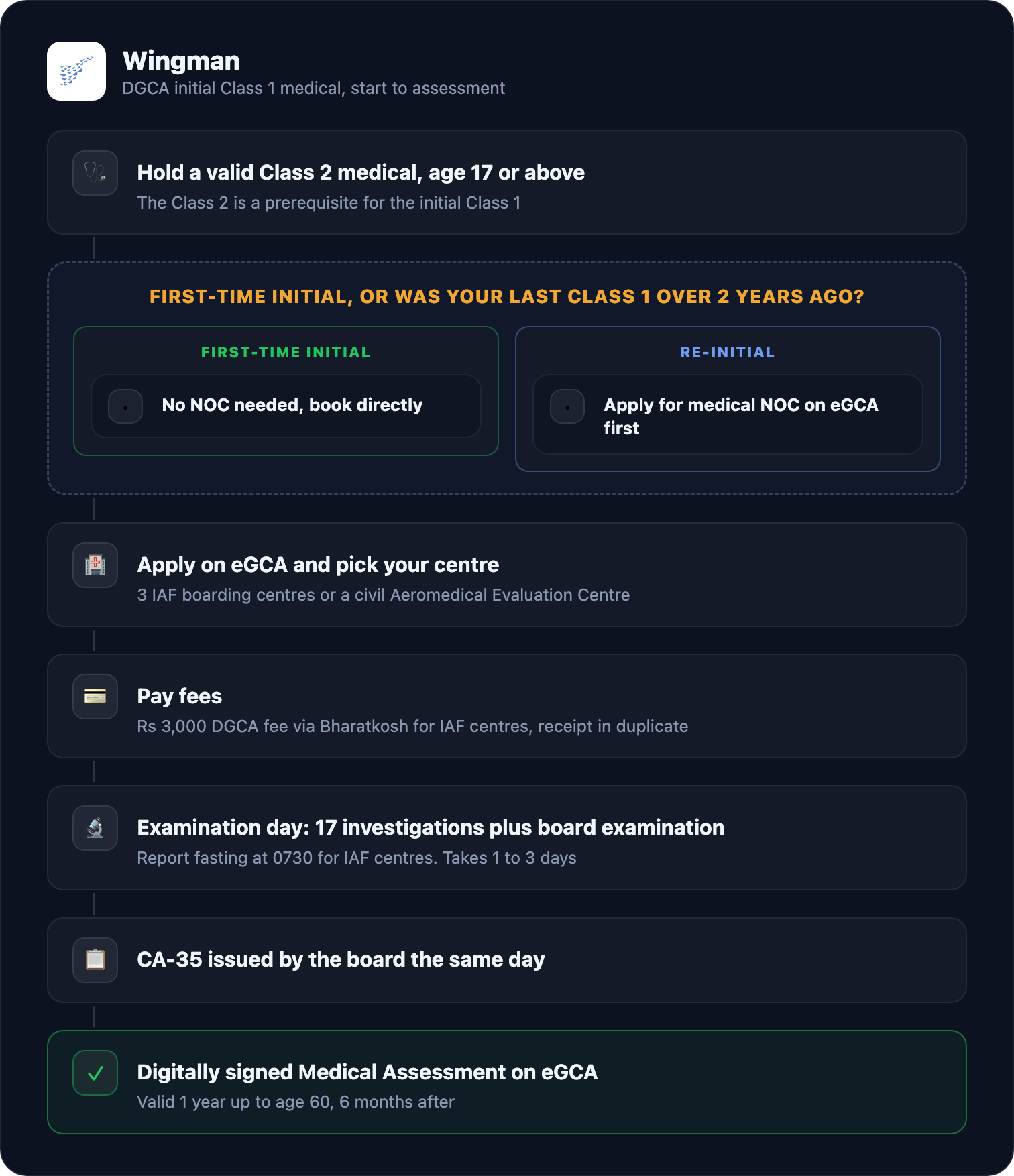
- Initial Class 1. Your first Class 1 assessment. You must hold a valid Class 2 medical and be at least 17. No NOC is required.
- Re-initial Class 1. If your last Class 1 assessment was more than 2 years ago, you are treated as a fresh case and need a re-initial, which does require a medical NOC through eGCA before the appointment.
- Renewal. The periodic assessment that keeps an existing Class 1 current, done at any of the renewal centres or by one of the 55 DGCA-empanelled Class 1 medical examiners across the country. The dedicated walkthrough is in how to apply for a Class 1 medical renewal on eGCA.
One correction to a widely repeated claim: a first-time initial does not need a NOC. The medical NOC (applied for on eGCA under Request for Medical NOC) exists for the other categories: re-initial, delayed renewal, early renewal, post-temporary-unfitness reviews, and special medicals. If you are a fresher with a valid Class 2, you book the appointment, not the NOC. The NOC process itself is covered in how to apply for a medical NOC on eGCA.
Where the initial Class 1 is done: 13 centres
Until late 2025, initial Class 1 medicals were effectively an IAF-only affair. A DGCA public notice dated 22 October 2025 changed that by approving civil hospitals as Aeromedical Evaluation Centres, and the official list (updated April 2026) now has 13 centres conducting Class 1 examinations.
IAF boarding centres (initial, re-initial, and all other types):
- AFCME, Subroto Park, New Delhi
- Institute of Aerospace Medicine (IAM), IAF, Bengaluru
- MEC(E), 5 Air Force Hospital, Jorhat
Civil Aeromedical Evaluation Centres:
- Dr. Balabhai Nanavati Hospital, Mumbai (initial and re-initial only)
- VM Medical Centre, Worli, Mumbai
- Indraprastha Apollo Hospital, New Delhi
- Max Multi Speciality Centre, Panchsheel Park, New Delhi
- Medanta The Medicity, Gurugram
- Apollo Hospitals, Greams Road, Chennai
- Apollo Hospitals, Bannerghatta Road, Bengaluru
- Apollo Hospitals, Jubilee Hills, Hyderabad
- Apollo Hospitals, Vijay Nagar, Indore
- Ruby Hall Clinic, Pune
Slots at the IAF centres in particular fill up weeks ahead, so treat the choice of centre as a scheduling decision: pick one you can travel to and apply early. The DGCA publishes the current centre and examiner list as a PDF under Personnel, Medical on dgca.gov.in, and it changes (three IAF centres were removed and several civil centres added between 2023 and 2026), so confirm against the latest list before you book.
The official DGCA Class 1 test list
This is the question everyone asks, and the answer is published in FCL Circular 03 of 2025. The initial Class 1 examination includes these 17 investigations:
- Blood haemoglobin (Hb%)
- Total leucocyte count (TLC)
- Differential leucocyte count (DLC)
- Urine routine and microscopic examination
- Blood sugar, fasting and post-prandial
- HbA1c
- Liver function tests (LFT)
- Blood urea
- Serum creatinine
- Serum uric acid
- Lipid profile
- Resting ECG
- Chest X-ray, PA view
- Pure tone audiometry
- Ultrasound of the abdomen
- Ultrasound of the pelvis
- Dilated fundus examination
On top of the investigations, the medical board conducts its clinical examinations: general physical, ophthalmic including colour vision, and ENT, against the ICAO Annex 1 standards adopted in the CAR.
Two clarifications worth knowing, because older guides get them wrong. EEG is not on the standard initial list: it sits in the additional-investigations table alongside TMT, 2D echocardiography, Holter, thyroid profile, sleep study, and the viral markers, ordered case by case from your history or findings. And there is no standard dental or psychiatric test item on the official list. The board can demand any additional investigation it considers necessary, and one trigger is written into the circular explicitly: a BMI over 25, or known impaired glucose tolerance, makes a 75 g glucose tolerance test plus HbA1c mandatory.
Download the one-page test-list checklist (PDF) if you want this list, the documents to carry, and the day-of rules in printable form.
Getting reports done outside the centre
If any investigation is done at an outside lab (routine for TMT and echo at renewals), the rules are strict: the report must be an original from an NABL, NABH, or ISO-accredited lab, QR-coded, signed by the specialist, with your identity verified. Blood, urine, biochemistry, resting ECG, and audiometry reports are valid for 1 month; ultrasound, X-ray, TMT, echo, CT, and MRI for 2 months. Reports are uploaded to eGCA as a single PDF under Track Status, Upload Medical Investigation.
Booking and the eGCA application
- Log in to eGCA (our eGCA login guide covers registration and recovery).
- Apply for the medical appointment, selecting your centre. Multi-crew or single-crew operation type is selected in the application.
- Upload your photo per the specification and complete the medical declaration. A confirmatory email and SMS follow submission.
- For IAF centres, pay the DGCA fee on bharatkosh.gov.in and carry the receipt in two copies.
- On examination day, the centre takes it from there; any outside reports get uploaded to eGCA afterwards, and you re-validate your declarations once uploads are complete.
How the initial Class 1 process flows
Fees
- DGCA licensing fee: Rs 3,000 for an initial Class 1, Rs 2,000 for a renewal, paid via Bharatkosh for IAF centres.
- Investigation charges at IAF boarding centres: standardised at CGHS rates, roughly Rs 2,076 for the full initial battery. Age-milestone renewals range from about Rs 131 (routine yearly under 30) to about Rs 2,305 (the age 62 and 64 batteries with echo and PSA).
- Civil Aeromedical Evaluation Centres: set their own package prices, so ask the hospital when booking.
Travel and accommodation are your own arrangement, and the examination takes 1 to 3 days depending on findings.
Examination day: the practical rules
- Report at 0730 at IAF centres, per your appointment elsewhere.
- Come fasting: the blood sugar panel is drawn first thing.
- Get ear wax cleaned beforehand; blocked ears fail audiometry and add a needless referral.
- Carry: photo ID matching your eGCA record, your Class 2 medical assessment, spectacles with a current optometrist prescription if you wear them, the Bharatkosh receipt in duplicate (IAF centres), any specialist reports for known conditions, and the NOC if your category needs one.
- Serving Armed Forces pilots additionally need an NOC from their competent authority and their unit AFMSF-1 copy; foreign nationals need MoD security clearance arranged through the DGCA Medical Directorate.
Results: CA-35, the eGCA assessment, and validity
The examiner or board issues a CA-35 certificate the same day, but the medical is legally complete only when the DGCA Medical Assessor issues the digitally signed Medical Assessment on eGCA (under the Medical menu). Do not fly between an unfit CA-35 and DGCA’s final word, and for post-unfitness cases, only after DGCA issues a fit assessment.
Validity is age-based: 1 year up to age 60, 6 months after 60. Pilots over 40 on single-crew commercial operations or instructional duties are also on 6-month validity. Renewals can be done up to 45 days before expiry without shortening the cycle. Miss the expiry and you are into NOC territory: a delayed renewal needs a Delayed NOC, and past 2 years you are back to a re-initial.
Renewals also follow a published age-milestone schedule: fuller batteries at 25, 30, 35, 40, 45, 50, 55, and 60 (TMT joins from 35 and 40 onward, echocardiography and PSA at 60 and beyond), with lighter routine panels in between. The full year-by-year table is in FCL Circular 03 of 2025.
If you are declared unfit
A Class 1 outcome is fit, fit with limitations (for example, fit to fly as co-pilot only), temporarily unfit, or permanently unfit. Temporary unfitness is reviewed at an IAF boarding centre after the unfitness period. Permanent unfitness can only be recommended by an IAF boarding centre medical board and approved by DGMS (Air).
There is a formal appeal path: if you are declared temporarily unfit for more than 3 months, or permanently unfit, you can appeal to the DMS (CA) at the DGCA Medical Directorate within 90 days, with your original specialist reports. A justified appeal gets a review at an Air Force appellate centre, and for permanent-unfitness cases, not the centre that declared you unfit. The DGMS (Air) decision is final.
One more thing the circular is blunt about: declare your medical history truthfully. A false declaration to the examiner is reported to DGCA for penal action.
Keep your hours ready alongside your medical
A medical certificate proves you are fit to fly. Your logbook proves what you have flown. The two run in parallel through your whole career, and examiners, employers, and regulators will ask for both. As you build toward your licence and then into the line, keeping flight time, currency, and certificate details organised saves a lot of last-minute scrambling.
Wingman is a digital pilot logbook used by 30,000+ pilots across 400+ airlines, available on iOS, Android, and Web. It is a global product rather than an India-only tool, and it produces regulator-compliant exports for DGCA alongside the FAA, EASA, UK CAA, GCAA, GACA, NZCAA, HKCAD, CASA, and CAAS. For the Indian context specifically, there is a focused walkthrough on keeping a DGCA pilot logbook in India. There is a free tier up to 250 logged hours, so you can start recording while you are still a trainee, and you can move your records into the Wingman web app whenever you are ready.
Frequently asked questions
What tests are included in the DGCA Class 1 initial medical?
The official list has 17 investigations: Hb%, TLC, DLC, urine routine and microscopy, fasting and PP blood sugar, HbA1c, LFT, blood urea, serum creatinine, serum uric acid, lipid profile, resting ECG, chest X-ray PA view, pure tone audiometry, ultrasound abdomen, ultrasound pelvis, and dilated fundus examination, plus the board’s clinical examinations. EEG, TMT, and echo are case-by-case additions, not defaults.
Where is the initial DGCA Class 1 medical conducted?
At 13 approved centres: the IAF boarding centres at New Delhi (AFCME), Bengaluru (IAM), and Jorhat (MEC-E), plus DGCA-approved civil Aeromedical Evaluation Centres in Mumbai, Delhi, Gurugram, Chennai, Bengaluru, Hyderabad, Indore, and Pune, approved by the public notice of 22 October 2025.
Do I need a NOC before my first Class 1 medical?
No. The medical NOC is not required for a first-time initial. It applies to re-initials (last Class 1 over 2 years old), delayed and early renewals, post-temporary-unfitness reviews, and special medicals, and is applied for on eGCA after you have a confirmed appointment.
Do I need a Class 2 medical before a Class 1?
Yes. A valid DGCA Class 2 medical is a prerequisite, and the minimum age for a Class 1 is 17. We cover the prerequisite in how to apply for a Class 2 medical in India.
How long is a Class 1 medical valid?
One year up to age 60 and six months after, with six-month validity also applying over age 40 in single-crew commercial or instructional flying. Renewal is permitted up to 45 days before expiry.
How much does the DGCA Class 1 medical cost?
Rs 3,000 DGCA fee for an initial (Rs 2,000 renewal) via Bharatkosh at IAF centres, plus investigation charges at CGHS rates, roughly Rs 2,076 for the initial battery. Civil centres price their own packages.
← All articles