Common challenges faced by student pilots in India
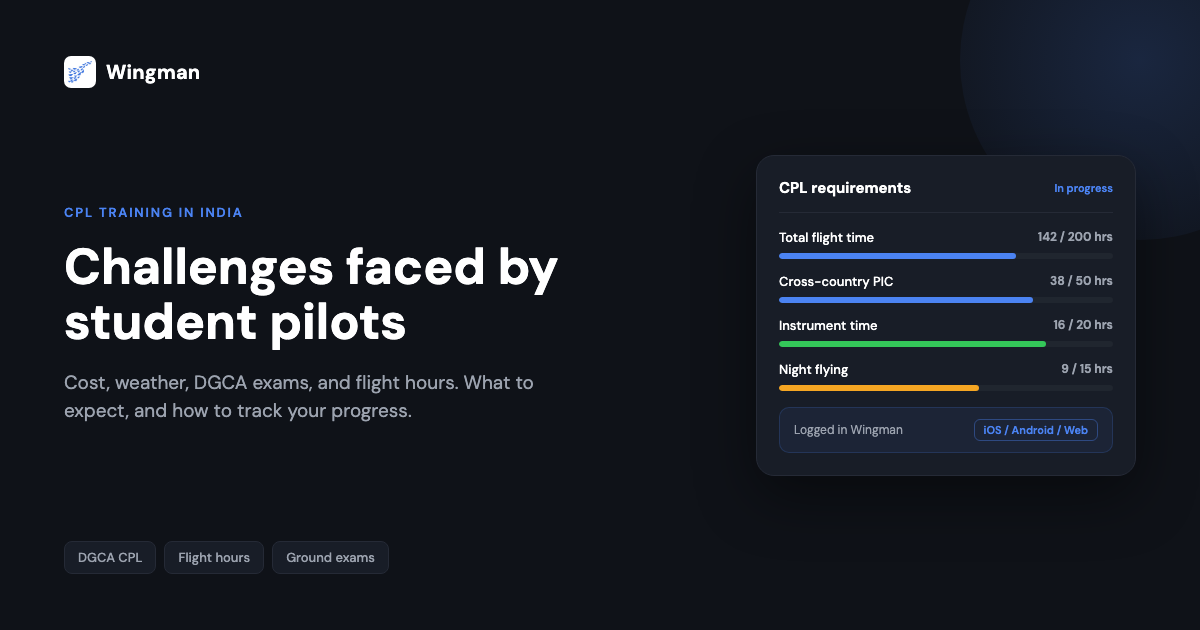
Training toward a Commercial Pilot Licence (CPL) in India is a long project, not a single decision. Between the first ground class and the day your licence is issued, most student pilots run into the same set of obstacles: the cost, the weather, the exams, and the slow grind of building flight hours. None of these are reasons to stop, but knowing what is coming makes the path easier to plan for.
This guide walks through the challenges student pilots face most often during DGCA CPL training, with India-specific context on cost, flight hours, and the regulatory steps involved. Where a challenge connects to a process worth understanding in detail, there is a linked guide so you can go deeper without losing the thread.
What student pilots are actually training toward
Before the challenges make sense, it helps to be clear on the goal. A CPL is the licence that lets you fly for hire and reward, and it is the standard target for anyone aiming at an airline career in India. Getting there means clearing DGCA written examinations, passing a Class 1 medical, and logging the required flight time toward the licence.
The full picture of what DGCA expects is set out in our overview of requirements for CPL in India and the more specific CPL flying requirements in India. Reading these early gives you a map, which is the single best defence against most of the challenges below.
1. The cost of CPL training
The financial burden is the obstacle most aspiring pilots feel first. Flight training in India is expensive because the cost is driven by aircraft hire and fuel, both billed by the hour, on top of ground school, examination fees, and a medical. The total varies widely depending on the flying school, the aircraft you train on, and how quickly you complete your hours. We break down the real numbers in CPL cost in India.
Many student pilots fund training through education loans or family support, and managing that money over an 18-to-24-month programme is a challenge in itself. The hidden cost is time: every weather delay or scheduling gap stretches the timeline and, often, the budget. A few habits reduce the waste, and we have collected practical ones in tips and tricks to save cost while doing your flight training. Choosing the right school matters too, which is why it is worth comparing DGCA-approved flying schools in India before you commit.
2. Weather-dependent training
Flying is tied to the weather in a way few other kinds of study are. Monsoon season, fog, low cloud, and strong winds can ground a student pilot for days or weeks, and these delays do not respect your schedule or your loan repayment plan. Northern Indian flying schools in particular lose significant winter mornings to fog.
The challenge is not just the lost flying. Long gaps between lessons cause skill fade, so you can spend the first part of a returning session re-learning what you had already mastered. There is no way to control the weather, but you can control how you use the downtime: ground study, chair-flying procedures, and reviewing your previous flights all keep you sharp so that when the weather clears, you fly rather than revise.
3. The DGCA written examinations
CPL training is not only about flying the aircraft. A large share of the work is ground school, covering air navigation, aviation meteorology, air regulation, and technical general and technical specific subjects. Balancing this academic load against flight lessons is mentally demanding, and the examinations are a common place where timelines slip.
You can plan around this by knowing exactly which papers you need, which we cover in exams to be cleared in order to get CPL, PPL, ATPL, and by preparing with the right resources, collected in our list of study materials for CPL. When a result is due, you check it on the DGCA exam portal, and our walkthrough on how to check your exam results on the DGCA Pariksha website shows the exact steps.
4. Building the required flight hours
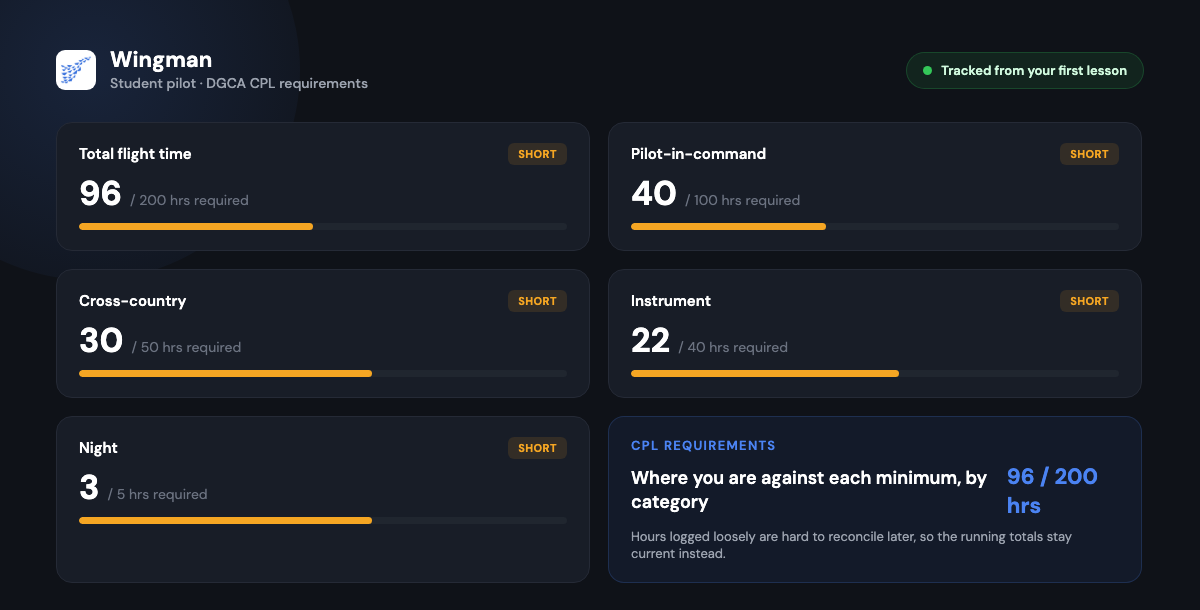
A CPL in India is built on flight time, and accumulating those hours is a slow, sometimes frustrating process. [VERIFY] DGCA sets a minimum total flight time for CPL issue, along with sub-requirements for pilot-in-command time, cross-country flying, instrument time, and night flying. Every one of those categories has to be met and evidenced, not just the headline total.
This is where many student pilots lose ground without realising it: hours flown but logged loosely, or split across a paper logbook and scattered notes, become hard to reconcile when it is time to count cross-country or PIC time. Keeping an accurate, category-by-category running total from your very first lesson removes that problem. A digital logbook that tracks each requirement against your actual flying makes the gap between where you are and where you need to be visible at any moment, which is far better than discovering a shortfall near the end.
5. Physical and mental stress
Flying is demanding in a way that catches new students off guard. Early lessons combine sensory overload, time pressure, and the responsibility of controlling an aircraft, and that produces real stress. Takeoffs, landings, and emergency procedures all have to become second nature while you are still nervous about them.
On top of the flying itself sits the pressure of the medical. A CPL requires a DGCA Class 1 medical, and the worry about meeting and maintaining medical standards is a stressor that runs in the background for many student pilots. The practical response is the same one professional pilots use: steady routines, honest self-assessment, and not flying when you are not fit to. Managing fatigue and stress is a skill examiners want to see, not a weakness to hide.
6. Performance plateaus
Almost every student pilot hits a stage where progress seems to stall. Landings stop improving, or a manoeuvre that was getting better suddenly is not. These plateaus are normal and they are temporary, but they are demoralising in the moment, especially when each hour costs money.
The way through a plateau is usually structured review rather than simply flying more. Looking back over your recent flights, identifying the specific points that are not improving, and briefing them with your instructor is more effective than another unfocused session. Keeping good notes on each flight, including what went wrong and what you want to fix next time, turns a vague sense of being stuck into a concrete list you can work through.
7. The regulatory and paperwork load
DGCA processes are detailed, and learning to navigate them is part of becoming a pilot. Between computer numbers, examination registration, the eGCA platform for licensing, medical records, and the final licence application, there is a steady stream of administrative steps that have to be done correctly and in order. Mistakes here cause delays that have nothing to do with your flying ability.
The most common avoidable problem is a logbook that does not stand up to scrutiny. DGCA expects entries in a specific format, and a logbook with gaps, inconsistencies, or missing endorsements can hold up your licence. Our guide on the DGCA logbook entry format shows what is expected. Getting this right from the first flight is far easier than reconstructing it later.
8. Aircraft availability and maintenance
Student pilots train on a shared fleet, and that fleet is not always available. Scheduled maintenance, unexpected snags, and high demand for a limited number of aircraft all cause cancellations. A booked slot can disappear because the aircraft is grounded, and that pushes your timeline and adds to the cost of staying current.
There is little a student can do about a school’s fleet directly, but you can reduce the impact. Being flexible with slots, staying near the top of the standby list, and keeping your ground knowledge current so you are ready the moment an aircraft frees up all help you fly more of the hours that are actually available.
How the CPL journey fits together

The diagram is a simplification, and the exams and flying happen in parallel rather than one after the other, but it shows why accurate record-keeping sits at the centre of the process. Your logbook is the evidence that ties your flying to your licence application.
Keeping your training organised from day one
Most of the challenges above are easier to manage when your records are in order. Weather delays cause skill fade you can review against past flights, flight-hour requirements need category-by-category tracking, plateaus respond to honest notes, and DGCA paperwork demands a logbook in the right format. A single, accurate record of your flying supports all of these.
Wingman is a digital pilot logbook used by 30,000+ pilots across 400+ airlines, and it keeps your hours, currency, and licence details in one place across iOS, Android, and Web. It tracks your time by category, so the progress toward your CPL requirements is always visible rather than something you reconstruct at the end. For the India-specific setup, there is a focused walkthrough on keeping a DGCA pilot logbook in India. There is a free tier up to 250 logged hours, which covers a large part of CPL training, so you can start logging from your first lesson without committing anything up front.
Frequently asked questions
What is the hardest part of CPL training in India?
It varies by person, but cost and the time it takes to build flight hours are the two challenges most student pilots name. Weather delays and the DGCA written examinations stretch the timeline further. None of these are unusual, and planning around them, rather than being surprised by them, is what keeps training on track.
How long does it take to become a commercial pilot in India?
Most CPL programmes are planned over roughly 18 to 24 months, but the real timeline depends heavily on weather, aircraft availability, and how quickly you clear the written examinations. Building flight hours is rarely the limiting factor on its own; the delays around it usually are. [VERIFY]
How much does CPL training cost in India?
The total depends on the flying school, the aircraft, and how long the training takes, because the largest costs are billed by the flight hour. We cover the current figures and what drives them in our guide on CPL cost in India. [VERIFY]
How do I keep track of my flight hours during training?
Log every flight accurately from your first lesson, broken down by the categories DGCA cares about, such as pilot-in-command, cross-country, instrument, and night time. A digital logbook like Wingman tracks these totals automatically and shows your progress against CPL requirements, which is far more reliable than reconciling a paper logbook near the end of training.
Do weather delays affect my progress as a student pilot?
Yes. Lost flying days extend your timeline and can cause skill fade when there are long gaps between lessons. You cannot control the weather, but using the downtime for ground study, procedure review, and looking back over your recent flights keeps you ready to fly productively as soon as conditions allow.
← All articles