Foreign CPL conversion to an Indian CPL: documents, process, and timelines
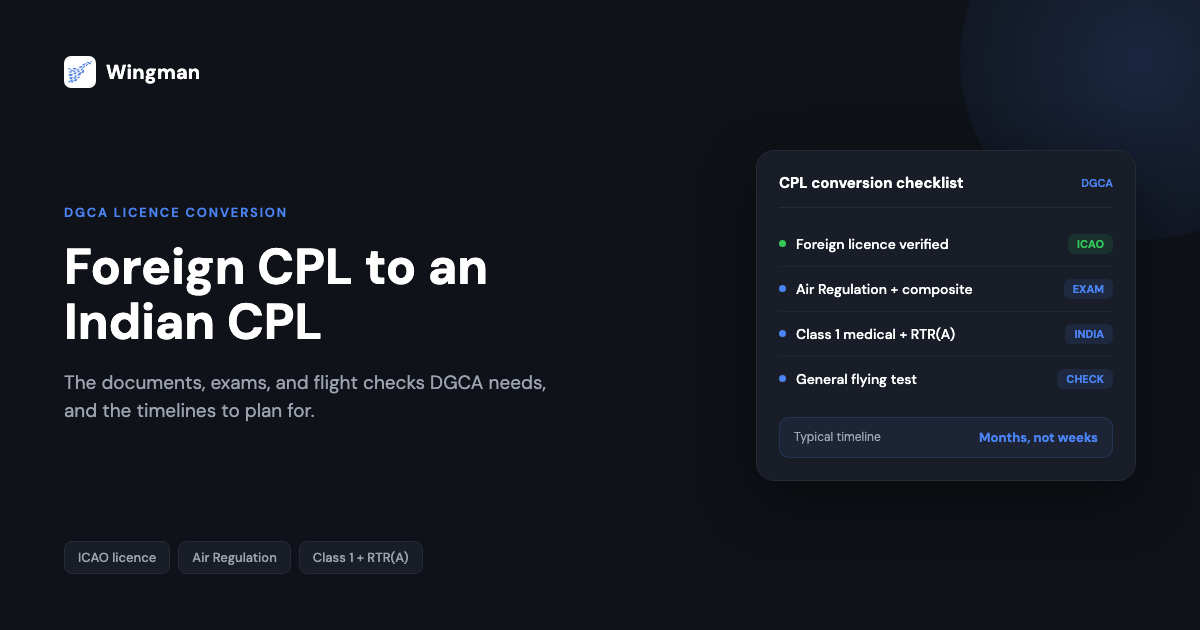
If you already hold a Commercial Pilot Licence (CPL) issued by another ICAO Contracting State and you want to fly commercially in India, you do not start your licensing from zero. The Directorate General of Civil Aviation (DGCA) runs a conversion route that recognises the training and experience behind your existing licence, then checks it against Indian requirements through document verification, examinations, and flight checks. This guide explains what the conversion involves, which documents you need, the order things happen in, and the practical timelines and costs to plan for.
The aim here is to give you a clear picture before you contact DGCA, so you arrive with the right paperwork rather than discovering gaps one step at a time. Regulatory detail changes, so treat the specifics below as a planning baseline and confirm the current position against DGCA before you commit money or travel.
Who can convert a foreign CPL to an Indian CPL
The conversion route is intended for holders of a current CPL issued by an ICAO Contracting State. [VERIFY] Because the foreign licence must trace back to ICAO standards, the issuing authority of your licence matters more than your nationality. In practice, licences issued under widely recognised systems such as the FAA in the United States, EASA member states, the UK CAA, and similar authorities are the common starting points for conversion. [VERIFY]
DGCA verifies the foreign licence directly with the issuing authority, so the licence has to be valid and in good standing at the time of application. [VERIFY] A lapsed or suspended licence cannot be converted until its status is resolved with the original authority. The conversion is not a transfer that cancels your foreign licence; you keep the original and gain an Indian CPL once you meet Indian requirements.
Documents you need to gather
Conversion is document-heavy, and missing paperwork is the most common reason applications stall. Assemble the following before you begin. [VERIFY]
- Valid foreign pilot licence. Your CPL must be current and in full force, not expired or under restriction.
- Verification letter from the issuing state. An official letter from your licensing authority confirming the authenticity and current status of your licence. DGCA may also seek this confirmation directly.
- Valid foreign Class 1 medical assessment. A current medical certificate from the country that issued your licence.
- Authenticated logbook. Your flying record, with the last five years authenticated by your aviation authority, so DGCA can confirm recency and total experience.
- Certificates of skill tests. Evidence of skill tests passed, which matters in particular if you hold or seek a multi-engine rating.
- Statement of cross-country flights. A record of cross-country flying, relevant if you are carrying across an Instrument Rating (IR).
- Cross-country check reports. Reports for the cross-country checks required under Indian rules.
- Night and instrument flying evidence. Recent instrument time, which is relevant when an IR is involved.
- Multi-engine endorsement evidence. If you want a multi-engine endorsement on the Indian licence, expect an associated knowledge test.
- Psychological assessment. A personality or aptitude assessment may form part of the process. [VERIFY]
Authentication and attestation requirements are strict, so check exactly how DGCA wants each foreign document certified before you post or upload anything. [VERIFY]
Indian examinations and flight checks
A foreign CPL demonstrates that you can fly to a recognised standard, but India requires you to show knowledge of Indian air law and procedures and to fly to Indian check standards. Plan for the following on Indian soil. [VERIFY]
- Air Regulation paper. You must pass the DGCA Air Regulation examination, which covers Indian aviation law and rules.
- Composite paper. A combined paper covering meteorology and navigation. A pass in Air Regulation and the composite paper is generally required to have been achieved within a defined recent window before licence issue. [VERIFY]
- General flying test. A flight test at a DGCA-approved institute covering day, night, and instrument elements as applicable to your ratings.
- Signal reception test. A test of your ability to receive radio signals, conducted in India if it was not done abroad.
- Indian Class 1 medical. An assessment at a DGCA-approved medical centre, separate from your foreign medical.
- RTR(A). The Radio Telephony Restricted (Aeronautical) licence issued in India by the licensing authority for wireless. If you do not already hold an equivalent accepted by DGCA, you take the Indian RTR(A).
To prepare for the written papers and the radio licence, these focused guides cover the same examinations in detail:
- How to prepare for the DGCA CPL Navigation exam
- How to prepare for the DGCA CPL Meteorology exam
- Class 1 medical for pilots
- RTR examination
The conversion process step by step
The conversion does not run in a strict single file order, because some items such as the medical and the written exams can be arranged in parallel. The sequence below is a sensible way to plan it.
- Confirm eligibility. Check that your foreign CPL is current, issued by an ICAO Contracting State, and that the issuing authority will confirm its status to DGCA. [VERIFY]
- Gather and authenticate documents. Collect your licence, verification letter, foreign medical, authenticated logbook, and test or check evidence in the format DGCA accepts.
- Apply to DGCA. Submit the conversion application with your documents through the DGCA process and pay the applicable fees. [VERIFY]
- Sit the Indian examinations. Pass the Air Regulation paper and the composite meteorology and navigation paper within the accepted recency window. [VERIFY]
- Complete the Indian medical and RTR(A). Obtain an Indian Class 1 medical and the Indian RTR(A) if you do not already hold an accepted equivalent.
- Pass the flight checks. Complete the general flying test and signal reception test at an approved institute, covering the ratings you are carrying across.
- Licence issue. Once DGCA has verified your foreign licence and confirmed all Indian requirements are met, your Indian CPL is issued.
Conversion flow

Fees and timelines to plan for
Conversion costs are not a single fee. You should budget separately for the DGCA application and licence fees, examination fees, the Indian Class 1 medical, the RTR(A) process, and flight check costs at the approved institute. Exact amounts are set by DGCA and the relevant authorities and are revised from time to time, so confirm the current schedule rather than relying on older figures. [VERIFY]
Timelines depend heavily on two things you do not fully control: how quickly your foreign authority responds to DGCA’s verification request, and how soon you can get examination, medical, and flight check slots. Document verification with the issuing state is often the longest single wait. [VERIFY] A realistic plan treats the process as a matter of months rather than weeks, and front-loads the slow items, principally the verification letter and the authenticated logbook, so they are moving while you sit exams and arrange checks.
Keeping your flight records ready for conversion
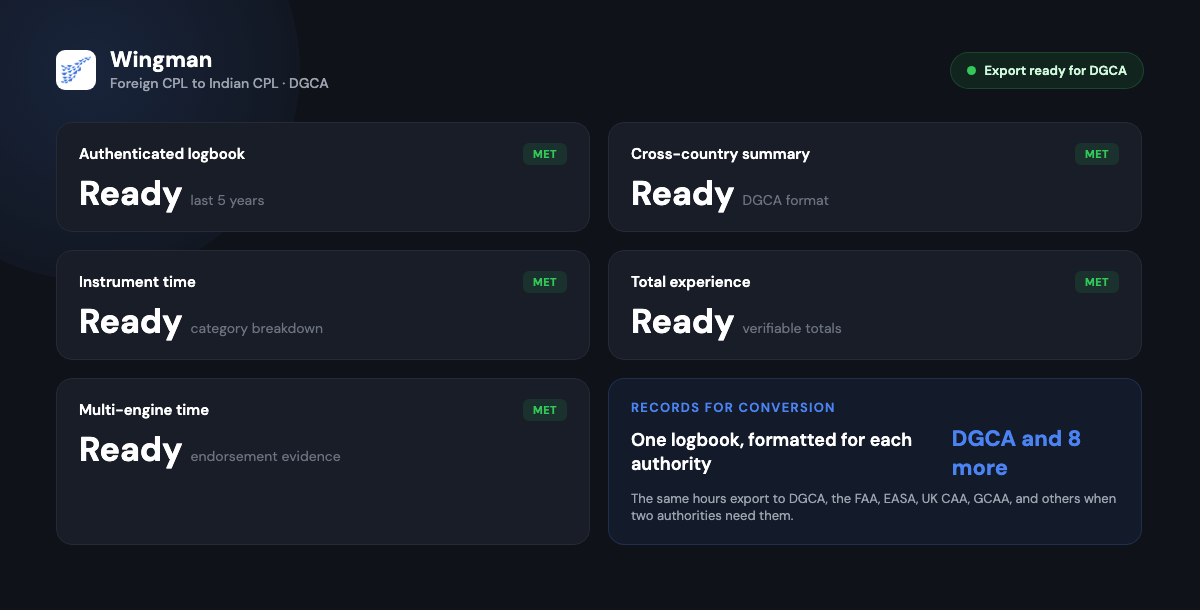
The authenticated logbook is one of the load-bearing documents in a conversion, because DGCA uses it to confirm your total experience, recency, cross-country time, and instrument time against Indian requirements. If your hours are scattered across paper books and spreadsheets, assembling a clean, verifiable record is one of the more tedious parts of the application.
A digital logbook makes this far easier to produce on demand. Wingman is a pilot logbook used by 30,000+ pilots across 400+ airlines, and it keeps your hours, currency, and ratings in one place across iOS, Android, and Web. It produces regulator-compliant exports for DGCA alongside the FAA, EASA, UK CAA, GCAA, GACA, NZCAA, HKCAD, CASA, and CAAS, which is useful when you are moving between systems and need the same hours presented to two authorities. There is a free tier up to 250 logged hours, so you can organise your record before you apply without committing anything up front. For India specifically, there is a focused walkthrough on keeping a DGCA pilot logbook in India.
Frequently asked questions
Can I convert any foreign CPL to an Indian CPL?
The conversion route is for holders of a current CPL issued by an ICAO Contracting State. [VERIFY] The licence must be valid and in good standing so DGCA can verify it with the issuing authority. A lapsed or restricted licence has to be put right with the original authority before it can be converted.
Do I have to retake all the pilot examinations in India?
No, you do not repeat your full training, but you do have to pass the Indian Air Regulation paper and the composite meteorology and navigation paper, complete an Indian Class 1 medical, hold an Indian RTR(A) if you do not have an accepted equivalent, and pass the required flight and signal reception checks. [VERIFY]
How long does foreign CPL conversion take?
Plan in months rather than weeks. The biggest variable is how quickly your original licensing authority confirms your licence to DGCA, followed by the availability of exam, medical, and flight check slots. [VERIFY] Starting the verification letter and logbook authentication early shortens the overall timeline.
What does the conversion cost?
There is no single fee. Budget separately for DGCA application and licence fees, examination fees, the Indian Class 1 medical, the RTR(A) process, and flight check costs at an approved institute. Amounts are revised periodically, so confirm the current schedule directly. [VERIFY]
Does converting cancel my foreign licence?
No. Conversion gives you an Indian CPL while you keep your original foreign licence. You are adding an Indian licence based on your existing qualification, not surrendering the licence you already hold. [VERIFY]
← All articles