How to convert an FAA license to EASA
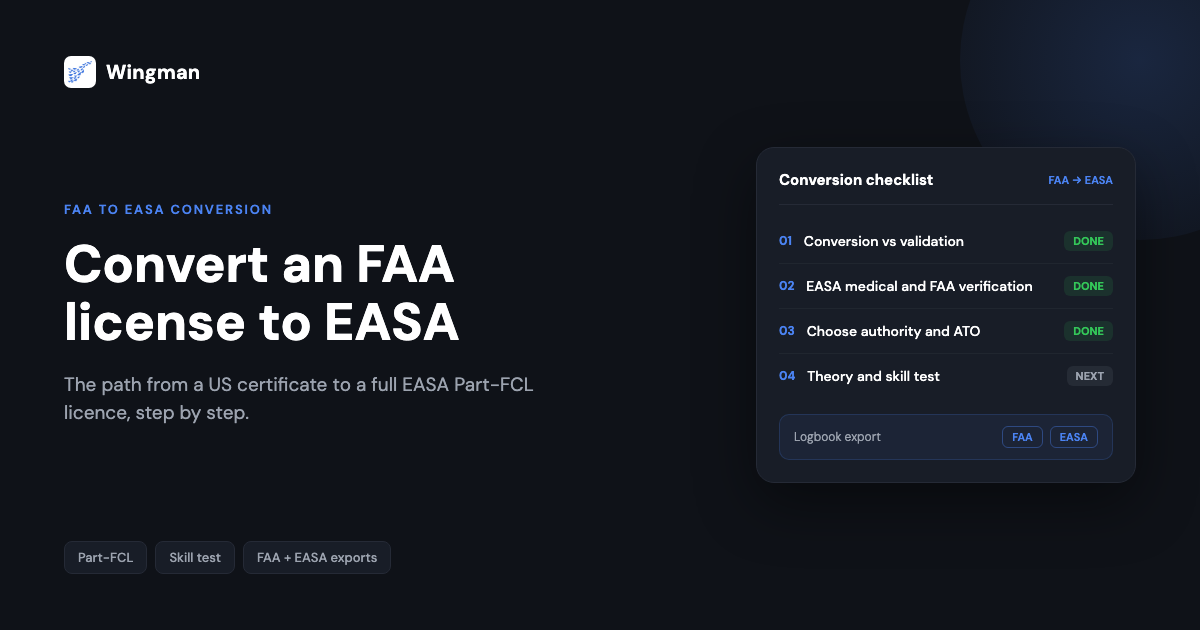
If you hold an FAA certificate and want to fly in Europe on a long-term basis, you will need an EASA Part-FCL licence. There is no automatic swap between the two systems, but there is a defined route, and FAA experience counts heavily in your favour. This guide walks through that route step by step: how conversion differs from a temporary validation, what documents you need, how to choose the right Approved Training Organisation, and what the EASA skill test actually involves.
The process is administrative as much as it is operational. Most of the friction comes from paperwork, medicals, and theory rather than flying, so knowing the sequence in advance saves weeks. Read this once before you contact any training provider, then keep it open as a checklist while you work through each stage.
Conversion vs validation: pick the right path first
The first decision is whether you want a full conversion or a validation, because the requirements diverge sharply from there.
A validation lets you exercise the privileges of your FAA licence inside EASA airspace for a limited period. Under the regulatory framework that covers third-country licences, a validation of a private pilot licence can be issued for up to 12 months, and it is generally restricted to PPL-level, non-commercial flying [VERIFY]. It is the faster option if you only need to fly a European-registered aircraft for a season, but it does not give you a European licence and it expires.
A conversion results in a full EASA Part-FCL licence in your own right, recognised long-term across all EASA member states. This is the path you want if you are relocating, joining a European operator, or planning a career in the region. The rest of this guide focuses on conversion, with notes where validation differs.
Conversion credit and the exact requirements are governed by Part-FCL and by any bilateral arrangement in force between the FAA and EASA at the time you apply [VERIFY]. The headline point is that your FAA hours and ratings reduce, but do not eliminate, the European theory and testing you must complete.
Step 1: Confirm your baseline requirements
Before you approach a training organisation, make sure you can assemble the core entry documents. For a conversion you will typically need:
- A valid FAA pilot licence (PPL, CPL, or ATPL) with the ratings you intend to carry across.
- An EASA medical certificate at the right class: Class 2 for PPL-level conversion, Class 1 if you are converting a CPL or ATPL [VERIFY]. Your FAA medical does not substitute for this; you must be examined by an EASA-authorised aero-medical examiner.
- Proof of ICAO English language proficiency at Level 4 or above, recorded to EASA standards [VERIFY].
- A radiotelephony qualification accepted by your chosen licensing authority.
- A verification of your FAA certificate sent directly from the FAA to the European authority, requested using FAA Form 8060-71 [VERIFY].
- Supporting records: your logbook, passport or ID, and any residence documentation your authority requires if you are not an EU resident.
Getting the licence verification and the EASA medical moving early matters, because both involve third parties and can become the long pole in the timeline.
Step 2: Choose your EASA authority and ATO
EASA sets the rules, but the licence is issued by a national aviation authority within the EASA system, and you apply through an Approved Training Organisation (ATO) affiliated with that authority. Your choice here shapes cost, language of administration, and processing speed.
When comparing ATOs and authorities, look at:
- Processing responsiveness. Administrative turnaround varies between authorities. Some are known among converting pilots for faster correspondence, though you should confirm current timelines directly rather than relying on reputation [VERIFY].
- Language. Some authorities conduct paperwork and examiner liaison in English throughout, which simplifies the process for FAA pilots.
- Structured conversion packages. A good ATO will bundle the application filing, medical scheduling, theory preparation, brush-up flying, and skill-test booking into one managed path rather than leaving you to coordinate each piece.
Ask any prospective ATO to map your specific FAA ratings against the EASA equivalents and tell you exactly which theory exams and test segments apply to you. That single conversation removes most of the uncertainty in this process.
Step 3: Clear the required theory
This is the step FAA pilots most often underestimate. EASA does not waive its theoretical knowledge requirements on the strength of FAA experience alone; the volume of theory depends on the licence level you are converting.
- For a PPL conversion, expect a reduced set of theory exams focused on the areas where EASA and FAA syllabuses differ, such as air law and operational procedures, as determined by your ATO and authority [VERIFY].
- For an ATPL, the theory load is substantial. The EASA ATPL(A) theoretical knowledge syllabus is examined across 13 subject papers, and converting pilots are generally expected to complete the associated theory course at an ATO before sitting them [VERIFY].
Plan theory early. It runs in parallel with your medical and paperwork, and for ATPL-level conversions it is usually the longest single element.
Step 4: Complete brush-up and familiarisation training
Most ATOs schedule a short block of familiarisation flying before the skill test, commonly in the region of 5 to 10 hours depending on your recency and the rating involved [VERIFY]. The aim is not to re-teach you to fly; it is to align you with EASA procedures and test expectations. Typical focus areas include:
- EASA-standard operating and radio procedures.
- Performance-based navigation (PBN) operations, which are integral to current EASA testing [VERIFY].
- Upset, stall, and abnormal-configuration handling to the EASA standard.
Use this block to fly to the examiner’s tolerances rather than the FAA ones you are used to. The differences are small individually but add up on a test.
Step 5: Pass the EASA skill test
The skill test is conducted by an EASA-authorised examiner and is the gate to issue. The examiner assesses general handling, navigation, and emergency and abnormal procedures, with additional sections where you are carrying instrument, multi-engine, or night privileges across.
A few rating-specific notes:
- Instrument rating. An FAA IR holder can convert toward an EASA IR(A), which involves an instrument-focused skill test and an assessment of IFR knowledge and procedures [VERIFY].
- Night rating. Night privileges require documented night experience, including the relevant solo or pilot-in-command night take-offs and landings, recorded to EASA expectations [VERIFY].
- Multi-engine piston. A current MEP rating can be carried across subject to the multi-engine elements of the test and proof of recent experience [VERIFY].
Step 6: Submit and receive your licence
Once you have passed the skill test, the ATO submits your completed application, examiner report, theory passes, medical, and verified FAA credentials to the issuing authority. After processing:
- A validation results in a time-limited document allowing PPL-level privileges for the validity period set by your authority [VERIFY].
- A conversion results in a full EASA Part-FCL licence, normally matching the level of the FAA licence you converted, with the ratings you completed testing for.
Keep copies of every submission. If anything in the application needs clarification, having your own record of what was sent and when shortens the back-and-forth.
Keeping your records conversion-ready
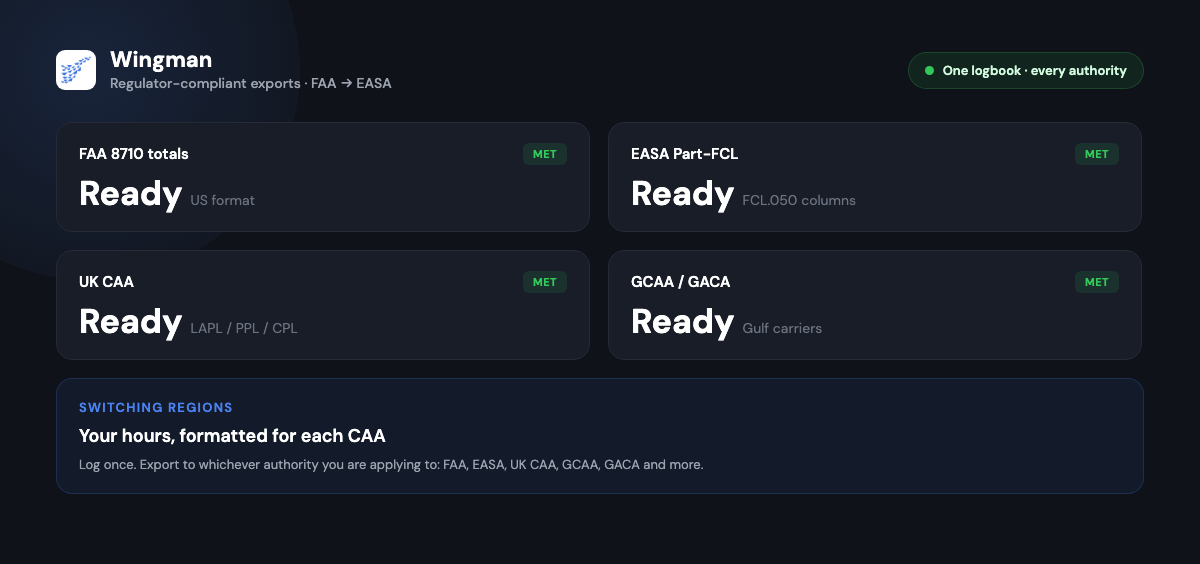
The single thing that makes this whole process smoother is a clean, exportable logbook. Verification, theory credit, and skill-test eligibility all rest on your recorded hours and experience, and you will be asked to present them in a format the European authority and examiner accept.
Wingman is a pilot logbook used by 30,000+ pilots across 400+ airlines, and it keeps your hours, ratings, currency, and medical dates in one place across iOS, Android, and Web. Because it produces regulator-compliant exports for both FAA and EASA, you can generate the report an EASA ATO or examiner expects without re-formatting your data by hand. There is a free tier up to 250 logged hours, so you can keep your records straight throughout the conversion without committing up front. For the European side specifically, there is a focused walkthrough on keeping an EASA digital logbook, and for your existing records there is a guide to the FAA pilot logbook. If you fly for an operator, Wingman can import your roster automatically and keep the hours flowing in while your paperwork is in progress; you can start in the Wingman web app.
Conversion at a glance

Frequently asked questions
How long does it take to convert an FAA licence to EASA?
It depends on the licence level and how quickly your medical, FAA verification, and theory move. A PPL conversion can be relatively quick once paperwork is in hand, while an ATPL conversion is longer because of the theory course and examinations. The administrative steps, not the flying, usually set the pace [VERIFY].
Do I need to redo all the theory exams?
Not all of them in every case. EASA does not fully waive theory for FAA holders, but the number of papers depends on the licence level and is determined by your ATO and authority. PPL conversions involve a reduced set, while ATPL conversions involve the full theoretical knowledge syllabus [VERIFY].
Is a validation the same as a conversion?
No. A validation lets you exercise your FAA privileges in EASA airspace temporarily and is typically limited to PPL-level flying, while a conversion gives you a full EASA Part-FCL licence in your own right with no expiry tied to the validation period [VERIFY].
Can I use my FAA medical for the EASA licence?
No. You need an EASA medical certificate issued by an EASA-authorised aero-medical examiner, at Class 2 for PPL-level conversion or Class 1 for CPL and ATPL conversions. Your FAA medical does not substitute for it [VERIFY].
Will my FAA hours count toward the EASA licence?
Yes. Your logged FAA experience is central to the conversion and reduces the requirements, which is why keeping an accurate, exportable logbook matters. You will need to present your hours in a format the European authority and examiner accept.
← All articles