CPL cost in USA: a 2026 breakdown of what a commercial pilot licence costs
If you are planning to train as a commercial pilot in the United States, the first practical question is usually the hardest one to answer cleanly: what does it actually cost. Headline figures online range from $50,000 to over $100,000, which is a wide enough spread to be almost useless when you are trying to plan. The reason for the spread is that a Commercial Pilot Licence (CPL) is not a single purchase. It is the sum of flight hours, ground study, examiner fees, medicals, and equipment, and each of those line items moves depending on the path you choose.
This guide breaks the CPL cost in the USA down into its real components for 2026, separates the two training paths that change the maths the most (Part 61 and Part 141), and shows where most of the money actually goes. The numbers below are realistic planning estimates, not quotes; flight schools price differently by region, aircraft type, and how quickly you finish, so treat them as a framework rather than a final bill.
The short answer: what a CPL costs in the USA in 2026
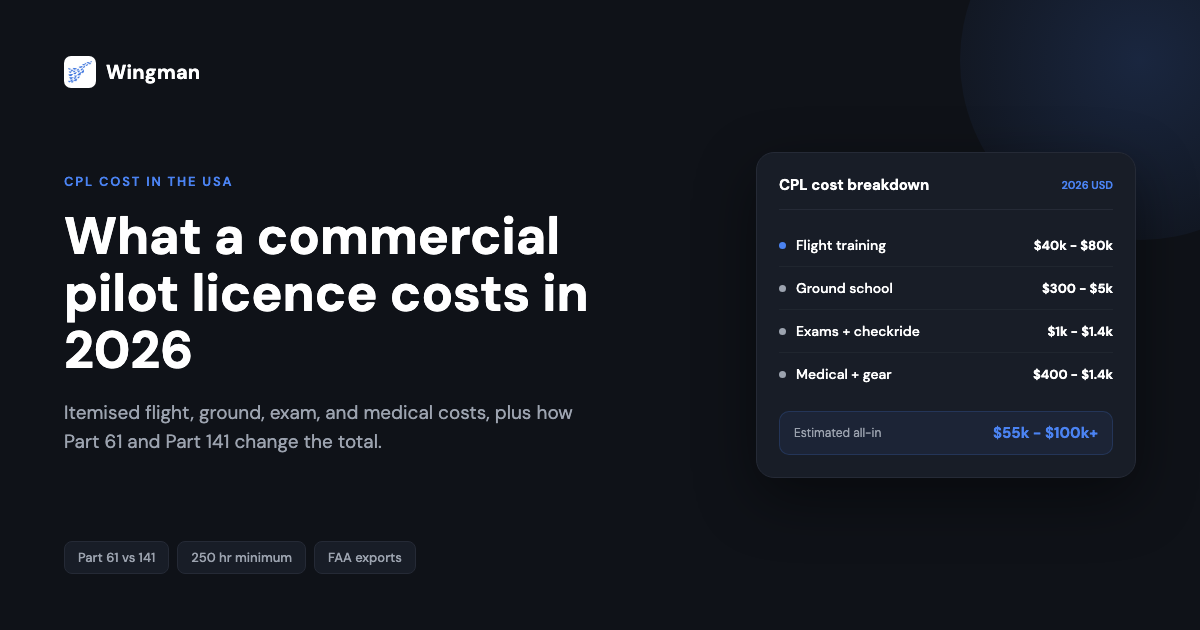
For a student starting from zero and training toward a CPL, a realistic all-in budget in 2026 is roughly $55,000 to $100,000 or more. [VERIFY] The single biggest driver of where you land in that range is flight time, because the United States requires a substantial number of logged hours before you can sit the commercial checkride, and aircraft rental plus instructor time is billed by the hour.
A useful way to think about it: the licences and ratings you stack on the way to a commercial certificate (Private Pilot, Instrument Rating, then Commercial) each carry their own training cost, and the CPL stage sits on top of that. Many students quote the CPL figure as the full journey from no licence to commercial, which is why the totals look large.
The cost driver most people miss: Part 61 vs Part 141
The Federal Aviation Administration (FAA) allows two regulatory tracks to a commercial certificate, and the choice between them changes both the hours and the structure of your spend.
- Part 61 training is more flexible and is common at smaller flight schools and with independent instructors. Under Part 61 you generally need 250 hours of total flight time to qualify for the commercial certificate. [VERIFY]
- Part 141 training uses an FAA-approved, structured syllabus, often at dedicated academies. Because the curriculum is approved, the FAA permits a lower minimum, commonly cited as 190 hours of total time. [VERIFY]
On paper Part 141 looks cheaper because it requires fewer hours. In practice the comparison is not that simple. Part 141 schools tend to have higher fixed course pricing and stricter scheduling, while Part 61 lets you train at your own pace and shop for aircraft rates, but can drift longer (and therefore more expensive) if your training is interrupted. The right choice depends on whether you value structure and a faster timeline or flexibility and cost control.
Itemised CPL cost breakdown
Here is where the money actually goes. These are 2026 planning estimates for the full journey toward a commercial certificate.
| Cost item | Typical 2026 range (USD) | Notes |
|---|---|---|
| Flight training (aircraft + instructor, all ratings) | $40,000 - $80,000 | The largest single cost; scales with total hours flown [VERIFY] |
| Ground school / theory instruction | $300 - $5,000 | Online self-study is cheapest; in-person academy ground school costs more [VERIFY] |
| FAA written (knowledge) test fees | ~$175 per test | Charged per exam by the testing centre [VERIFY] |
| Checkride / practical exam (DPE fee) | $800 - $1,200 per checkride | Designated Pilot Examiner fees vary by region and rating [VERIFY] |
| Aviation medical certificate | $100 - $200 | Second-class medical for commercial privileges, via an FAA Aviation Medical Examiner [VERIFY] |
| Headset and equipment | $300 - $1,200 | Headset, kneeboard, charts, flight bag [VERIFY] |
| Books, apps, and study materials | $200 - $800 | Manuals, test-prep, electronic flight bag subscriptions [VERIFY] |
The line item that swings hardest is flight training, and within that, the number of hours you fly. That is why understanding the hours requirement matters as much as understanding the price per hour.
Time building: the biggest variable in the bill
After your Private Pilot and Instrument Rating, you typically still need to accumulate hours to reach the commercial minimum. This stretch, often called time building, is where budgets either hold or blow out.
Because the commercial certificate requires reaching that total-time threshold (250 hours under Part 61, fewer under an approved Part 141 course), the gap between the hours you have after your ratings and the hours you need is flown largely to build time. If aircraft rental sits at, say, $150 to $220 per hour wet, [VERIFY] then every extra ten hours adds well over a thousand dollars. Two students with identical instruction rates can end up thousands apart simply because one flew more efficiently, passed checkrides on the first attempt, and built hours in a cheaper aircraft.
This is the practical reason that careful record-keeping pays off. Knowing exactly how many hours you have logged, in which categories, and how close you are to each requirement, lets you plan the cheapest route to the minimums instead of over-flying expensive aircraft to be safe.

How to keep the CPL cost under control
You cannot change the FAA hour minimums, but you can change how much each hour costs and how many hours you waste. A few levers make the biggest difference:
- Train consistently. Long gaps mean re-learning, and re-learning is flown on the meter. Frequent, regular lessons usually finish in fewer total hours.
- Compare aircraft rates for time building. The aircraft that is right for instruction is not always the cheapest aircraft for simply accumulating hours.
- Prepare hard for written tests and checkrides. A failed checkride means a re-test fee plus more flight time to re-prepare. First-time passes protect the budget.
- Track your hours and spending as you go. When you can see your running totals against each requirement, you stop guessing and stop over-flying.
Why tracking your hours (and costs) matters for US flight students
A commercial certificate is built one logged hour at a time, and in the United States those hours have to be recorded accurately for the FAA, broken down by category and class, cross-country, night, instrument, and pilot-in-command time. A clear, current logbook is not just a regulatory requirement at the checkride; it is also your best tool for managing cost, because it tells you exactly how close you are to each minimum and stops you from flying expensive hours you do not need.
Wingman is a digital pilot logbook used by 30,000+ pilots across 400+ airlines, and it keeps your hours, currency, and certificate details in one place across iOS, Android, and Web. It produces regulator-compliant exports for the FAA, so the totals you show an examiner match the records you keep. There is a free tier up to 250 logged hours, which lines up neatly with the total time many students are working toward for the commercial certificate, so you can log your entire training journey before deciding whether you need the Pro features. You can start logging at app.wingmanlog.com.
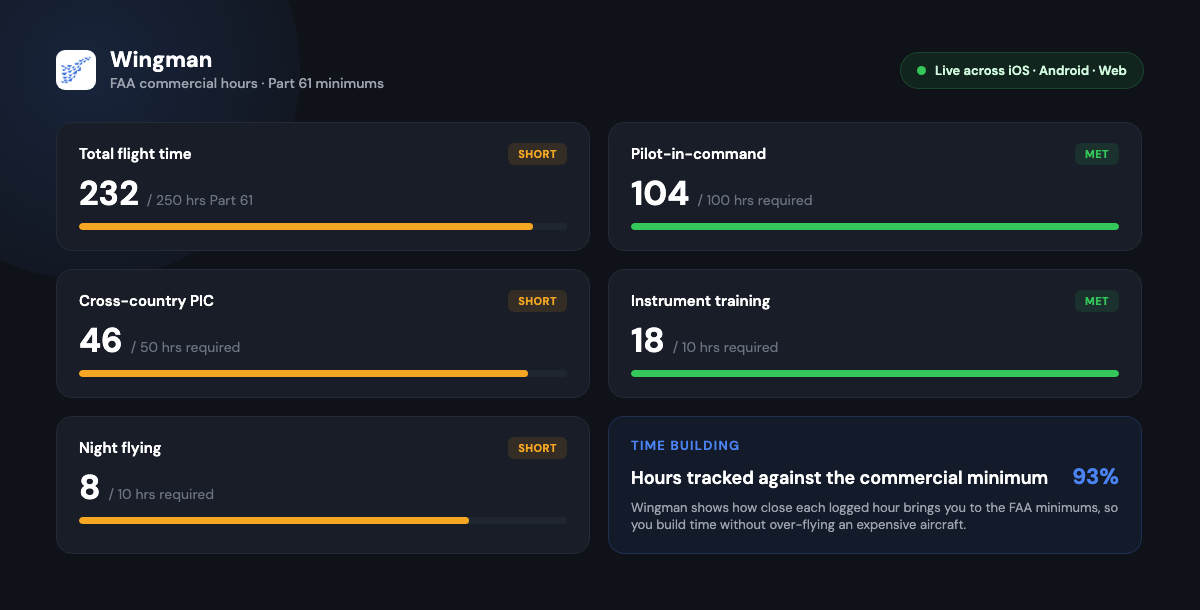
For students who want to watch their budget as closely as their hours, a logbook that shows running totals against each requirement turns an intimidating six-figure question into a series of trackable, plannable steps.
Frequently asked questions
How much does a CPL cost in the USA in 2026?
A realistic all-in budget for training from zero to a commercial certificate is roughly $55,000 to $100,000 or more, depending on your training path, location, aircraft rates, and how efficiently you finish. [VERIFY] Flight time is the largest single cost, so the total scales with how many hours you fly.
Is Part 61 or Part 141 cheaper for a CPL?
It depends. Part 141 requires fewer total hours (commonly cited as 190 versus 250 for Part 61), [VERIFY] which can lower flight cost, but Part 141 academies often have higher fixed course pricing and stricter scheduling. Part 61 is more flexible and lets you control aircraft costs, but can run longer and cost more if training is interrupted.
How many flight hours do you need for an FAA commercial certificate?
Under Part 61 you generally need 250 hours of total flight time, and under an FAA-approved Part 141 course the minimum is commonly cited as 190 hours. [VERIFY] These are minimums; many students log somewhat more before they are ready for the checkride.
What are the FAA exam and checkride fees?
The FAA knowledge (written) test is charged per exam at the testing centre, around $175 each, [VERIFY] and the practical checkride is conducted by a Designated Pilot Examiner whose fee commonly runs $800 to $1,200 depending on region and rating. [VERIFY] A failed checkride adds a re-test fee plus additional preparation flying.
Does a digital logbook help with a US commercial certificate?
Yes. The FAA requires accurate flight records broken down by category, class, and time type, and an examiner will review them at your checkride. A digital logbook like Wingman keeps those totals current, produces FAA-compliant exports, and shows how close you are to each hour requirement, which helps you plan the most cost-effective route to the minimums.
← All articles