CPL requirements in India: the DGCA checklist for a commercial pilot licence
A Commercial Pilot Licence (CPL) is the licence that lets you fly for a living in India. It is issued by the Directorate General of Civil Aviation (DGCA), and earning it means meeting a defined set of requirements across academics, flight hours, medical fitness, and written examinations. None of it is a mystery, but the requirements are specific, and knowing them up front helps you plan your training rather than discovering each condition one stage at a time.
This guide lays out the CPL requirements in India in the order most candidates meet them. It covers the academic baseline, the DGCA flight-hour breakdown, the medical assessments, the theory papers and the radio licence, and the personal characteristics that carry pilots through a demanding programme. By the end you should have a clear checklist of what stands between you and your licence.
What a CPL is and who it is for
A CPL is the qualification a pilot needs to be paid to fly. With it you can hold the controls of an aircraft for hire or reward, which is the threshold airlines and charter operators require before you can begin earning. It sits above the Private Pilot Licence (PPL), which permits flying for personal purposes only, and below the Airline Transport Pilot Licence (ATPL), which is needed to act as captain on scheduled airline operations.
Most aspiring airline pilots in India work toward the CPL first, then build experience and add ratings on the way to an ATPL. If you want the wider view of which written papers apply to each licence, our guide on exams to be cleared in order to get CPL, PPL, ATPL maps them out so you can see where the CPL fits in the progression.
Academic qualifications you need first
Before any flying counts toward a licence, you need the right academic base. To be eligible for a CPL in India you must have completed 10+2 (or an equivalent examination) with physics and mathematics. [VERIFY] Candidates who finished schooling without those subjects can usually add them through recognised open-schooling routes before applying, so a gap here does not close the door, it just adds a step.
You also need to be at least the minimum age set by DGCA for licence issue, hold the required medical category, and be able to read, speak, and understand English to the standard civil aviation requires. [VERIFY] The academic and age conditions are worth confirming early, because they determine when you can formally enrol and when your first solo and licence issue can happen.
DGCA flight-hour requirements for a CPL
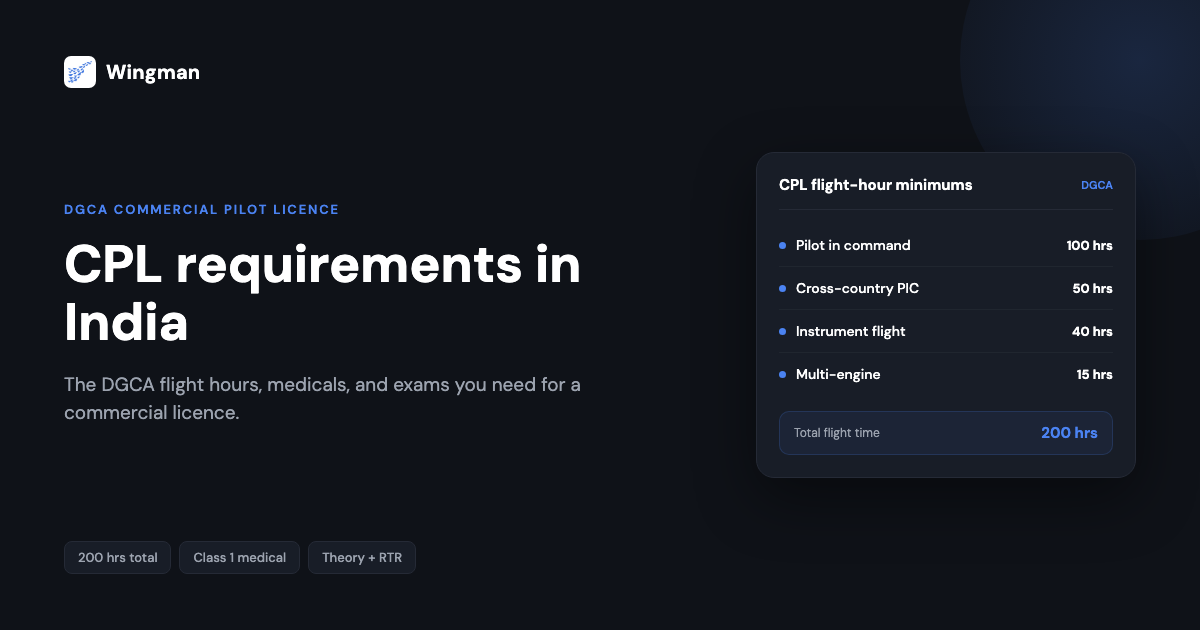
Flight time is the core of the CPL. DGCA sets a minimum total of flying experience and then specifies how that time must be split across pilot-in-command (PIC), instrument, cross-country, multi-engine, and night flying. The minimum total flight time for a CPL in India is 200 hours, made up of the components below. [VERIFY]
- 100 hours of flight time as pilot in command (PIC). [VERIFY]
- 50 hours of cross-country flying as PIC, which must include one cross-country flight of at least 300 nautical miles with full-stop landings at two aerodromes different from the departure point. [VERIFY]
- A 250 nautical mile cross-country check and a 120 nautical mile check as part of the cross-country requirement. [VERIFY]
- 40 hours of instrument flight time, of which up to 20 hours may be completed on an approved flight simulator. [VERIFY]
- 15 hours of dual or PIC time on multi-engine aircraft where a multi-engine endorsement is sought. [VERIFY]
- 10 take-offs and 10 landings carried out by night. [VERIFY]
These hours are accumulated by enrolling at a DGCA-approved flying training organisation and working through a structured commercial pilot training course. Because the requirements stack across several categories at once, candidates usually plan their sorties so that a single cross-country flight, for example, contributes to PIC, cross-country, and night totals where the conditions allow. Keeping an accurate running tally of each category as you fly is what stops you arriving at the licence stage short on one specific requirement.
Medical fitness: Class 2 and Class 1
Medical fitness is non-negotiable for a CPL, and it comes in two stages. Candidates typically clear a Class 2 medical assessment early, often before or at the start of training, as the initial gate. The CPL itself requires a Class 1 medical, which is the more thorough examination covering cardiovascular, vision, hearing, neurological, and general health standards. [VERIFY]
The Class 1 is the one that matters most for a commercial career, because it has to be held and renewed for as long as you exercise the privileges of the licence. Our overview of the Class 1 medical for pilots explains what the assessment looks at and why it is worth getting an early read on your fitness before you commit time and money to training.
The DGCA theory exams and RTR
Alongside the flying, a CPL candidate has to pass the DGCA written examinations and obtain a radio licence. The CPL theory papers are the academic core of the licence, and the Radio Telephony Restricted, known as the RTR (A), is the separate examination that licenses you to operate aircraft radio equipment. [VERIFY]
The main CPL subjects each have their own focused preparation. We have dedicated guides for the three most-asked-about papers:
- How to prepare for the DGCA CPL Regulations exam for Air Regulation.
- How to prepare for the DGCA CPL Meteorology exam for Aviation Meteorology.
- How to prepare for the DGCA CPL Technical exam for Technical General and Technical Specific.
The written papers are sat through the DGCA examination system, and once you have taken a paper you can check the outcome online. Our walkthrough on how to check your exam results on the Pariksha DGCA website covers that step, and if you are still setting up your records, the guide on how to apply for a DGCA computer number explains the reference identity that ties your exam record together.
The five Cs: characteristics that carry you through
Meeting the formal requirements is one thing. Finishing the programme is another, and the candidates who get through tend to share a set of personal qualities. They are worth naming, because they are as real a part of the requirement set as any logbook total.
Commitment. CPL training is long, costly, and demanding. A steady, self-driven commitment is what keeps a candidate moving through weather delays, re-sits, and the slow build of hours.
Confidence. Flying asks you to make decisions and stand by them, often with incomplete information and limited time. Measured confidence, grounded in training rather than bravado, is what good decision-making rests on.
Communication. Clear communication with air traffic control, fellow crew, and ground teams is a safety function, not a soft skill. Much of the RTR and crew-resource side of training exists to build exactly this.
Calmness. The ability to stay composed when something does not go to plan is what lets a pilot keep flying the aircraft first and solving the problem second. Composure under pressure is trained, but temperament helps.
Conditioning. Fitness for duty spans physical, mental, and cognitive readiness. The Class 1 medical checks the physical side, but staying rested, healthy, and sharp across a career is an ongoing personal requirement.
Logging your hours as you build toward the CPL
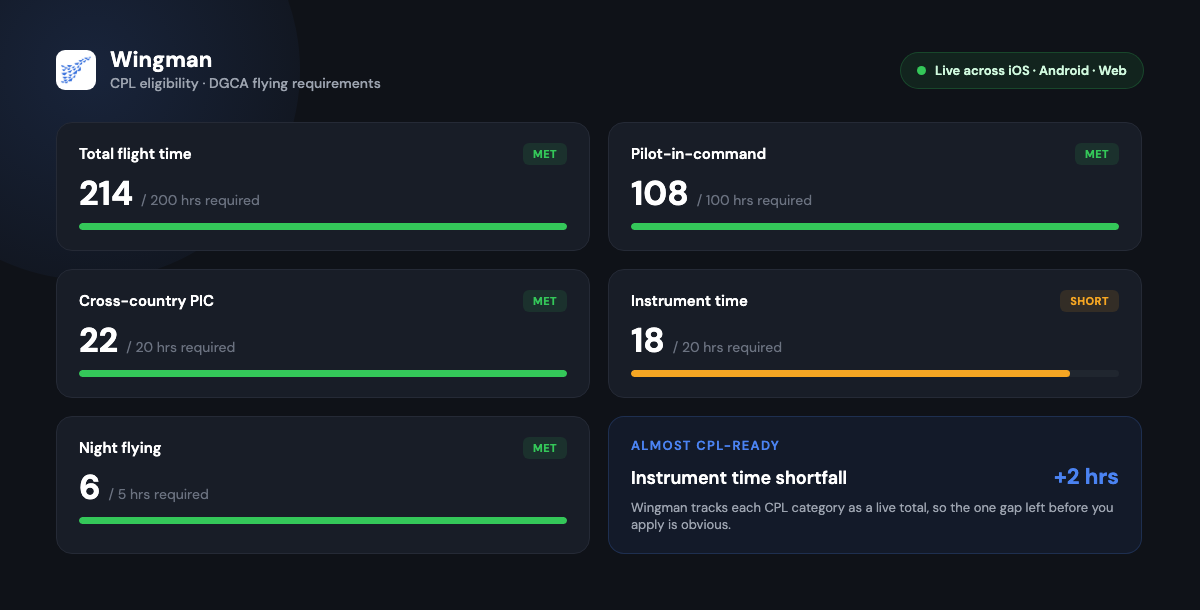
Every hour you fly toward the CPL has to be recorded accurately, because the licence is granted against documented experience in each category above. A digital logbook makes that far easier than a paper book, because it totals PIC, cross-country, instrument, night, and multi-engine time for you and flags where you still have ground to cover.
Wingman is a pilot logbook used by 30,000+ pilots across 400+ airlines, and it keeps your hours, currency, and licence details in one place across iOS, Android, and Web. There is a free tier up to 250 logged hours, which comfortably covers the trainee phase, so you can start logging from your first sorties without committing anything up front. The Pro plan is ₹4,499 per year in India when you are ready for more.
Wingman is a global product rather than an India-only tool, and it produces regulator-compliant exports for DGCA alongside the FAA, EASA, UK CAA, GCAA, GACA, NZCAA, HKCAD, CASA, and CAAS. For the India-specific setup, there is a focused walkthrough on keeping a DGCA pilot logbook in India, and you can start straight away at app.wingmanlog.com.
Putting the requirements in order
The requirements above are not strictly sequential, but they do tend to fall into a natural order. Seeing them as a path makes the programme easier to plan.

Treat the chart as a guide rather than a fixed timetable. In practice the medical, exams, and flying overlap, and an approved training organisation will sequence them to suit your enrolment and the weather.
Frequently asked questions
How many flying hours do you need for a CPL in India?
The minimum total flight time for a CPL in India is 200 hours, including 100 hours as pilot in command, 50 hours of cross-country PIC time with a flight of at least 300 nautical miles, 40 hours of instrument time (up to 20 of which may be on an approved simulator), and night flying with take-offs and landings. [VERIFY] Confirm the current split against the prevailing DGCA Civil Aviation Requirements before you plan your training.
What academic qualifications do I need for a CPL?
You must have completed 10+2 or an equivalent examination with physics and mathematics. [VERIFY] Candidates who studied other subjects can usually add physics and maths through a recognised open-schooling route before applying, so it is a step to plan for rather than a barrier.
Which medical do I need for a commercial pilot licence?
A CPL requires a DGCA Class 1 medical, the more detailed of the two assessments. Many candidates clear a Class 2 medical first as an early eligibility check. [VERIFY] The Class 1 has to be held and renewed for as long as you exercise the licence, so an early assessment is worth doing before you commit to training.
What exams do I have to pass for a CPL in India?
You need to clear the DGCA CPL theory papers, which include Air Regulation, Aviation Meteorology, and the Technical subjects, along with the Radio Telephony Restricted (RTR) examination. [VERIFY] There are dedicated preparation guides for the Regulations, Meteorology, and Technical papers, and you can check your results through the Pariksha DGCA portal.
How long does it take to get a CPL?
There is no single fixed duration, because it depends on how quickly you accumulate the required flight hours, clear the medicals, and pass the written papers. Weather, examination scheduling, and aircraft availability all affect the timeline, so candidates plan around hour targets rather than a fixed number of months. Logging your hours accurately as you go is the simplest way to see how close you are to the CPL minimums.
← All articles