DGCA approved flying schools in India: the directory and how to use it
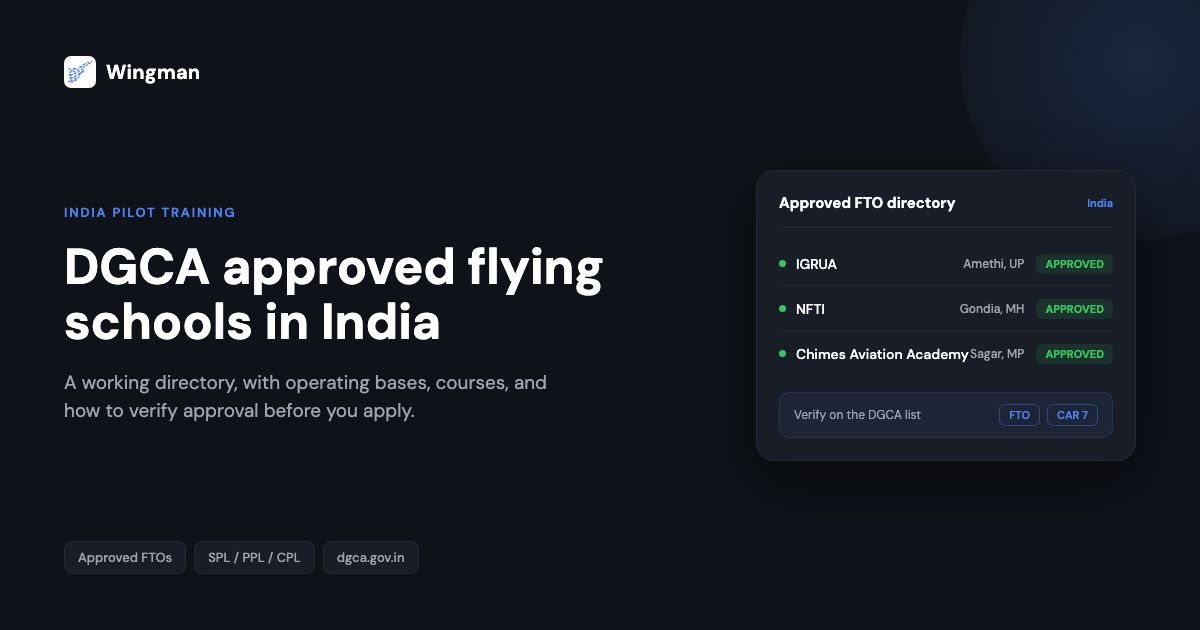
If you want to train as a pilot in India, the first practical decision is which flying school to join, and the one rule that sits above every other is approval. A DGCA approved flying school is a Flying Training Organisation (FTO) that the Directorate General of Civil Aviation has authorised to deliver flight training that counts toward an Indian licence. Hours flown at a school without that approval do not carry the same weight when you apply for a Student Pilot Licence, Private Pilot Licence, or Commercial Pilot Licence, so confirming approval before you pay anything is not optional.
This page is a working directory of DGCA approved flying schools in India, plus the part most lists skip: how to confirm a school is currently on the DGCA roster, what courses these schools run, and how to compare them before you commit two years and a large amount of money. Treat the table below as a starting shortlist, then verify each entry against the live DGCA list before you apply, because approvals and operating bases change.
What DGCA approved actually means
In India, civil flying training is delivered by Flying Training Organisations approved by the DGCA under the relevant Civil Aviation Requirements (the FTO approval framework sits in CAR Section 7). [VERIFY] An approved FTO has been assessed on its fleet, instructors, maintenance, infrastructure, and training syllabus, and is permitted to conduct ab-initio training toward DGCA licences. The approval is what links your logged training hours to your licence application, so it matters more than any marketing claim a school makes about placements or airline tie-ups.
Approval is not permanent or guaranteed. A school can have its approval suspended, can pause intake, or can change its operating base from one airfield to another. That is why a directory like this one is a shortlist rather than a final answer: the names are a reliable place to start, but the current status of any single school should always be checked directly.
How to confirm a school is currently DGCA approved
Before you shortlist or pay a deposit, confirm the school against the source rather than a third-party list:
- Open the DGCA website at https://www.dgca.gov.in and find the section listing approved Flying Training Organisations. [VERIFY]
- Check that the specific school name and its operating base appear on the current list, and note any conditions attached to the approval. [VERIFY]
- Confirm the school is actively running intakes, since an approval on paper does not always mean a school is taking new students at the base you want.
- Ask the school directly for its approval reference and the courses it is currently cleared to deliver, then cross-check that against what you saw on the DGCA list.
Doing this once, properly, protects the much larger investment of time and fees that follows.
DGCA approved flying schools in India
The schools below are widely recognised Indian FTOs. Operating bases are listed to help you plan around location, weather, and cost, but the full roster and each school’s current status should be verified against the DGCA list as described above. [VERIFY: the names, bases, and active status of every school in this table should be checked against the current DGCA approved FTO roster, as approvals and bases change.]
| Flying school | Operating base / state [VERIFY] | Website |
|---|---|---|
| Indira Gandhi Rashtriya Uran Akademi (IGRUA) | Amethi, Uttar Pradesh | igrua.gov.in |
| National Flying Training Institute (NFTI) | Gondia, Maharashtra | nfti.in |
| Chimes Aviation Academy | Sagar, Madhya Pradesh | caaindia.com |
| Orient Flight Aviation Academy | Pondicherry / Mysore | orientflights.com |
| The Bombay Flying Club | Dhule, Maharashtra | thebombayflyingclub.com |
| Government Flying Training School | Bengaluru, Karnataka | gfts.in |
| The Madhya Pradesh Flying Club | Indore / Bhopal, Madhya Pradesh | mpfc.in |
| The Gujarat Flying Club | Vadodara, Gujarat | gujaratflyingclub.com |
| Redbird Flight Training Academy | Baramati, Maharashtra | redbirdaviation.com |
| FSTC Flying School | Jamshedpur / Kalaburagi | fstc.in |
| Asia Pacific Flight Training Academy | Hyderabad, Telangana | apft.edu.in |
| Falcon Aviation Academy | Hyderabad / Kalaburagi | falconaviation.in |
| Flytech Aviation Academy | Hyderabad, Telangana | flytechaviation.aero |
| Telangana State Aviation Academy | Hyderabad, Telangana | not listed |
| Rajiv Gandhi Academy for Aviation Technology | Thiruvananthapuram, Kerala | rgaviation.com |
| Wings Aviation | Hyderabad, Telangana | wingsaviation.co.in |
| Blue Ray Aviation | Mehsana, Gujarat | bluerayaviation.com |
| Ahmedabad Aviation and Aeronautics | Ahmedabad / Surat, Gujarat | aaa.co.in |
| Chetak Aviation | Indore, Madhya Pradesh | chetakaviation.com |
| Sha-Shib Flying Academy | Bhopal / Guna, Madhya Pradesh | shashibgroup.org |
This is not the complete national list. The DGCA roster runs longer and is updated over time, so if a school you are considering is not here, that does not mean it lacks approval. Check the live list and ask the school for its approval reference.
What courses DGCA approved schools offer
Most FTOs structure training around the licence ladder rather than one single course:
- Student Pilot Licence (SPL): the entry point, taken early in training. See validity of the DGCA Student Pilot Licence in India.
- Private Pilot Licence (PPL): builds the first block of pilot-in-command and dual hours.
- Commercial Pilot Licence (CPL): the licence most students are working toward, with a defined flying requirement on top of ground exams.
The flying side and the exam side run in parallel. For the hours you need to accumulate, see CPL flying requirements in India, and for the written papers, see exams to be cleared in order to get CPL, PPL, ATPL. Knowing both before you join lets you ask a school sharper questions about how quickly you can realistically finish.
How to compare DGCA approved schools
Approval gets a school onto your shortlist; these factors decide between the ones that remain:
- Fleet size and serviceability: more airworthy aircraft generally means less waiting for slots and faster hour-building.
- Base weather and flyable days: a base with long stretches of poor weather stretches out your timeline. This is one reason students compare bases across states.
- Instructor-to-student ratio: a crowded school can leave you queuing for both aircraft and instructors.
- Total cost and what it includes: published fees often exclude exam fees, accommodation, type-specific costs, and extra hours. Compare against the realistic range in CPL cost in India.
- Track record: ask how many students completed their CPL in the last cycle and how long it took.
For a worked example of how to read a single school’s fees, fleet, and base together, see our breakdown of the Madhya Pradesh Flying Club. If you are still weighing India against training overseas, the pros and cons of flying schools in India and abroad lays out the trade-offs on cost, timeline, and licence conversion.
Cadet programmes and scholarships as alternatives
An FTO is not the only route into the cockpit. Some airlines run structured cadet programmes that take you from selection to a type rating, and there are funding options that reduce the upfront cost of training:
- Cadet pilot programmes: see the overview of cadet pilot programmes, and specific schemes such as the Air India cadet pilot programme and the IndiGo cadet pilot programme.
- Scholarships: see pilot scholarships in India for schemes that help offset training fees.
These are adjacent paths rather than replacements for an FTO, and many cadets still complete part of their flying at an approved school.
Logging the hours you build at flying school
From your first training sortie, every hour needs to be recorded accurately, because your logbook is what you present for licence issue and, later, for jobs. A digital logbook keeps that record consistent from your SPL through your CPL. Wingman is a pilot logbook used by 30,000+ pilots across 400+ airlines, and it keeps your hours, currency, and licence details in one place across iOS, Android, and Web.
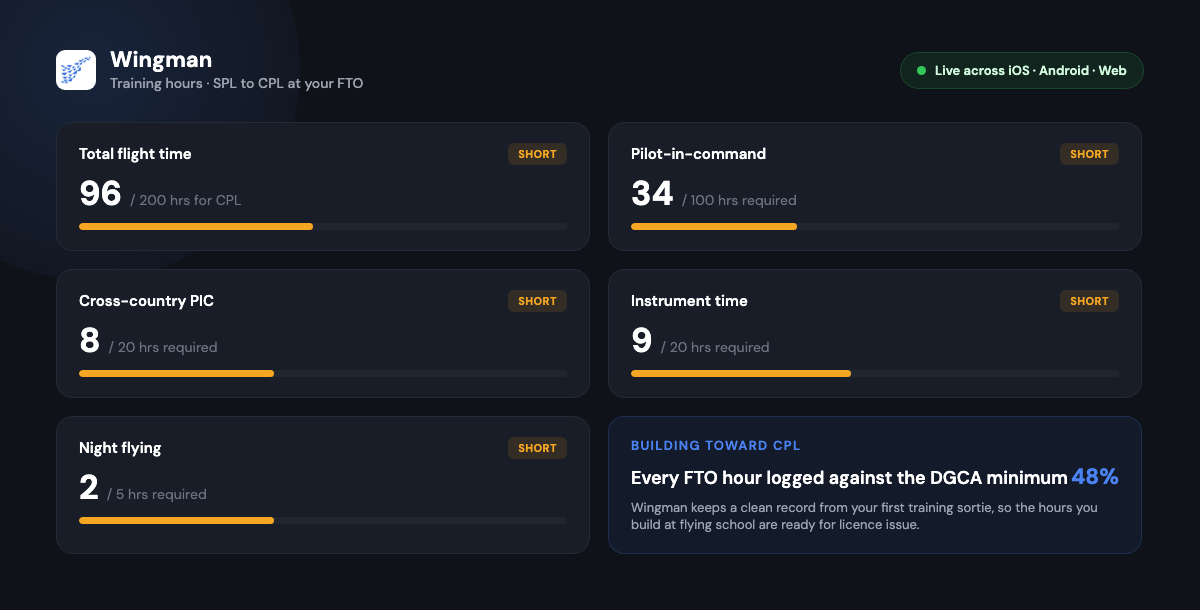
Wingman is a global product rather than an India-only tool, and it supports DGCA among regulators including the FAA, EASA, UK CAA, GCAA, GACA, NZCAA, HKCAD, CASA, and CAAS, so the logbook you start at flying school still works if you later fly abroad or convert your licence. There is a free tier up to 250 hours, which covers a good part of ab-initio training before you commit anything. For the India-specific workflow, see the walkthrough on keeping a DGCA pilot logbook in India, and you can start at app.wingmanlog.com.
Frequently asked questions
What does DGCA approved mean for a flying school?
It means the school is a Flying Training Organisation that the Directorate General of Civil Aviation has authorised to deliver flight training toward Indian licences. The approval covers the school’s fleet, instructors, maintenance, and syllabus, and it is what links your logged training hours to your SPL, PPL, or CPL application. [VERIFY]
How do I check if a flying school is currently DGCA approved?
Check the current list of approved Flying Training Organisations on the DGCA website at https://www.dgca.gov.in, confirm the school name and its operating base appear, and ask the school directly for its approval reference and the courses it is cleared to deliver. Approvals and bases change, so verify rather than relying on an older list. [VERIFY]
Which licences can I earn at a DGCA approved flying school?
Most approved schools run the full licence ladder: the Student Pilot Licence as the entry point, the Private Pilot Licence, and the Commercial Pilot Licence that most students work toward. The flying hours and the written exams run in parallel, so plan both from the start.
Is the list of schools on this page the complete DGCA roster?
No. The DGCA roster is longer than the directory here and is updated over time. If a school you are considering is not listed, that does not mean it lacks approval. Confirm it against the live DGCA list and ask the school for its current status.
Are cadet programmes an alternative to flying school?
They are an adjacent route rather than a direct replacement. Airline cadet programmes offer a structured path toward a type rating, and many cadets still complete part of their flying at an approved school. Scholarships can also reduce the upfront cost of training at an FTO.
← All articles