DGCA ATPL eligibility: hour requirements and the 2026 eGCA auto-update
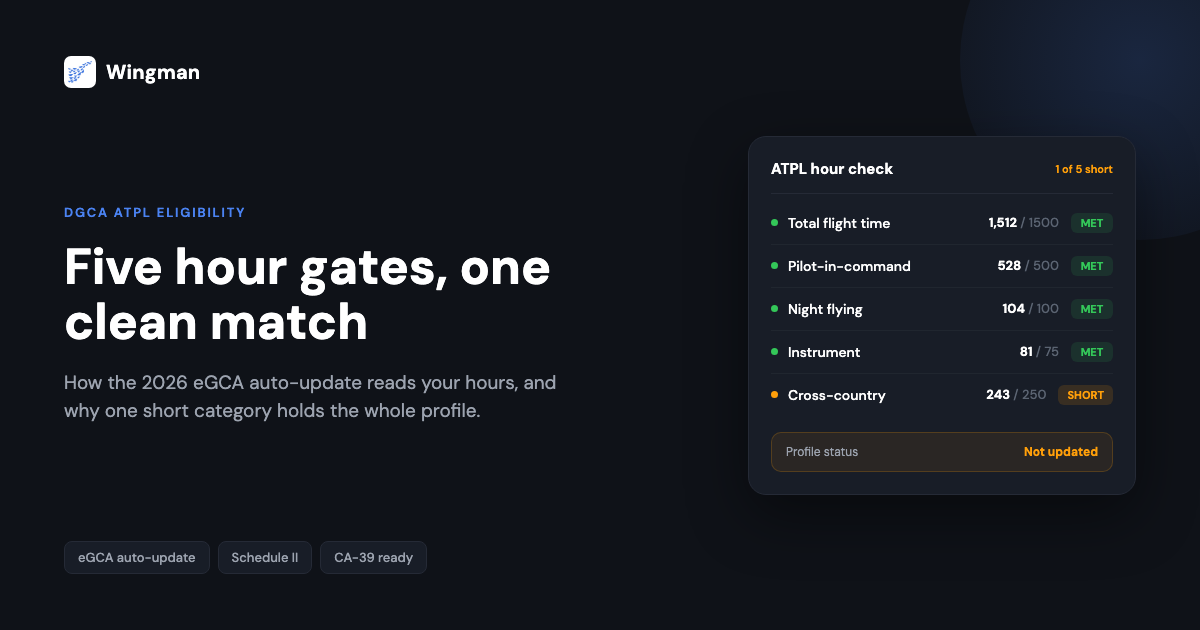
If you are a First Officer at IndiGo, Air India, Akasa Air, or SpiceJet approaching the 1500-hour mark, DGCA ATPL eligibility stops being a distant milestone and becomes a records problem. The hours are one part of it. Getting eGCA to recognise those hours, in the right categories, is the part that decides whether your profile updates on its own or stalls.
This post sets out what DGCA ATPL eligibility actually requires across each hour category, how the eGCA system reads your data, the specific places pilots fail an automated check, and how to prepare your records so your eligibility is recognised without a manual back-and-forth.
A note on figures before you read further: treat every threshold and timeline in this post as a working reference, not the governing source. Verify your own figures against the current Schedule II of the Aircraft Rules, 1937, and against DGCA’s current published rules, before you submit any application.
DGCA ATPL eligibility at a glance
Eligibility for an Airline Transport Pilot Licence in India is not a single hour count. It is a set of category minimums, and every one of them has to be satisfied independently. Reaching 1500 total hours while falling short on pilot-in-command time means you are not yet eligible, regardless of how large the total looks.
The table below sets out the hour categories an ATPL application is assessed against, per Schedule II, Section M of the Aircraft Rules, 1937. The full breakdown, including how co-pilot and PICUS time is credited, is in our DGCA ATPL requirements reference.
| Hour category | Minimum required | What it counts |
|---|---|---|
| Total flight time | 1,500 hours | As pilot of an aeroplane, with 150 hours in the preceding 12 months |
| PIC or PICUS | 500 hours | Command time, or co-pilot duties performed under supervision (PICUS); must include 200 hours cross-country of which 50 at night |
| Cross-country (total) | 1,000 hours | All cross-country flight time |
| Night flying | 100 hours | Flight time conducted at night |
| Instrument time | 100 hours | Actual or simulated, of which at least 50 hours in actual flight |
| Recency | 10 hours in the preceding 6 months | Plus the 150-hours-in-12-months clause above |
Read the table as five separate gates rather than one. A First Officer on short domestic sectors can reach 1500 total hours while still building toward the 100-hour night requirement. A pilot who has flown predominantly as SIC can sit well above 1500 total hours and remain short on the 500-hour PIC figure. A shortfall in any single category holds the entire eligibility decision.
This is also why the category your hours are recorded under matters as much as the hours themselves. An hour flown at night only counts toward the night requirement if it is logged as night. The same hour mislabelled is an hour the system cannot credit where you need it.
Beyond the flying-hour gates, ATPL eligibility also has a written-examination component and other licensing prerequisites set out in the Aircraft Rules and the relevant Civil Aviation Requirements. Those are outside the scope of this post, which focuses on the flying-hour records that the eGCA comparison reads.
What the 2026 auto-update actually changed
The concrete change, per the Pariksha public notice: from 2 February 2026, the DGCA’s examination portal auto-updates a pilot’s exam category from CPL to ATPL by fetching the licence record directly (DigiLocker and Aadhaar-matched), removing the manual profile step that used to sit between holding a CPL and registering for ATPL papers.
The broader shift it belongs to is bigger than one form: DGCA’s licensing stack now reads your records digitally at every stage. eGCA computes your category totals from the flight records you upload, compares your CA-39 submission against its own computed record, and since January 2026 issues the ATPL itself as an Electronic Personnel Licence in the eGCA app. At each of those steps the system is a comparison engine, not a judgement engine. It does not interpret, reconcile, or give you the benefit of the doubt. If a category total is short by two hours because of how a sector was logged, the system reads a shortfall. The automation rewards records that are already correct. It does nothing for records that are almost correct.
That distinction is the entire reason this post exists. The work is not in reaching 1500 hours. The work is in making sure every hour is sitting in the category eGCA expects to find it in.
How eGCA matches your logbook to the requirements
The auto-update step does not read your personal logbook. It reads the flying-hour data already recorded in your eGCA profile, and that data is only as accurate as what has been entered and accepted there.
The matching process is a direct comparison. The system takes each category total from your eGCA record and checks it against the corresponding minimum. Every category must clear its threshold for the profile to update.

The takeaway is that there is no partial result. The profile either updates or it does not. If it does not, the system does not tell you which category fell short in a way that resolves the problem for you. You are left to identify the gap yourself by comparing your own records against each minimum.
This is why preparation has to happen in your logbook long before you expect the profile to update. The system reflects your data. It does not correct it.
Common failure modes
Most pilots who reach genuine ATPL eligibility and still see no profile update are not short on flying. They are short on a category total because of how hours were recorded. These are the patterns that come up most often.
Block time logged as flight time. Block time runs from the moment the aircraft first moves under its own power to the moment it comes to rest at the gate. Flight time, for logging purposes, is a narrower measure. A logbook that records block time in a flight-time field inflates every total. The figures look healthy, but they do not represent what the regulation asks for. When the discrepancy is eventually corrected, category totals drop, and a profile that looked eligible no longer is.
Missing or incomplete category fields. A flight entered with a total time but no night, instrument, or cross-country breakdown contributes only to the total. The system has nothing to credit toward the other four minimums for that sector. A pilot with hundreds of sectors logged this way can be far above 1500 total hours and still read as short on night or cross-country, simply because those fields were never filled.
Expired exam validity. The flying-hour check is one part of ATPL eligibility. The written examination is another. Under the DGCA’s exam-eligibility CAR, written passes are valid for 5 years for the purpose of ATPL issue, and if that window lapses before your application is complete, the hours alone do not carry you. Check your exam dates against your expected eligibility timeline early, not at application time.
Logbook and eGCA out of step. Your eGCA profile and your personal logbook are two separate records. The auto-update step reads only eGCA. A logbook that is current and correct does nothing for you if the corresponding data was never entered into or accepted by eGCA. Periodic reconciliation between the two is the only way to catch this before it costs you time.
How to prepare your records for ATPL eligibility
Preparation is a reconciliation exercise. The goal is for every category total in your records to be accurate, complete, and consistent with what eGCA holds, well before you expect the automated check to recognise you.
-
Confirm your flight time basis. Establish that every entry records flight time, not block time, in the flight-time field. If you have historically logged block time, work out the scale of the discrepancy before it surfaces during an application.
-
Fill every category field. For each sector, make sure night, instrument, and cross-country time are recorded where they apply, not left blank. A sector with only a total time entered contributes to one minimum and ignores four.
-
Reconcile your logbook against eGCA. Compare your personal records against the flying-hour data in your eGCA profile. They should agree across every category. Where they do not, identify why before you need the numbers to be right.
-
Check your written exam validity. Confirm your ATPL written exam results are still within their validity window for a licence upgrade, with enough margin to complete the application.
-
Verify your totals against Schedule II. Before treating yourself as eligible, check each category total against the current Schedule II of the Aircraft Rules, 1937. The thresholds in this post are a working reference; the official source governs.
A logbook that produces accurate, complete, category-correct totals is a logbook the auto-update step can recognise without manual intervention. That is the entire objective.
How Wingman keeps your CA-39 totals ATPL-ready
The CA-39 is the flying experience summary that an ATPL application draws on. Compiling it by hand means totalling every category across years of flying and trusting that nothing was miscounted along the way.
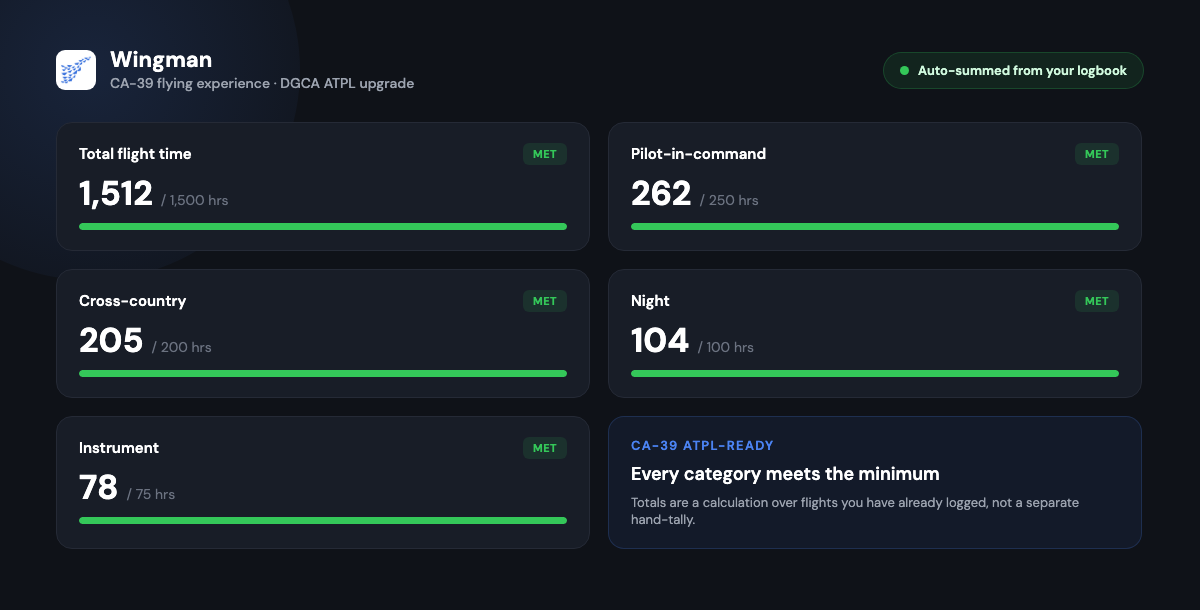
Wingman generates the CA-39 directly from your logbook data. Because every flight in Wingman carries its category breakdown, the CA-39 totals are a calculation over records you have already kept, not a separate manual tally. Total time, PIC, night, instrument, and cross-country are summed from the underlying entries, which removes the arithmetic errors that creep into hand-totalled summaries.
For Indian First Officers, Wingman imports roster data so that night, instrument, and cross-country fields are populated as flights are logged, rather than left blank to be reconstructed later. The result is a record where the category totals are consistent from the day each flight is entered, which is the same consistency the eGCA comparison depends on. Wingman is used by 30,000+ pilots across 400+ airlines, and it supports DGCA alongside the FAA, EASA, UK CAA, GCAA, and other regulators, so the same logbook continues to serve you if your licensing context changes later in your career. There is a free tier up to 250 logged hours, so you can start before you commit anything.
For the wider DGCA logging context, see Wingman’s DGCA pilot logbook requirements guide and the DGCA pilot logbook app overview.
FAQ
What are the minimum flying hours required for DGCA ATPL eligibility?
Under Schedule II, Section M of the Aircraft Rules, 1937, a DGCA ATPL requires 1,500 hours total flight time, including 500 hours as PIC or PICUS, 1,000 hours of cross-country, 100 hours of night flying, and 100 hours of instrument time of which at least 50 in actual flight, plus recency of 150 hours in the preceding 12 months and 10 in the preceding 6. Every category minimum must be met independently; clearing the 1,500-hour total alone does not make you eligible.
What is the DGCA eGCA auto-update and how does it affect ATPL eligibility?
Reporting indicates DGCA introduced an auto-profile-update step around February 2026 that compares the flying-hour data in your eGCA profile against the ATPL category minimums. When every category clears its threshold, the system recognises your hour eligibility without a manual review request. When any category falls short, your profile stays unchanged. The system reflects your eGCA data exactly as recorded, so accurate, complete records are what allow it to work in your favour. Confirm the current scope of this feature against DGCA’s published notices.
Why does my eGCA profile not reflect my correct hours even though my logbook is up to date?
The auto-update step reads your eGCA flying-hour data, not your personal logbook. The two are separate records. If your logbook is current but the corresponding data was never entered into or accepted by eGCA, the system has nothing updated to read. A category total can also fall short if night, instrument, or cross-country fields were left blank, so the hours exist as total time but cannot be credited to the specific minimum. Reconciling your logbook against eGCA, category by category, is how you find the gap.
What is the difference between block time and flight time for DGCA ATPL purposes?
Block time runs from when the aircraft first moves under its own power to when it comes to rest at the end of the flight. Flight time, for logging purposes, is the narrower measure of time in flight. They are not interchangeable. Recording block time in a flight-time field inflates every category total, which can make a profile look eligible when the underlying flight time is short. Confirm which basis your records use and ensure the flight-time field holds flight time.
How long are DGCA ATPL written exam results valid for a licence upgrade?
DGCA ATPL written examination results are understood to carry a defined validity period for the purpose of a licence upgrade. If that window lapses before your application is complete, the flying hours alone do not carry the application. The exact validity period should be confirmed against DGCA’s current published rules; do not rely on a remembered figure. Check your own exam validity status with enough margin to complete the application comfortably.
Can Wingman generate the CA-39 form directly from my logbook data?
Yes. Wingman generates the CA-39 flying experience summary from the flight entries already in your logbook. Because each flight carries its category breakdown, the CA-39 totals for total time, PIC, night, instrument, and cross-country are calculated from your existing records rather than tallied by hand, which removes the arithmetic errors common in manual summaries.
Ready your records before the system checks them
An automated eligibility check rewards one thing: records that are already correct. The 1500 hours are the easy part of an ATPL upgrade. Hours sitting in the right categories, complete on every field, and consistent with what eGCA holds, are the part that decides whether your profile updates on its own or stalls.
The way to be ready is to keep records that are accurate from the first entry rather than reconstructed at the end. Start logging with Wingman so that every flight carries its category breakdown from the day it is flown, your CA-39 totals are a calculation rather than a manual tally, and your eGCA data is ATPL-ready when you reach the threshold.
Verify your own hour figures, exam validity, and the eGCA auto-update details against DGCA’s current published rules and the current Schedule II of the Aircraft Rules, 1937 before you submit any application.
← All articles