Different types of pilot uniforms, and what each one is built for
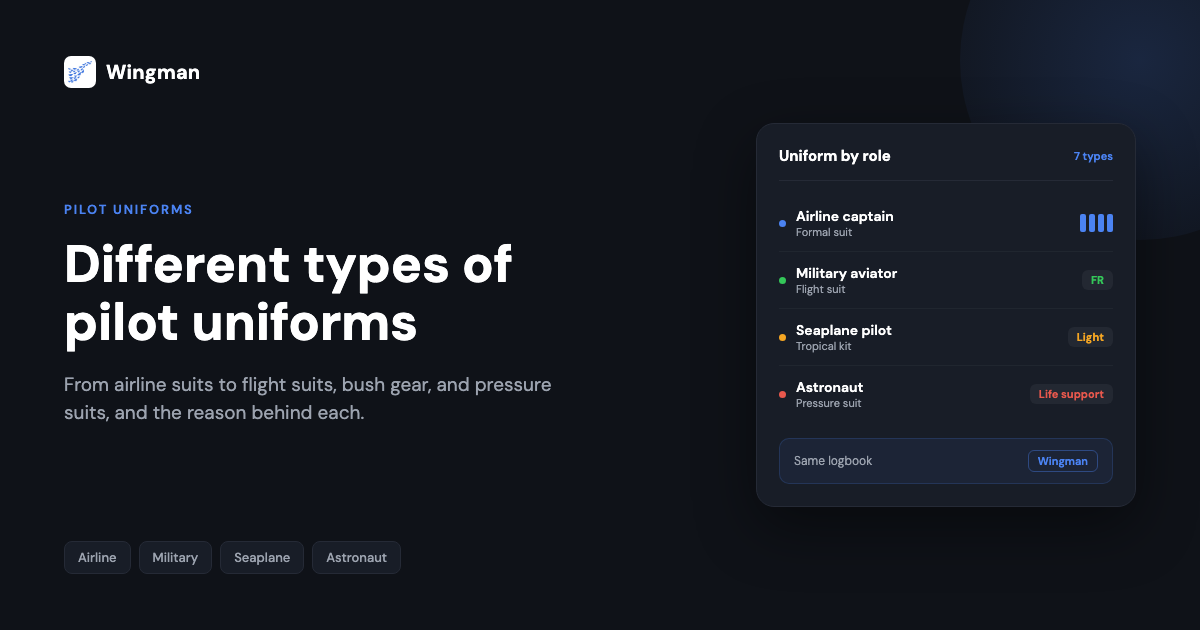
A pilot uniform is not just a look. It is a working garment shaped by the job, the climate, and the rules of the operation. A long-haul airline captain, a military fast-jet pilot, a seaplane pilot in the tropics, and a bush pilot in the far north all fly aircraft, but they dress in very different ways because they fly in very different conditions. This guide walks through the main types of pilot uniform around the world and explains the reasoning behind each one, so the differences make sense rather than looking arbitrary.
The post is organised by the kind of flying involved. For each type you get the typical garments, the rank and identity markings you tend to see, and the practical reason the uniform looks the way it does. If you are more interested in the individual pieces, such as epaulettes, wings, and the cap badge, that is covered separately in our breakdown of the parts that make up a pilot uniform. This article is about the categories of uniform; that one is about the components within them.
What actually shapes a pilot uniform
Before the individual types, it helps to know the forces that pull a uniform into its final form. Three things dominate. The first is the operating environment: temperature, humidity, water, and the risk of fire all push the design. The second is identity and authority, because passengers, crew, and ground staff need to read rank and role at a glance. The third is regulation and branding, since airlines and air forces set dress standards, and the marks on the sleeve or shoulder usually carry a defined meaning rather than a decorative one. Almost every difference below traces back to one of these three.
Commercial airline pilots
This is the uniform most people picture: a tailored dark suit, usually navy or black, worn with a white shirt and a peaked cap. Rank is shown by stripes, normally on the epaulettes and the lower sleeve. Four stripes indicate a captain and three a first officer, a convention that is broadly consistent across the industry, though the exact styling is set by each airline. Pilot wings sit on the chest, and the cap badge carries the operator or national marking.
The reason the airline uniform stays formal is that the role is public and customer-facing. The crew represent the airline to thousands of passengers a day, so the garment is built to look consistent, authoritative, and reassuring rather than to handle extreme weather. Comfort still matters for long duty periods, which is why modern airline uniforms increasingly use breathable, low-maintenance fabrics under the formal cut.
Airlines do occasionally rethink the look. In India, IndiGo introduced a retro-styled uniform reported to be designed by fashion designer Rajesh Pratap Singh, built around a bomber-style jacket inspired by mid-century flight jackets, with summer and winter trouser options. [VERIFY] It is a useful illustration of how an operator can refresh the standard airline template while keeping the formal, easily-recognised core intact.
Military aviators
Military flying uses a different wardrobe because the priority is survival and function, not public presentation. The everyday working garment is the flight suit, a one-piece coverall, commonly in a green, grey, or blue-grey shade depending on the air force. [VERIFY] It is typically made from fire-resistant material such as aramid fabric, with multiple pockets sized for flight-deck use, and it carries unit patches, name tape, rank, and qualification badges rather than airline-style stripes.
Over and around the flight suit sits a layer of specialised equipment: helmet, oxygen mask, anti-g trousers for high-performance jets, and a survival vest. Each air force, from the Royal Air Force to the United States services to others worldwide, sets its own patches, colours, and ceremonial variants, so the detail differs between nations even though the underlying flight-suit concept is shared. Military pilots also keep a formal service dress uniform for parades and official duties, which looks closer to the airline template, while the flight suit is what they actually fly in.
Seaplane and floatplane pilots
Seaplane operations, common in places such as the Maldives, parts of Canada, and Alaska, often run a far more relaxed dress code. In tropical seaplane work it is normal to see short-sleeved shirts, shorts, and sandals or deck shoes. [VERIFY] That is a deliberate response to the environment: high heat and humidity, frequent contact with water during boarding and docking, and short sectors between resorts or islands. A heavy formal suit would be impractical when part of the job involves stepping onto a float or a pontoon.
The trade-off is that the uniform still needs to signal that the person is the pilot. Operators usually keep a branded shirt, a name badge, and sometimes shoulder marks so the casual look does not lose the identity function entirely. In colder seaplane regions the same logic produces a warmer, more rugged version of the same idea.
Bush and utility pilots
Bush flying in remote regions, classically associated with the Canadian and Alaskan wilderness, produces one of the most function-first uniforms of all. Here the clothing is essentially cold-weather and survival gear: insulated jackets or parkas, sturdy boots, layered clothing, and gloves. The reasoning is direct, because a forced landing in remote terrain means the pilot may have to wait or walk for survival, so the clothing doubles as protection against the elements.
Branding and rank markings are minimal in this world. The emphasis is entirely on staying warm, dry, and mobile, which is why bush-pilot dress often looks like serious outdoor clothing rather than a conventional uniform. It is a clear example of environment overriding presentation.
Helicopter pilots
Helicopter pilots span a wide range, from offshore oil-and-gas transport to emergency medical services, police aviation, and corporate work, so their dress varies with the mission. A common baseline is a flight suit similar in concept to the military version, often fire-resistant, with role patches and name tags. Offshore crews flying over cold water add survival suits and life jackets because of the ditching risk, which is a regulatory as well as a practical requirement.
Where the operation is more corporate or executive, the helicopter pilot may instead wear an airline-style shirt-and-trousers uniform to match the customer-facing role. So the helicopter category is less a single look and more a spectrum that shifts depending on whether the priority is survival, branding, or both.
Astronauts and high-altitude crews
At the far edge of aviation sits the pressure suit. Astronauts, sometimes described as space pilots, wear highly engineered suits because they operate where there is little or no usable atmosphere. The launch-and-re-entry suit, such as NASA’s orange suit, is built to keep the crew alive if cabin pressure is lost, while the spacewalk suit is effectively a self-contained life-support system. [VERIFY] High-altitude reconnaissance and test pilots use related full-pressure suits for the same reason. These are the most specialised garments in the whole field, and they show how completely the environment can dictate what a pilot wears.
Vintage and heritage aviators
Finally there are the heritage uniforms worn at airshows, in aviation museums, and by warbird and vintage-aircraft pilots. These recall the early decades of flight: leather flight jackets, cloth or leather flying helmets, goggles, and scarves. Originally these were the practical answer to open cockpits and unheated cabins, where wind, cold, and oil were constant. Today they are largely about preservation and display, but they remain a real category because vintage and ceremonial flying still happens, and the clothing is part of operating those aircraft authentically.
How a uniform encodes rank and role
Across nearly all of these types, the uniform is also an information system. Stripes and epaulettes mark seniority, wings mark qualification, and patches or badges mark the unit, operator, or specialisation. The same four-stripe captain marking that reads instantly in an airline terminal has a military equivalent in the rank slide on a flight suit. If you want the detail on each piece and what it signifies, the companion guide on the components of a pilot uniform breaks them down one by one.
Pilot uniform types at a glance

The record behind the uniform
Whatever a pilot wears, the part of the job that follows them through their whole career is the logbook. Every sector flown, in any of these roles, has to be recorded accurately for licensing, currency, and employment. That is the gap a digital logbook fills. Wingman is a pilot logbook used by 30,000+ pilots across 400+ airlines, keeping hours, currency, and licence details in one place across iOS, Android, and Web.

Wingman is a global product rather than a single-country tool, so it suits pilots across these very different operations. It supports regulator-compliant exports for the FAA, EASA, UK CAA, GCAA, DGCA, GACA, NZCAA, HKCAD, CASA, and CAAS, and it can import rosters automatically from systems such as AIMS eCrew, NavBlue RAIDO, CAE Crew Access, ARMS, CESAR, Sabre, FLICA, and PDC CrewConnex. There is a free tier up to 250 logged hours, so you can start recording while you are still building toward a licence. You can open the app to begin, or read the wider Wingman guides for more detail.
Frequently asked questions
Why are pilot uniforms different from one type of flying to another?
Because the job is different. A uniform is shaped mainly by the operating environment, the need to show rank and role, and the dress rules of the operation. An airline captain dresses formally for a public, customer-facing role, while a bush pilot dresses for cold and survival. The same logic explains every variation in this guide.
What do the stripes on a pilot uniform mean?
The stripes, usually on the shoulder epaulettes and lower sleeve, indicate rank. Four stripes generally mean a captain and three a first officer, although the exact styling is set by each airline or air force. For a full breakdown of stripes, wings, and the cap badge, see the companion guide on the parts that make up a pilot uniform.
Why do military pilots wear a one-piece flight suit instead of a suit?
The flight suit is built for function and survival rather than presentation. It is commonly made from fire-resistant material, has flight-deck-sized pockets, and carries unit patches, name tape, and rank. Military pilots keep a separate formal service dress for ceremonial duties, but the flight suit is what they actually fly in. [VERIFY]
Why are seaplane pilot uniforms so casual?
Tropical seaplane operations involve heat, humidity, and frequent contact with water during boarding and docking, so a heavy formal suit is impractical. Lighter clothing such as short-sleeved branded shirts keeps the pilot comfortable while a name badge and shoulder marks preserve the identity role. [VERIFY]
Where does a digital logbook fit with all of this?
The uniform is the visible part of the role, but the logbook is the permanent record of the flying. A digital logbook such as Wingman records hours, currency, and licence details across any type of operation, supports exports for major regulators, and offers a free tier up to 250 hours, so it works for pilots from airlines to bush operations.
← All articles