EASA logbook requirements explained: keeping your electronic logbook compliant
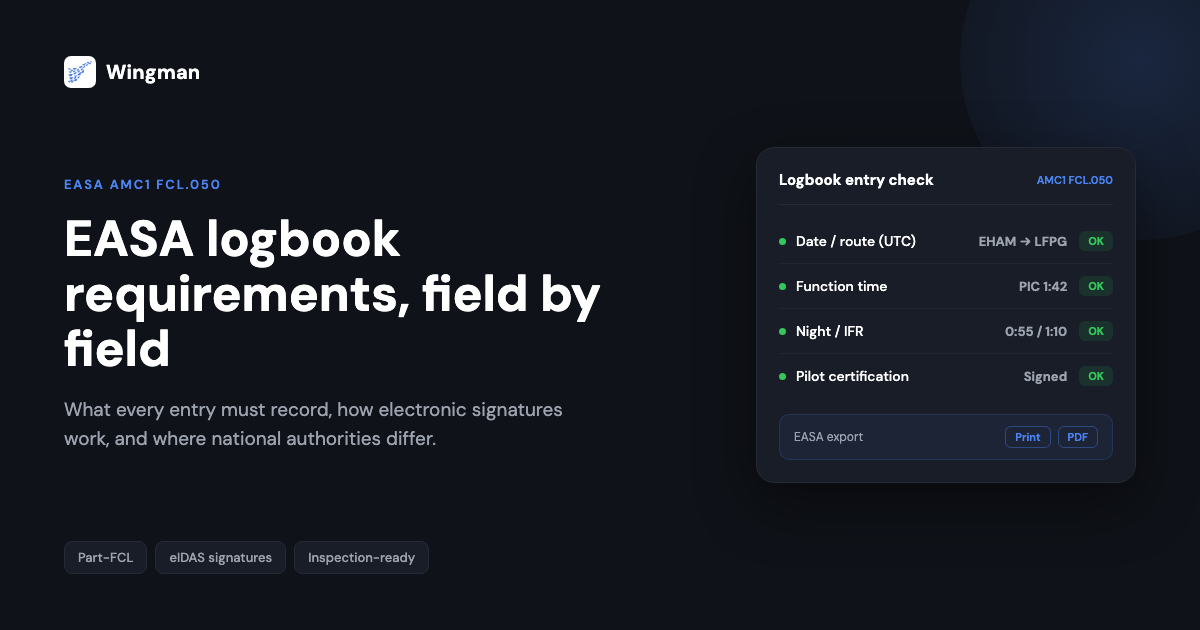
If you fly under European Union rules, your logbook is part of your licence record. The competent authority can ask to see it during a skill test, a proficiency check, a licence application, or a ramp inspection, and it has to hold up. The rules that govern what a logbook must contain sit in Part-FCL, and the practical detail lives in AMC1 FCL.050, the acceptable means of compliance published by the European Union Aviation Safety Agency (EASA).
Electronic logbooks are accepted across EASA member states, but acceptance is conditional. The record has to carry the same information a paper logbook would, it has to be certified by the pilot, and it has to be available for inspection on request. This guide walks through what EASA actually asks for, field by field, then covers the parts that trip pilots up: electronic signatures under eIDAS, national variations between authorities, and the difference between block time and airborne time. The aim is to let you check your own logbook against the rule rather than guess.
What EASA Part-FCL asks a logbook to record
FCL.050 is short. It states that a pilot shall keep a reliable record of the details of all flights flown, in a form and manner established by the competent authority. The detail of what “reliable record” means is in AMC1 FCL.050, which lists the fields each entry should capture. [VERIFY]
The mandatory items break down into a few groups.
Flight identification
- Date of the flight [VERIFY]
- Departure and arrival aerodrome (place) and time, recorded in UTC [VERIFY]
- Aircraft make, model or variant, and registration [VERIFY]
Time accounting
- Total time of flight [VERIFY]
- Single-pilot or multi-pilot time, split as applicable [VERIFY]
- Pilot function time: pilot-in-command (PIC), co-pilot, dual instruction, or flight instructor or examiner time [VERIFY]
Operational conditions
- Night time [VERIFY]
- Instrument flight time, separated into actual instrument conditions and instrument flight under a hood or in a simulator [VERIFY]
Specific functions and FSTD time
AMC1 FCL.050 also sets out how to record the cases that are easy to get wrong: pilot-in-command under supervision (PICUS), flight time as a student pilot acting as PIC (SPIC), a series of flights flown on the same day, and time spent in a flight simulation training device (FSTD). FSTD time must be recorded separately from actual flight time, never folded into it. [VERIFY]
For pilots building toward an ATPL, cross-country time matters because the licence has minimum cross-country and PIC requirements, so the logbook needs to make that time identifiable rather than buried in totals. [VERIFY]
Two practical rules apply to every entry. Entries should be made as soon as practicable after the flight. On paper, they must be in ink or indelible pencil. In electronic form, they must be in a format acceptable to the competent authority. [VERIFY]
What “electronic logbook” means under EASA
EASA does not run a logbook approval scheme. There is no list of certified apps, and no stamp that makes one logbook official and another not. What the rule requires instead is that an electronic logbook does the same job a paper one does and can be produced when asked. In practice an acceptable electronic logbook needs to:
- Contain every item required by AMC1 FCL.050, in the same structure a paper logbook uses
- Be certified by the pilot, so each entry is attributable to the person who flew
- Be available for inspection on request, which in practice means it can be printed, signed, and handed over
- Preserve the integrity of past entries, so a record cannot be silently altered after the fact
The signature and integrity side is where electronic logbooks differ most from paper, and it is governed by a separate body of EU law.
Electronic signatures and the eIDAS framework
EASA published guidance on the use of electronic documents, records, and signatures that points to the eIDAS Regulation (EU) No 910/2014 for how electronic signatures and seals should work across member states. [VERIFY] eIDAS defines three levels of electronic signature, and the distinction matters when an authority decides whether a digital certification is trustworthy:
- A simple electronic signature, which can be as basic as a typed name
- An advanced electronic signature (AdES), which is uniquely linked to the signer and can detect later tampering
- A qualified electronic signature (QES), which is an advanced signature backed by a qualified certificate issued by a trust service provider, and carries the same legal weight as a handwritten signature across the EU
The equivalent for an organisation rather than a person is an electronic seal, with a qualified electronic seal (QESe) at the top tier. [VERIFY] For a personal pilot logbook, the relevant point is that the higher the assurance level, the less room there is for an authority to question whether an entry is genuine. Alongside the signature itself, an authority looking at a digital record will expect supporting controls: user authentication, an audit trail of changes, and correction tracking so amendments are visible rather than overwriting history. [VERIFY]
None of this means you need a qualified certificate to keep a personal logbook. It means that when an electronic record is challenged, the way it was signed and protected is what decides whether it stands.
A worked check on one entry
To make the rule concrete, take a single night IFR sector and walk it against AMC1 FCL.050. The entry should show the date, the departure and arrival aerodromes with UTC off-blocks and on-blocks times, the aircraft type and registration, the total flight time, the function time logged as PIC or co-pilot, the portion logged as night, and the portion logged as actual instrument time. If the sector was flown under supervision toward an upgrade, the PICUS time is recorded separately and, in some states, countersigned. If any one of those fields is missing, the entry is incomplete under the AMC, regardless of whether it came from paper or an app.
Where national authorities differ
EASA sets the floor, but member states administer licensing through their own national aviation authorities, and some add national formats or extra steps on top of Part-FCL. This is the part pilots most often miss, because a logbook that satisfies the AMC can still fall short of what a specific authority wants to see at licence issue.
Ireland is a documented example. The Irish Aviation Authority asks that logbooks meet AMC1 FCL.050 and also follow its national guidance, including the PLAM 024 logbook FAQ. [VERIFY] Among the points it sets out is that PICUS time has to be countersigned by the commander of the flight, and that pages presented for a licence application should be certified. [VERIFY] Other authorities publish their own guidance, so the safe approach is to check the national authority for the state that issued, or will issue, your licence rather than assume the AMC alone is the full requirement.
The takeaway is not that the rules conflict. It is that “EASA compliant” and “accepted by my authority” are two checks, and you want both before a licence appointment.
Block time and airborne time
A recurring question is whether you must log both block time and airborne time. EASA defines flight time for aeroplanes as block time, that is, from the moment the aircraft first moves under its own or external power for the purpose of taking off until it comes to rest at the end of the flight. That is the figure that counts toward licence and currency requirements. [VERIFY]
Airborne time, measured from rotation to touchdown, is a separate figure. EASA does not generally require a private pilot to log both, so recording block time is usually sufficient for licensing purposes. [VERIFY] Commercial operators often track airborne time as well for maintenance and engine monitoring, which is why airline rosters tend to carry both. If you are flying for a licence rather than an operator, the practical answer is to log block time consistently and keep it as your primary figure.
Keeping an EASA-compliant logbook with Wingman
The reason an electronic logbook is worth the switch is that it removes the manual steps where compliance usually slips: a missed UTC conversion, a PICUS column left blank, a cross-country total that has to be added by hand the night before a check. Wingman is a pilot logbook used by 30,000+ pilots across 400+ airlines, and it keeps your hours, function time, and licence detail in one record across iOS, Android, and Web.
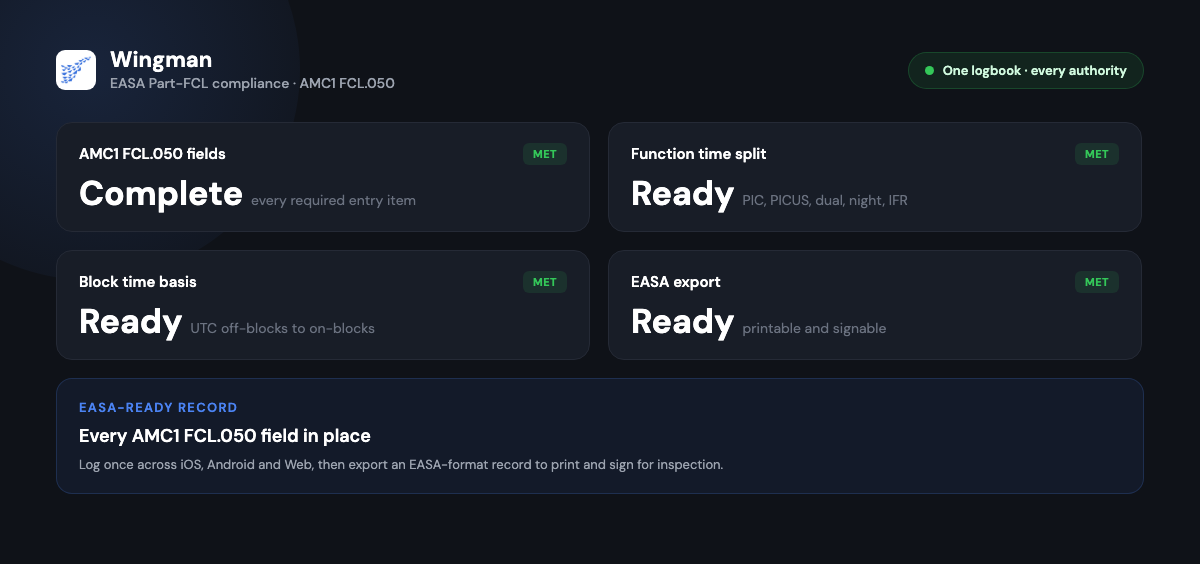
A few things matter specifically for EASA pilots:
- The entry fields follow the AMC1 FCL.050 structure, so PIC, PICUS, dual, night, and instrument time each have their own column rather than being lumped together.
- Roster import pulls sectors straight from airline systems including AIMS eCrew, NavBlue RAIDO, CAE Crew Access, ARMS, CESAR, Sabre, FLICA, and PDC CrewConnex, which keeps times and registrations accurate instead of retyped.
- Exports are produced in regulator formats, including EASA, alongside FAA, UK CAA, GCAA, DGCA, GACA, NZCAA, HKCAD, CASA, and CAAS, so a record can be printed and signed for inspection or a licence application.
Wingman is a global product, not a single-country tool, and there is a free tier up to 250 logged hours, so you can start keeping a clean record while you are still building time. The Pro plan is $59 per year, billed as $4.99 a month annually. For a deeper walkthrough of keeping a digital logbook under European rules, see the EASA digital logbook guide.
Frequently asked questions
Are electronic logbooks accepted under EASA rules?
Yes. EASA accepts electronic logbooks provided they hold every item required by AMC1 FCL.050, are certified by the pilot, and can be produced for inspection, which in practice means printed and signed on request. There is no EASA approval scheme that certifies particular apps. [VERIFY]
Does my logbook need to be approved by EASA?
No. EASA does not approve or certify logbooks. The requirement is compliance with AMC1 FCL.050, not formal approval. A record that matches the required fields and can be inspected is acceptable, while some national authorities add their own format or certification steps at licence issue. [VERIFY]
What information must every logbook entry contain?
At minimum: the date, departure and arrival aerodromes and times in UTC, aircraft make, model and registration, total flight time, the pilot function (PIC, co-pilot, dual, instructor), and operational conditions such as night and instrument time. Simulator time is recorded separately from actual flight time. [VERIFY]
Do I need a qualified electronic signature for my logbook?
Not for a personal logbook. The eIDAS framework defines signature levels up to a qualified electronic signature, and higher levels give an authority more confidence that an entry is genuine, but a personal logbook is accepted when it can be certified and inspected. The signature level matters most if a record is ever challenged. [VERIFY]
Should I log block time or airborne time?
Log block time as your primary figure, because EASA defines flight time as block time and that is what counts toward licence and currency requirements. EASA does not generally require private pilots to log airborne time as well, though commercial operators often track both for maintenance purposes. [VERIFY]
← All articles