ELP test for pilots in India: full form, levels, and DGCA requirements
If you are training toward a pilot licence in India, the English Language Proficiency test is one of the requirements you will meet along the way. It is administered by the Directorate General of Civil Aviation (DGCA) and follows the international standard set by the International Civil Aviation Organization (ICAO). This guide explains what ELP stands for, what the test actually measures, who is eligible, how it is scored, and how long an endorsement stays valid, so you know what to expect before you sit it.
What ELP stands for in aviation
ELP is short for English Language Proficiency. In aviation it refers to a pilot’s ability to speak and understand the English used in radiotelephony and other operational communication. The requirement exists because English is the common working language of international civil aviation, and clear two-way communication between flight crew and air traffic control is a safety matter. To make that proficiency measurable and comparable across countries, ICAO defined a six-point rating scale and a set of language skills that every assessment checks against. [VERIFY]
In India, the ELP test for pilots is the DGCA’s way of confirming that a licence holder or applicant meets that ICAO standard. It is not a written English exam in the school sense. It is a spoken assessment focused on how well you communicate in an aviation context, conducted by an authorised examiner and rated against the ICAO scale.
What the ELP test measures
The ELP test for pilots in India is an oral examination. An authorised ELP examiner engages you in conversation, asks questions, and rates your spoken English against the ICAO Language Proficiency Rating Scale. The assessment looks at a defined set of language skills rather than a single overall impression: [VERIFY]
- Pronunciation: clear and accurate pronunciation with appropriate stress, intonation, and rhythm.
- Structure: command of English grammar, including sentence structure, verb forms, tenses, and word order.
- Vocabulary: understanding and use of both aviation-specific and general English vocabulary relevant to aviation contexts.
- Fluency: the ability to communicate smoothly and confidently, expressing ideas clearly without undue pauses or hesitation.
- Comprehension: the ability to understand spoken English in aviation scenarios, including instructions and communication with air traffic control.
- Interactions: responding appropriately and promptly in a two-way exchange, including checking, confirming, and clarifying. [VERIFY]
The examiner rates each skill, and your overall result is decided by the lowest of the individual ratings rather than an average. In other words, a single weak area sets your level, so it is worth working evenly across all of them rather than relying on strengths in one or two.
The ICAO rating scale: Level 1 to Level 6
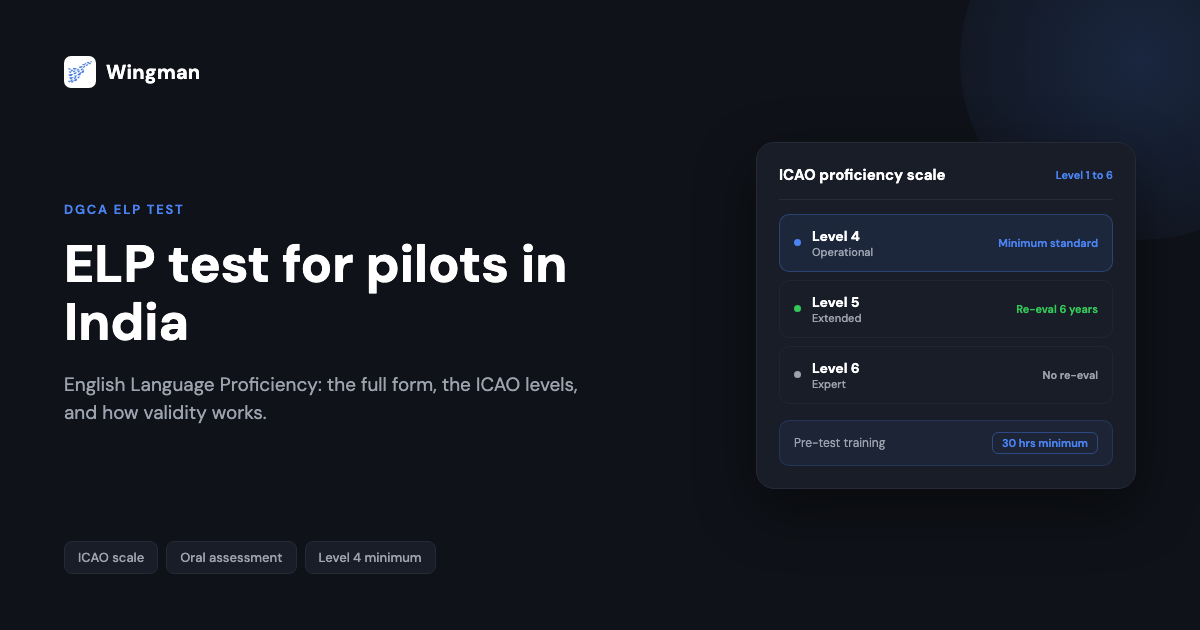
ICAO grades language proficiency on a scale that runs from Level 1 (Pre-elementary) through to Level 6 (Expert). For operational flying the key thresholds are: [VERIFY]
- Level 4 (Operational) is the minimum standard required to exercise the privileges that depend on the endorsement.
- Level 5 (Extended) indicates a stronger command of the language.
- Level 6 (Expert) is the highest rating and is generally treated as not requiring further re-evaluation.
A candidate rated below Level 4 has not met the operational standard and will need to retest after further training. Where you sit on the scale also determines how often you must be re-assessed, which is covered further down.
Who is eligible to take the ELP test
To appear for the ELP test in India, candidates are expected to meet a few baseline criteria: [VERIFY]
- Age: at least sixteen years old at the time of application.
- Educational qualification: passed the Class 10 examination, or an equivalent examination from a recognised Board.
- Aviation English training: candidates are required to complete a minimum of 30 hours of aviation English language training from a DGCA-approved organisation before the proficiency test. This applies even where English was the medium of instruction in Class 10 or 10+2, subject to the conditions set out in the relevant DGCA requirement. [VERIFY]
Because the training has to come from an approved provider, it is worth confirming the current list of DGCA-approved ELP training organisations and examiners before you book, rather than assuming a given centre qualifies. [VERIFY]
How the ELP test is scored
ELP assessments follow specific principles so that results are accurate and comparable. The main points are: [VERIFY]
- Spoken language focus: the test assesses speaking and listening, not reading and writing.
- Radiotelephony context: it evaluates language as used in aviation, emphasising voice-only communication, strategic skills such as paraphrasing, and being intelligible to the international aviation community.
- Effective oral communication: grammar, syntax, vocabulary, and pronunciation are assessed to the extent that they affect effective oral communication.
- Lowest rating decides the result: the overall rating is the lowest of the ratings across the language skills.
- Impartiality: an examiner should not assess a candidate they personally provided language training to, to keep the assessment fair.
- Face-to-face and recorded: tests are conducted in person at an approved provider’s designated location and are recorded for review and verification.
How an ELP rating is decided

How long an ELP endorsement is valid
An ELP endorsement is not necessarily permanent. Apart from Level 6, which is generally treated as not requiring re-evaluation, the re-assessment periods are: [VERIFY]
- Level 4 (Operational): re-evaluation every three years.
- Level 5 (Extended): re-evaluation every six years.
A candidate who is rated below the operational level has additional requirements before retesting: [VERIFY]
- Fresh training: complete a further minimum of 30 hours of aviation English language training to build proficiency before retesting.
- Minimum retest gap: wait at least 30 days from the previous test before reappearing, to allow time for training and improvement.
Because these periods and conditions are set by DGCA and can be revised, confirm the current validity rules and any forms against the applicable DGCA Civil Aviation Requirement before you plan a renewal. [VERIFY]
Where ELP fits in your DGCA journey
The ELP test is one of several requirements between starting training and holding a licence. The written flight crew examinations are a separate track, and if you are mapping out which papers you need, exams to be cleared in order to get CPL, PPL, ATPL sets those out so you can plan your sittings.
Licence and endorsement processes run through DGCA’s eGCA platform, which is where many of your records, including language proficiency, are tied to your profile. If you are getting set up there, the pilot registration process with eGCA and how to get your eGCA ID explain how to register and what to expect. Keeping these accounts straight early means your ELP endorsement and other records sit where they should when you need them.
Keeping your records once you are flying
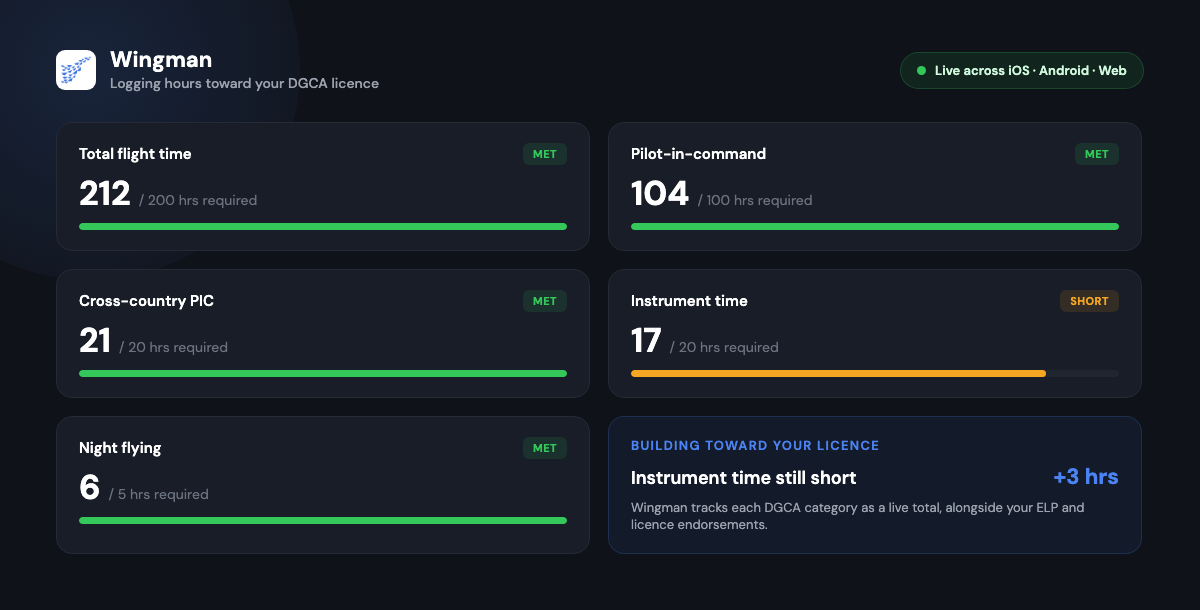
Clearing the ELP test and your written exams is one part of the licence path. The other large part is flight time, and once you are flying toward your CPL, PPL, or ATPL, those hours need to be recorded accurately. This is where a digital logbook earns its place. Wingman is a pilot logbook used by 30,000+ pilots across 400+ airlines, and it keeps your hours, currency, and licence and endorsement details in one place across iOS, Android, and Web.
Wingman is a global product rather than an India-only tool, and it produces regulator-compliant exports for DGCA alongside the FAA, EASA, UK CAA, GCAA, GACA, NZCAA, HKCAD, CASA, and CAAS. For India specifically, there is a focused walkthrough on keeping a DGCA pilot logbook in India. There is a free tier up to 250 logged hours, so you can start recording while you are still building toward your licence, and Pro is ₹4,499 per year if you outgrow it. You can also import rosters automatically from systems such as AIMS eCrew, NavBlue RAIDO, CAE Crew Access, and ARMS, which saves re-entering duty data once you are line flying.
Frequently asked questions
What is the full form of ELP in aviation?
ELP stands for English Language Proficiency. It refers to a pilot’s ability to speak and understand the English used in radiotelephony and operational aviation communication, assessed against the ICAO Language Proficiency Rating Scale. In India the ELP test is administered by DGCA.
Is the ELP test mandatory for pilots in India?
The ELP endorsement is part of the language proficiency requirements that apply to pilot licences in India, in line with the ICAO standard. The exact application to a given licence is set by DGCA, so confirm the current requirement for your specific licence against the applicable DGCA Civil Aviation Requirement. [VERIFY]
What is the minimum ELP level a pilot needs?
Level 4 (Operational) is the minimum standard on the ICAO scale required to exercise privileges that depend on the endorsement. Level 5 (Extended) and Level 6 (Expert) are higher ratings, with Level 6 generally treated as not requiring further re-evaluation. [VERIFY]
How often does an ELP endorsement need to be renewed?
Apart from Level 6, re-evaluation periods apply: every three years for Level 4 (Operational) and every six years for Level 5 (Extended). Confirm the current periods against DGCA before planning a renewal. [VERIFY]
How much training do I need before the ELP test?
Candidates are required to complete a minimum of 30 hours of aviation English language training from a DGCA-approved organisation before sitting the proficiency test. A candidate rated below Level 4 must complete a further 30 hours and wait at least 30 days before retesting. [VERIFY]
← All articles