FAA to GCAA and GACA logbook conversion: a Gulf-ready guide for US pilots
US-certificated pilots are joining Gulf carriers in steady numbers. The UAE’s Emirates, Etihad, flydubai, and Air Arabia, along with Saudi Arabia’s Saudia, flynas, and flyadeal, all recruit ATP and CPL holders trained under the FAA system. The flying transfers in the way most pilots expect. The paperwork is where the surprises tend to sit, and your logbook sits at the centre of it.
Your logbook is the one document that follows you across every move like this. The hours are yours, but the way you present them has to satisfy a crew records team and a regulator you have not dealt with before. This guide maps what happens to an FAA logbook when it reaches a Gulf carrier’s desk, so you can arrive with a finished record rather than a reconstruction project. The focus here is specific: converting and presenting your FAA flight time for GCAA in the UAE and GACA in Saudi Arabia, not the broader medical, licence, and relocation picture that other guides cover.
Two distinct authorities sit behind these carriers. The UAE is regulated by GCAA, the General Civil Aviation Authority. Saudi Arabia is regulated by GACA, the General Authority of Civil Aviation. They are separate bodies with separate processes, and the difference matters before you sign anything. If you want the wider comparison of what each authority asks for, the key differences between GCAA, GACA, and other CAAs is a useful companion to this FAA-specific walkthrough.
Two regulators, two pathways: GCAA and GACA at a glance
For initial airline employment, FAA ATP holders generally pursue licence validation rather than full conversion. [VERIFY] Validation lets you exercise the privileges of your existing certificate within the host state’s framework, usually tied to the airline that sponsors you. Full conversion, meaning a locally issued licence held in your own right, is a separate process. Its requirements vary by authority and should be confirmed directly with the relevant office.
| UAE | Saudi Arabia | |
|---|---|---|
| Regulator | GCAA (General Civil Aviation Authority) | GACA (General Authority of Civil Aviation) |
| Carriers commonly hiring FAA pilots | Emirates, Etihad, flydubai, Air Arabia | Saudia, flynas, flyadeal |
| Typical route for initial employment | Licence validation (verify current requirements) [VERIFY] | Licence validation (verify current requirements) [VERIFY] |
| Where to confirm requirements | gcaa.gov.ae and airline HR | gaca.gov.sa and airline HR |
The practical takeaway is that moving to the Gulf is really two different administrative tracks, depending on whether your offer is in the UAE or Saudi Arabia. Requirements at both authorities change over time, so treat the airline’s crew records department and the regulator’s own site as your source of truth, not forum threads or second-hand summaries. For a broader view of how a licence move to either authority works end to end, see the guide on switching your pilot licence to GCAA or GACA.
What Gulf carriers actually check in your logbook
Before a regulator sees anything, the airline’s crew records and type rating teams review your hours. They are confirming that the totals you claim on your application trace back to source records, that categories and classes line up with what they expect, and that the document is legible and internally consistent. Gulf carriers typically want your hours presented in a format their HR and type rating departments can cross-check against your FAA records.
Three things draw the most attention:
- Total time and the breakdown behind it, including PIC, SIC, cross-country, night, instrument, and multi-engine time.
- Type and class alignment, so the aircraft you claim experience on can be matched to their fleet and to your intended rating.
- Internal consistency, so your monthly and yearly subtotals add up to the career totals on your summary.
This is verification, not suspicion. A clean, well-organised logbook moves through review faster, which is the entire reason to prepare it before you apply rather than during the process.
FAA logbook format: what carries over and what does not
The hours in your FAA logbook are valid records of flight time. What does not always travel cleanly is the vocabulary. FAA logbooks record time in categories and classes that do not map directly onto the ICAO terminology a Gulf authority uses. An entry such as “Airplane Multiengine Land”, or its common abbreviation AMEL, is precise under Part 61, but it is not phrased the way an ICAO-aligned reviewer expects to read it against a type entry. [VERIFY]
This is a presentation problem, not a validity problem. Your time still counts. The work is in restating column headings and class abbreviations in terms a GCAA or GACA reviewer reads without friction, while keeping the underlying numbers identical to your source records. Anything you restate has to reconcile exactly with the FAA logbook it came from.
| FAA logbook term | What a Gulf reviewer is looking for |
|---|---|
| AMEL / ASEL (class) | Aircraft category and class, mapped to the specific type where relevant |
| PIC / SIC | The capacity in which the time was logged, consistent with your role |
| Cross-country | Cross-country time under the definition the reviewer applies |
| Total time | A career total that reconciles with every subtotal |
If your prior flying was under EASA rather than the FAA, the column structure is closer to what a Gulf reviewer expects, but the same reconciliation discipline applies. Pilots coming from that direction can read the EASA to GCAA conversion logbook guide instead.
How to convert your FAA records into a clean Gulf-ready summary
The goal is a single summary a reviewer can read in one pass and reconcile against your detailed logbook. Working from your existing FAA records, the process is straightforward. Treat these as steps you can run in order.
- Consolidate every source. Pull all of your flying into one place: paper logbooks, prior digital logbooks, and any airline-provided records.
- Reconcile the totals. Confirm that your PIC, SIC, night, instrument, cross-country, and multi-engine subtotals add up to your career total time.
- Map the terminology. Restate FAA class and category labels in ICAO-aligned language without changing any numbers.
- Produce a clean summary. Generate a structured total-time summary alongside a detailed record the airline can cross-check.
- Keep your source records attached. Hold your original FAA logbook ready, since the summary is read alongside it, not instead of it.
You can do all of this by hand in a spreadsheet. The catch is that every manual rebuild is a fresh chance to introduce a transcription error, and a subtotal that does not reconcile is exactly what slows a review down. Structuring your total time records is its own discipline, and it is far easier when the underlying data is already clean.
The two-track conversion flow

Common gaps US pilots discover during the transition
A few recurring issues surface once pilots start assembling a Gulf-ready record. None of them is unusual, and all of them are easier to fix before an application than during one.
- Scattered history. Time spread across a paper logbook, an old app, and a spreadsheet, with no single reconciled total.
- Terminology mismatch. Class and category labels that read cleanly to an FAA examiner but need restating for an ICAO-aligned reviewer.
- Subtotals that do not tie out. Small arithmetic drift between monthly pages and career totals, which a reviewer will notice.
- Format friction. A record that cannot be exported as a clean summary, which forces a manual rebuild under time pressure.
Catching these early is the difference between submitting a finished document and explaining an inconsistent one. Many Gulf-bound pilots use the move as the moment to leave paper behind entirely, a shift covered in why Middle East pilots are moving off paper logbooks.
Does GCAA or GACA accept a digital logbook?
A common worry for US pilots is whether a digital record is acceptable at all, or whether a Gulf carrier expects a stack of paper. In practice, what a crew records team needs is a record they can read and reconcile, which a clean digital export delivers. Whether they want it on paper, as a PDF, or both is an airline-by-airline question, so confirm it with the crew records department. The wider question of digital acceptance across the region is covered in are digital pilot logbooks accepted by Middle East aviation authorities. Keep your original FAA logbook regardless, since a digital summary is read alongside your source records, not as a replacement for them.
How Wingman structures your logbook for Gulf submission readiness
Wingman keeps your entire flying history in one logbook and lets you export it in structured formats, including PDF summaries. For a Gulf transition, that means you can produce a total-time summary and a detailed record from the same source data, with subtotals that reconcile because they are calculated from your entries rather than retyped. You can export your logbook as a PDF summary when an airline asks for one, without rebuilding anything.
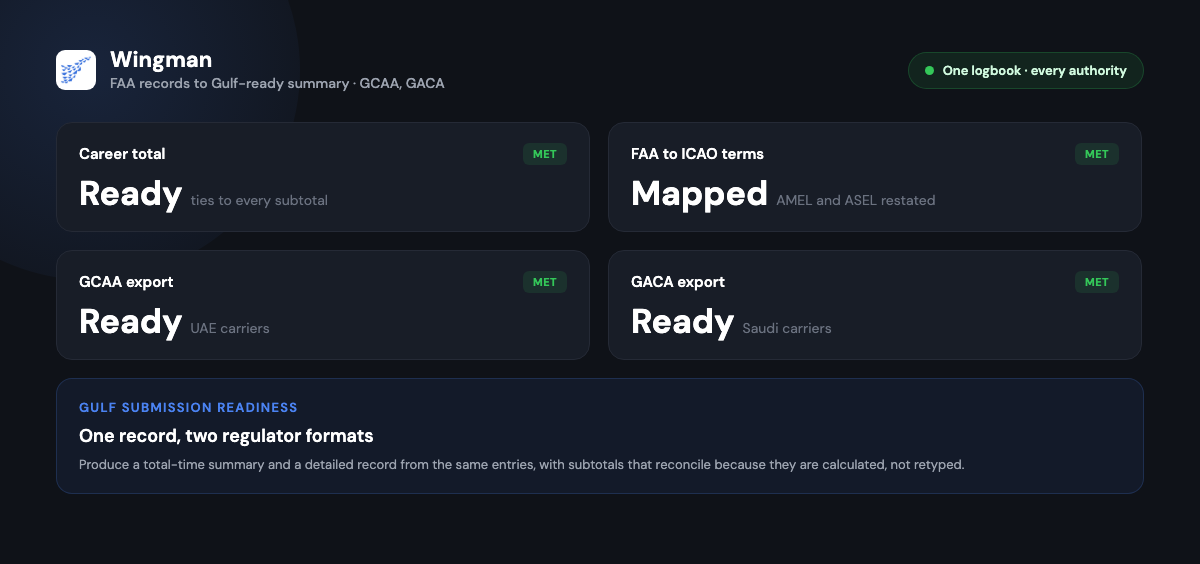
Wingman is used by 30,000+ pilots across 400+ airlines and runs on iOS, Android, and Web. It supports regulator-compliant exports for the FAA, GCAA, and GACA among others, including EASA, UK CAA, DGCA, NZCAA, HKCAD, CASA, and CAAS, which matters when your career may move between systems more than once. If your flying comes off a Gulf roster, it can import automatically from systems such as AIMS eCrew, NavBlue RAIDO, CAE Crew Access, and Sabre, so your hours stay current without manual entry. There is a free tier up to 250 logged hours, so you can consolidate your FAA history and see the export before committing anything.
To be clear about the limits: Wingman is not approved or certified by any Gulf authority, and no logbook app is a substitute for confirming requirements with GCAA, GACA, or the airline. What it removes is the spreadsheet step. Your hours stay in one place across the move, and the export is a presentation of records you already trust.
Frequently asked questions
Do I need to convert my FAA licence to fly for a Gulf carrier, or is validation enough?
For initial employment with a Gulf carrier, FAA ATP holders generally pursue licence validation rather than full conversion. [VERIFY] Validation lets you fly for the sponsoring airline under the host authority’s framework. Full conversion to a locally issued licence is a separate process, and its requirements vary by authority, so confirm what your specific situation needs with GCAA or GACA and your airline’s crew records team.
Will GCAA and GACA airlines accept a digital logbook, or do they require printed paper?
Gulf carriers typically want your hours in a format their HR and type rating departments can cross-check against your FAA records, which usually means a clean summary they can read and reconcile. Whether they want it submitted on paper, as a PDF, or both depends on the airline, so ask the crew records department directly. A digital logbook that exports a clean PDF summary covers either case.
What hour categories do GCAA and GACA typically ask US pilots to document?
Reviewers generally want your total time supported by the standard breakdown you already keep: PIC, SIC, cross-country, night, instrument, and multi-engine time, tied to aircraft category and class. The exact fields and emphasis vary by authority and airline, so use the relevant carrier’s application guidance and the GCAA or GACA site as your reference rather than a generic checklist. [VERIFY]
My FAA logbook uses abbreviations like AMEL. Will Gulf HR teams understand them?
FAA class abbreviations such as AMEL, meaning Airplane Multiengine Land, are precise under Part 61, but an ICAO-aligned reviewer may not read them the same way. [VERIFY] The fix is to restate these labels in ICAO-aligned terms, mapped to aircraft type where relevant, while keeping the numbers identical to your source logbook. The time is valid either way. The goal is to remove any ambiguity for the person reviewing it.
How far back do I need to document my hours for a GCAA or GACA application?
Airlines generally want your complete flying history reconciled to a career total, since the total time on your application has to trace back to source records. How much detail they want for older time versus recent time varies by carrier, so confirm the level of detail with the crew records department. Keeping your full history in one place makes either request easy to answer.
Preparing your logbook before you apply
If you are preparing your logbook for a Gulf transition, Wingman gives you a clean export without the spreadsheet rebuild. Your FAA history stays in one place, your subtotals reconcile, and the summary is ready when an airline’s crew records team asks for it. Confirm your specific validation or conversion requirements with GCAA and GACA and your target airline, then arrive with the paperwork already done. Start free at wingmanlog.in.
← All articles