FAA vs EASA pilot license: key differences and how they affect your logbook
If you are deciding where to train, or you already hold a licence on one side of the Atlantic and want to fly on the other, the FAA vs EASA pilot license question shapes almost everything that follows: how many hours you need, how many exams you sit, what your medical looks like, and how your flight logbook has to be kept. Cost is usually what pushes the first decision, but the regulator you choose sets the rules you live with for the rest of your career.
This guide compares FAA and EASA licensing across the points that actually matter, then focuses on the part most pilots underestimate: how the two systems treat your logbook, and what that means if your career ends up spanning both. The regulatory figures below are drawn from the published rules, but rules change, so treat the specific numbers as a starting point and confirm the current text before you make a decision.
What FAA and EASA licences are
The Federal Aviation Administration (FAA) governs pilot certification in the United States under 14 CFR Part 61 and Part 141. The common certificates are the Private Pilot certificate (PPL), the Commercial Pilot certificate (CPL), and the Airline Transport Pilot certificate (ATP). [VERIFY]
The European Union Aviation Safety Agency (EASA) standardises licensing across EU and EFTA member states under Part-FCL (Flight Crew Licensing). The equivalent licences are the PPL(A), CPL(A), and ATPL(A). [VERIFY]
Both frameworks produce licences that airlines around the world recognise, but the path to each, and the paperwork that proves your experience, differ in ways that matter long after training ends.
Key differences between FAA and EASA licensing
1. Flight hour requirements
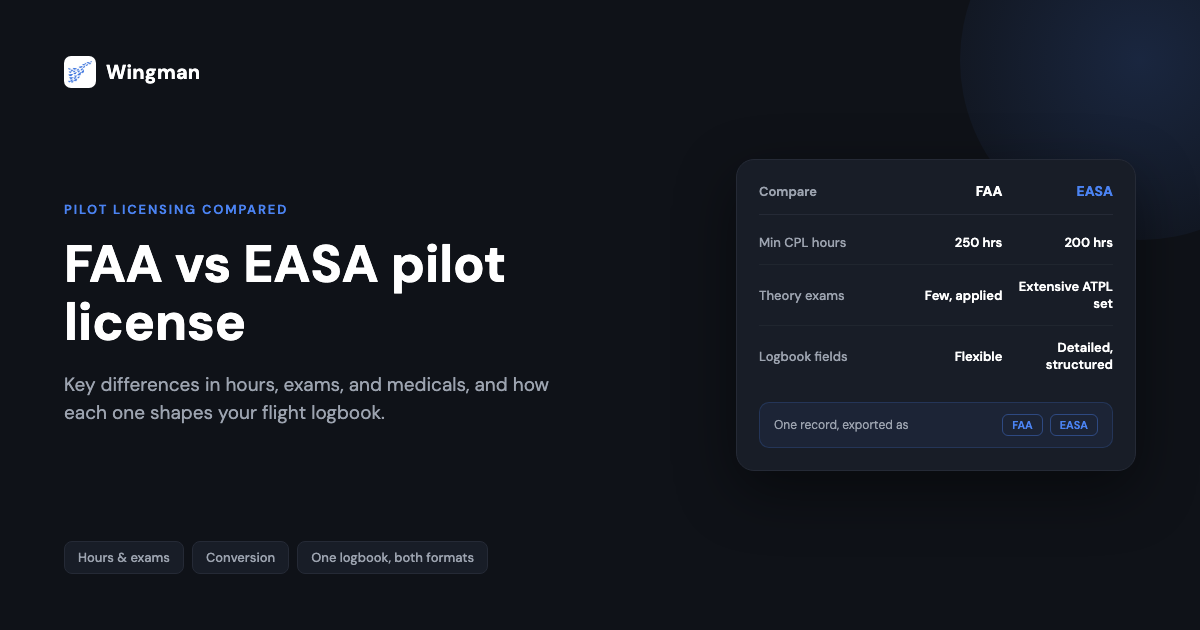
Per 14 CFR Part 61, the FAA private certificate requires a minimum of 40 hours total time, and the commercial certificate requires a minimum of 250 hours total time. [VERIFY] Under EASA Part-FCL, the PPL(A) requires a minimum of 45 hours, while the modular CPL(A) requires a minimum of 200 hours total time. [VERIFY]
The headline minimums rarely tell the whole story. Integrated EASA courses can change how hours are counted, and most pilots accumulate well beyond the floor before an airline will look at them. What matters for your records is that both systems expect you to be able to prove every hour, by category, when the time comes.
2. Training philosophy
FAA training leans on practical experience and instructor discretion. You can train under Part 61, which is flexible and instructor-driven, or Part 141, which follows an approved syllabus. [VERIFY] EASA training is more standardised across member states and includes a mandatory Multi-Crew Cooperation (MCC) course before you move into airline operations. [VERIFY] The practical effect is that EASA front-loads structure, while the FAA gives you more room to build experience your own way.
3. Theoretical knowledge exams
This is one of the largest gaps. FAA pilots typically sit a small number of written knowledge tests, often one per certificate level, in a multiple-choice format focused on applied knowledge. [VERIFY] EASA ATPL theory involves a far larger set of theoretical examinations covering subjects such as flight planning, meteorology, and human performance in considerable depth. [VERIFY] Pilots planning the European route should budget months for theory rather than weeks.
4. Medical standards
FAA medical certification runs under 14 CFR Part 67 and is generally regarded as more flexible at the entry levels. [VERIFY] EASA uses Class 1 and Class 2 medicals under Part-MED, with criteria that many pilots find stricter on cardiovascular, vision, and hearing standards. [VERIFY] A medical that clears one authority does not automatically satisfy the other, which is the first thing conversion candidates discover.
5. Licence recognition and conversion
An FAA certificate is not automatically valid in EASA states, and the reverse is also true. Converting in either direction generally means obtaining a medical from the new authority, sitting or crediting theory exams, passing a skills test with an approved examiner, and meeting an English language proficiency requirement. [VERIFY] The detail matters, and it is genuinely involved, so we walk through it separately in converting your FAA license to EASA.
Quick comparison
| Feature | FAA | EASA |
|---|---|---|
| Minimum PPL hours | 40 hrs [VERIFY] | 45 hrs [VERIFY] |
| Minimum CPL hours | 250 hrs [VERIFY] | 200 hrs [VERIFY] |
| Theory exams | Few, applied [VERIFY] | Extensive ATPL theory set [VERIFY] |
| Training structure | Flexible (Part 61 or 141) | Standardised, MCC required |
| Medical | Part 67, more flexible [VERIFY] | Part-MED, Class 1 and 2, stricter [VERIFY] |
| Logbook format | Flexible, paper or digital | Detailed, structured fields |
How the two systems affect your logbook
The licence you hold determines what your logbook has to contain, and this is where the two regulators diverge most in day-to-day record keeping.
FAA logbook standards
The FAA requires you to log the time used to meet certification, rating, or currency requirements. Under 14 CFR 61.51, entries must capture the date, aircraft type and registration, the relevant categories of flight time (PIC, SIC, solo, instrument and so on), departure and arrival points, and remarks for training or endorsements. [VERIFY] The FAA accepts both paper and digital logbooks and does not mandate a single format, which gives pilots flexibility but also leaves the burden of completeness on you. Our FAA digital logbook guide covers what a compliant electronic record looks like in practice.
EASA logbook standards
EASA is more prescriptive. The logbook is expected to record the date, departure and arrival aerodromes by ICAO code, aircraft type, variant and registration, the name of the pilot in command, flight time split by single-pilot or multi-pilot operation, clearly marked simulator (FSTD) entries, and the nature of the flight such as cross-country, night, or IFR. [VERIFY] The record has to be kept in a form acceptable to the authority and available for inspection. We break the field-level detail down in EASA logbook requirements explained.
A practical point that catches pilots out: an EASA-complete entry generally contains everything an FAA entry needs and more. So if you log to the stricter standard from the start, you avoid back-filling fields later.
Are electronic logbooks accepted
Both authorities accept electronic logbooks, provided the record is complete, accurate, and available when an inspector asks for it. The format is less important than the integrity of the data. If you want the detail on what each regulator expects from a digital record, see are electronic pilot logbooks legal under FAA and EASA rules. [VERIFY]
Managing dual FAA and EASA compliance
Pilots who operate, or plan to operate, under both authorities face a recurring problem: the temptation to keep two logbooks, or to re-format the same hours twice. That is where errors creep in, and an inconsistent record is the last thing you want in front of a regulator.
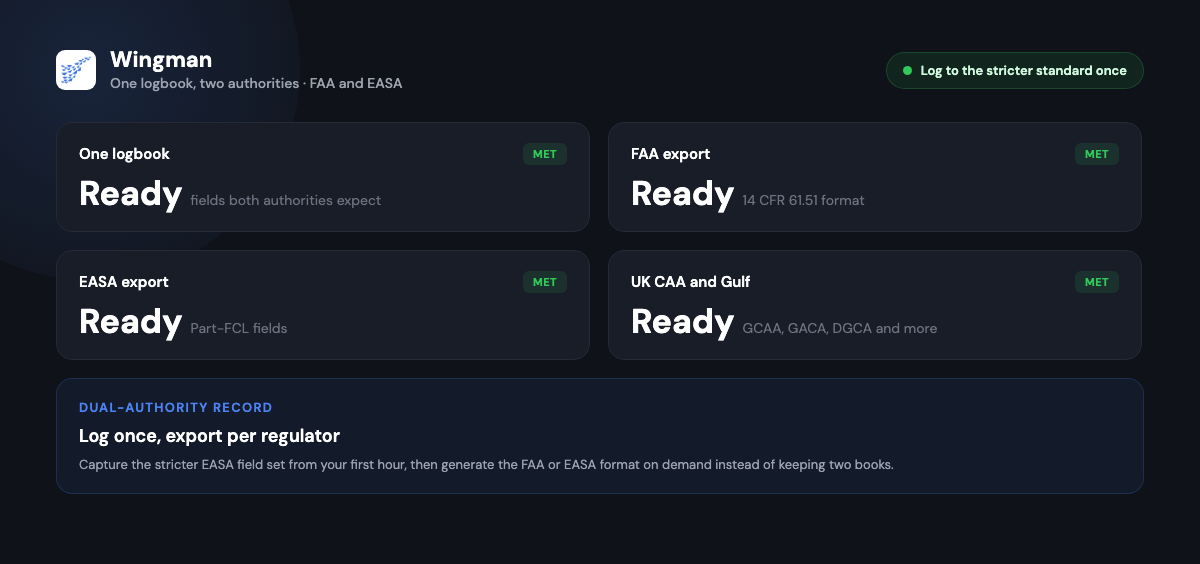
A cleaner approach is to keep one record built to the stricter standard, then export the view each authority needs:

The principle is simple: log each flight a single time, capture the full set of fields the stricter regulator wants, and generate the format you need on demand rather than maintaining parallel books.
Where Wingman fits
Wingman is built for exactly this dual-authority situation. It is used by 30,000+ pilots across 400+ airlines, and it keeps your hours, currency, and licence details in one place across iOS, Android, and Web.
For pilots straddling FAA and EASA, the relevant pieces are:
- One logbook with the fields both authorities expect, so you are not double-logging.
- Regulator-compliant exports for the FAA, EASA, UK CAA, GCAA, DGCA, GACA, NZCAA, HKCAD, CASA, and CAAS, so the same hours can be presented in the right format for each.
- Automatic roster import from systems including AIMS eCrew, NavBlue RAIDO, CAE Crew Access, ARMS, CESAR, Sabre, FLICA, and PDC CrewConnex, so airline flying flows in without manual entry.
There is a free tier up to 250 logged hours, so you can start building a clean record while still in training, and Pro is $59 per year ($4.99 per month billed annually, or ₹4,499 per year in India). You can sign in at app.wingmanlog.com to see how the exports work before committing anything.
Final thoughts
Both the FAA and EASA pathways lead to a professional flying career, but they ask for different preparation and, crucially, different record keeping. If there is any chance your career will cross between the two systems, the cheapest decision you can make early is to log to the stricter standard from your first hour. That single habit removes most of the friction that conversion candidates run into later, and it keeps your logbook audit-ready whichever authority is asking.
Frequently asked questions
Is an FAA license valid in Europe?
Not automatically. An FAA certificate is not directly valid for operations governed by EASA, and converting it generally requires an EASA medical, theory credits or exams, a skills test with an approved examiner, and an English language proficiency check. [VERIFY] The reverse applies when converting an EASA licence for FAA operations.
Which is harder, FAA or EASA?
The clearest difference is theory. EASA ATPL theory involves a substantially larger set of examinations than the FAA written tests, and EASA medical criteria are often regarded as stricter. [VERIFY] The FAA route is generally more flexible on training structure. Which is harder depends on whether exams or scheduling are your bigger constraint.
Do FAA and EASA require different logbook formats?
Yes. The FAA accepts a flexible format under 14 CFR 61.51 in either paper or digital form, while EASA specifies a more detailed set of fields under Part-FCL. [VERIFY] An EASA-complete entry usually contains everything an FAA entry needs, so logging to the EASA standard satisfies both.
Can I use one logbook for both FAA and EASA?
In practice, yes, if it captures every field the stricter authority requires and lets you export the format each regulator wants. Keeping a single source of truth and generating regulator-specific reports avoids the double-logging errors that come from maintaining two books.
Are electronic logbooks accepted by both the FAA and EASA?
Both authorities accept electronic logbooks as long as the record is complete, accurate, and available for inspection on request. [VERIFY] The integrity of the data matters more than the medium. See our guide on electronic logbook legality for the detail.
← All articles