GACA Class 1 medical requirements: what Saudi pilots need for their aviation medical
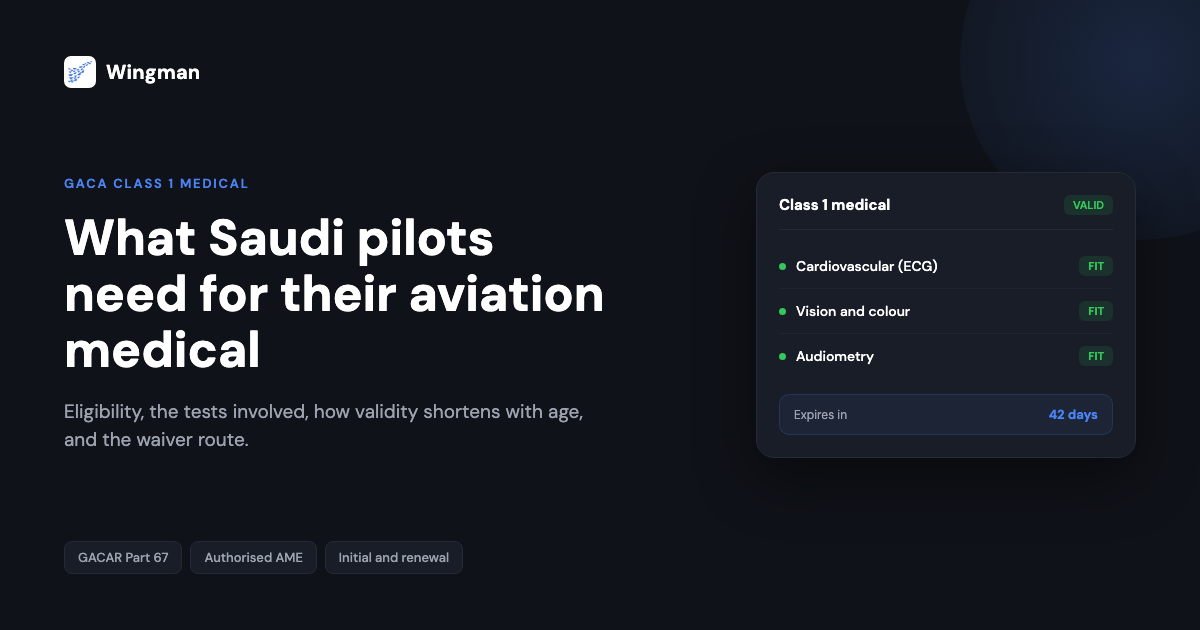
To fly professionally in Saudi Arabia, you need a valid GACA Class 1 medical certificate before you can exercise the privileges of a commercial licence. The certificate is issued under the rules of the General Authority of Civil Aviation (GACA) and confirms that you meet the physical and mental fitness standards set out in GACAR Part 67. For most professional pilots in the Kingdom, this is a recurring part of the job rather than a one-off hurdle, so it pays to understand how the initial exam works, how often you renew, and what can hold up an issue.
This guide covers eligibility, the tests involved, where to sit the exam, the renewal intervals that apply as you get older, the age-triggered checks such as ECG and audiometry, and the waiver route if you have a condition that would otherwise be disqualifying. It closes with how to keep your certificate, licence, and logbook deadlines in one place so a lapse never grounds you.
What a GACA Class 1 medical certificate is
A Class 1 medical certificate is the standard required for a Commercial Pilot Licence (CPL), an Airline Transport Pilot Licence (ATPL), and any role that involves flying for hire or reward. It is more demanding than the Class 2 certificate used by private pilots, and it assesses cardiovascular fitness, vision, hearing, neurological and mental health, and general physical condition against the standards in GACAR Part 67.
The certificate is what links your medical fitness to your licence. Without a current Class 1, your commercial privileges are suspended even if your licence and ratings are otherwise valid, which is why renewal timing matters as much as the initial assessment.
Eligibility for a GACA Class 1 medical
Under GACAR Part 67, an applicant for a Class 1 certificate generally needs to:
- Be at least 18 years old for the licence the certificate supports. [VERIFY]
- Meet the physical and mental fitness standards GACA defines for Class 1.
- Be free of any disqualifying medical condition, or hold an approved waiver for it.
- Pass the required tests across vision, colour perception, hearing, cardiovascular function, and general health.
- Complete psychiatric and neurological screening to aviation standards.
Meeting eligibility is not the same as guaranteeing an issue. The examiner assesses the whole picture, and a single borderline result can lead to deferral while further reports are gathered rather than an outright pass or fail.
What the GACA Class 1 medical exam includes
A GACA-authorised aviation medical examiner (AME) or aeromedical centre runs the assessment. The initial examination is the most thorough, and renewals repeat a core set of checks with additional tests added at certain ages or where your history calls for them.
General medical assessment
- Height, weight, and BMI
- Blood pressure
- Full physical examination and medical history review
Cardiovascular evaluation
- An electrocardiogram (ECG) is required at the initial examination, and again at renewal on a schedule that depends on your age and cardiac history. [VERIFY]
Vision requirements
- Distant visual acuity meeting the Class 1 standard in each eye separately, corrected or uncorrected. [VERIFY]
- Normal colour vision, assessed by Ishihara plates or an equivalent test.
- Healthy binocular function and no disqualifying eye disease.
Hearing assessment
- The ability to hear a conversational voice at a set distance in a quiet room.
- Pure-tone audiometry at the initial exam and at defined intervals, with more frequent testing as you get older. [VERIFY]
Laboratory tests
- Blood tests covering glucose, cholesterol, and haemoglobin.
- Routine urinalysis.
- Drug screening where required.
Mental and neurological health
- Screening for depression, anxiety, substance use, epilepsy, and related conditions.
- Cognitive and neurological assessment where the history or age band calls for it.
How long a GACA Class 1 medical is valid
The validity period of a Class 1 certificate is not fixed for life. It shortens as you get older, which is the single most common thing pilots get caught out by when planning renewals.
As a general framework used across ICAO-aligned regulators, a Class 1 certificate is typically valid for 12 months, reducing to 6 months once a pilot passes a defined age threshold, and reducing further for single-pilot commercial operations carrying passengers. [VERIFY] Because the exact intervals and age thresholds GACA applies can differ from other authorities and can change, confirm the period printed on your own certificate and treat that date as the one that governs you. [VERIFY]
The practical takeaway is that a pilot in their twenties and a pilot in their fifties are on different renewal clocks even if they fly the same aircraft. Once you cross an age band, your next certificate may carry half the validity you were used to, so build the shorter cycle into your planning rather than assuming an annual rhythm.
Renewal timing at a glance

Age-triggered checks: ECG and audiometry
Two tests deserve particular attention because they switch from occasional to routine as you age.
The ECG moves from a baseline check at your initial exam to a recurring requirement at renewal, with the interval tightening in the older age bands. [VERIFY] Audiometry follows a similar pattern: an initial baseline, then periodic testing that becomes more frequent over time. [VERIFY] Your AME will tell you which checks are due at each visit, but knowing they are coming helps you book enough time for the appointment and avoid a same-day surprise that pushes your issue back.
Where to sit your GACA Class 1 medical
You must be examined at a GACA-authorised AME or aeromedical centre. GACA publishes the current list, and it is worth checking it directly rather than relying on word of mouth, because approvals are updated over time. Centres that have appeared on the approved list include facilities in Jeddah, Riyadh, and Dhahran. [VERIFY]
Booking ahead matters. Demand rises around airline recruitment cycles, and the busiest centres can be booked out weeks in advance during peak months. [VERIFY] The exam itself is usually completed in a single visit for a straightforward case, but if a test result needs a specialist report, issue of the certificate can be deferred until that report is reviewed, which extends the turnaround. Fees are set by the individual centre and are not standardised across providers, so confirm the cost when you book rather than assuming a fixed national rate. [VERIFY]
Disqualifying conditions and the waiver route
Some conditions can lead to a refusal at Class 1 standard, including:
- Epilepsy or other seizure disorders
- Bipolar disorder or schizophrenia
- Insulin-dependent diabetes
- Colour vision deficiency, unless specifically cleared
- A history of substance dependence
- Uncontrolled hypertension or significant cardiac disease
A diagnosis does not always end the matter. GACA operates a medical examination and waiver process under which a pilot with a condition that would normally be disqualifying can be assessed for a special issuance, often subject to monitoring, additional reports, or operating limitations. [VERIFY] The process typically relies on specialist evidence demonstrating that the condition is controlled and does not compromise safety, and it can take longer than a standard renewal, so start early if you know a review will be needed. [VERIFY]
Documents to bring to your appointment
Before your assessment, carry:
- Government-issued ID (Iqama or passport)
- Your previous medical certificate, if you hold one
- Corrective glasses or contact lenses, if you wear them
- Specialist reports for any condition under treatment
- Copies of any existing GACA waivers or special issuances
Bringing both printed and digital copies avoids a wasted trip if the centre needs a document you did not expect.
Keep your medical, licence, and logbook in one place
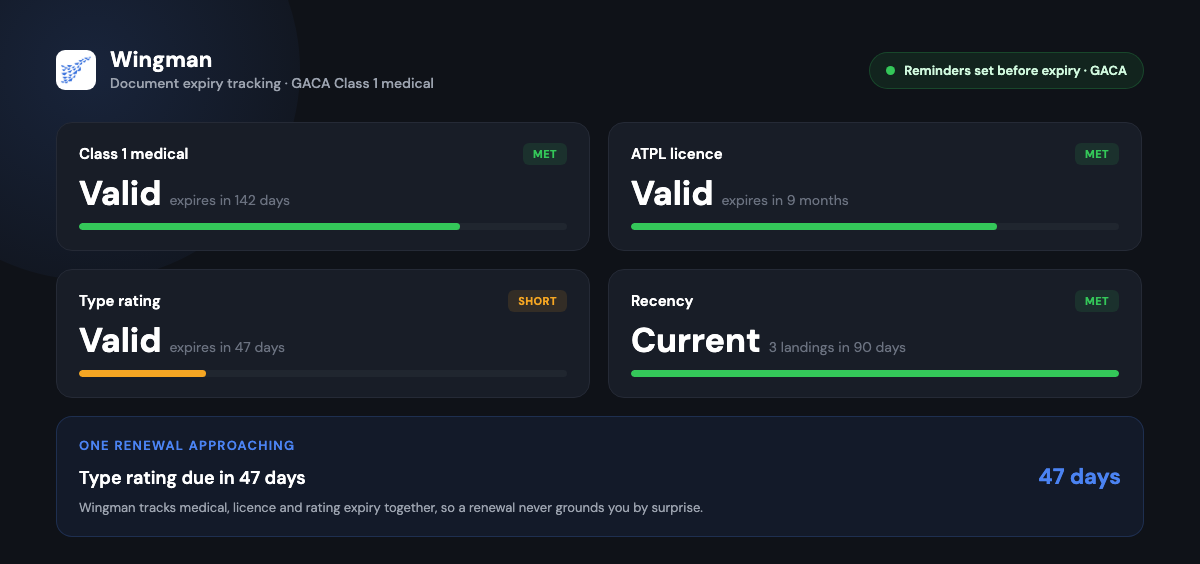
The hardest part of staying compliant is rarely the exam. It is remembering that your medical, licence, ratings, and recency all expire on different dates, often months apart, while you are flying a full roster. A single missed renewal can ground you even when everything else is current.
A digital logbook closes that gap. Wingman is used by 30,000+ pilots across 400+ airlines to keep flight time, currency, and document expiry in one place across iOS, Android, and Web. It imports your roster automatically from systems including AIMS eCrew, NavBlue RAIDO, CAE Crew Access, and Sabre, and it tracks expiry dates for your medical and licence so a renewal does not creep up on you. For Saudi and wider Gulf pilots, exports are produced in formats that line up with GACA and GCAA requirements alongside the FAA, EASA, UK CAA, and others.
There is a free tier up to 250 logged hours, so you can start tracking your documents before committing anything. You can create an account and start logging in a few minutes.
If your renewal involves more than the medical, our Saudi GACA pilot licence renewal checklist walks through the licence side, and our guide to the logbook differences between GCAA, GACA, and other Gulf authorities is worth reading if you fly across the region.
Helpful official references
Frequently asked questions
Who needs a GACA Class 1 medical certificate?
Anyone exercising the privileges of a commercial licence in Saudi Arabia needs a valid Class 1 certificate. That includes CPL and ATPL holders and anyone flying for hire or reward. Private pilots operate on a Class 2 certificate, which applies a less demanding standard.
How long is a GACA Class 1 medical valid?
Validity is not fixed and shortens with age. As a general ICAO-aligned framework, a Class 1 certificate is often valid for 12 months and reduces to 6 months past a defined age threshold, with further reductions for some single-pilot passenger operations. [VERIFY] Confirm the exact period and threshold against your own certificate and current GACA rules, since they can differ between authorities and change over time. [VERIFY]
When are ECG and audiometry tests required?
An ECG is taken at the initial exam and then repeated at renewal on a schedule tied to your age and cardiac history. Audiometry follows the same pattern, with a baseline at the initial exam and periodic testing that becomes more frequent as you get older. [VERIFY] Your AME confirms which tests are due at each visit.
What happens if I have a disqualifying condition?
A condition that would normally be disqualifying does not automatically end your career. GACA runs a waiver and special-issuance process under which you can be assessed for a certificate subject to monitoring, further reports, or operating limitations. [VERIFY] It usually needs specialist evidence that the condition is controlled and can take longer than a standard renewal, so begin the process early.
How far ahead should I book my medical?
Book ahead of expiry, and allow extra margin during airline recruitment peaks when authorised centres are busiest. [VERIFY] A straightforward exam is usually completed in one visit, but if a result needs a specialist report the certificate can be deferred until that report is reviewed, so leave room before your current certificate lapses.
← All articles