Indian aviation growth and the COVID-19 impact: where the market stands now
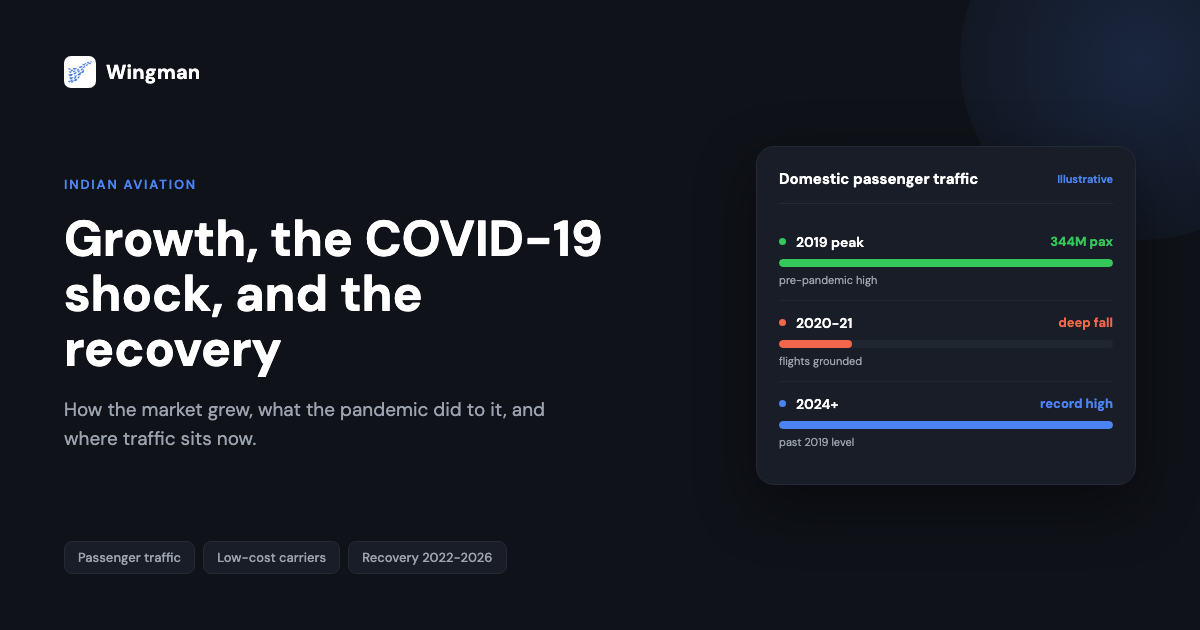
Indian aviation has been one of the fastest-growing air travel markets in the world, and then COVID-19 stopped almost all of it for the better part of two years. This post looks at how the market grew, what the pandemic did to it, and where domestic and international traffic actually sit now that the recovery has run its course. The aim is a plain, sourced picture rather than the “new normal” framing that was common when flights first resumed.
If you are a pilot or a cadet reading this, the numbers matter for a practical reason: they shape hiring, fleet orders, and how quickly you build hours. We close with what the recovery means for the flying side of the industry.
How Indian aviation grew
The commercial story is usually traced to the early years of scheduled flying in India, but the growth that built today’s market is more recent and came from a few clear drivers. The headline figures below are widely cited in industry and regulatory reporting, and each should be confirmed against the primary source before publication.
- Passenger traffic. India’s total air passenger numbers rose from roughly 18 million in the early 1990s to about 344 million in 2019, the last full year before the pandemic, according to widely reported DGCA and airport operator figures. [VERIFY]
- Low-cost carriers. The arrival of low-cost carriers such as IndiGo, SpiceJet and the former GoAir reshaped domestic flying. LCCs account for the large majority of the domestic market, a share often put at around 65 percent or higher. [VERIFY]
- Fleet growth. To meet demand, Indian carriers expanded their fleets from roughly 150 aircraft around 2000 to more than 650 by 2019. [VERIFY]
- International connectivity. International passengers carried to and from India grew from about 15 million in 2000 to over 70 million by 2019. [VERIFY]
- Airport infrastructure. Major hubs including Delhi, Mumbai and Bengaluru were modernised and expanded, and new greenfield airports were planned to absorb the rising traffic.
Behind these numbers sat economic liberalisation, rising middle-class incomes, and policy moves such as the regional connectivity scheme that subsidised flights on thinner routes. India was, on the eve of the pandemic, frequently described as the third-largest domestic aviation market in the world by passengers carried, behind the United States and China. [VERIFY]
The COVID-19 shock
The growth curve broke in March 2020. India suspended scheduled domestic flights from 25 March 2020 and scheduled international passenger flights from earlier that month, with operations grounded for roughly two months before domestic services resumed in a capped, phased way. [VERIFY] The effects were immediate and severe.
- Traffic collapse. With lockdowns and capacity caps in place, passenger volumes fell to a small fraction of normal levels, and the financial year 2020 to 2021 saw domestic traffic far below the 2019 peak. [VERIFY]
- Airline finances. Prolonged grounding and capped capacity put pressure on every Indian carrier. Some restructured, and the period contributed to the eventual change of ownership at Air India, which returned to the Tata group in 2022. [VERIFY]
- Jobs and pay. Airlines cut costs through layoffs, leave-without-pay arrangements and salary reductions that reached pilots, cabin crew, ground staff and engineering teams. [VERIFY]
- Airports and the wider chain. Airport operators, retail concessionaires and ground handlers all lost revenue that depends directly on passenger throughput.
- An uneven restart. Even after domestic flying resumed in May 2020, capacity caps on the number of flights and on fares stayed in place into 2022, which slowed the return to normal. [VERIFY]
The recovery: 2022 to 2026
This is the part of the story that the original version of this post could not tell, because it was written while the outcome was still uncertain. The recovery has now largely played out, and the direction is clear even where exact figures need checking.
Domestic capacity caps were removed in 2022, and Indian domestic passenger traffic returned to and then passed its pre-pandemic level. Industry and regulator reporting through 2023 and 2024 described domestic traffic at record highs, surpassing the 2019 baseline. [VERIFY] International traffic to and from India also recovered as countries reopened, with full-service and low-cost carriers rebuilding long-haul and regional networks. [VERIFY]
Two structural changes stand out from the recovery period:
- Consolidation and large fleet orders. The market consolidated around a smaller number of strong groups, and Indian carriers placed some of the largest aircraft orders in commercial aviation history during 2023, signalling confidence in long-run demand. [VERIFY]
- A return to hiring. As capacity came back and fleets grew, demand for pilots and cabin crew recovered, reversing the job losses of 2020 and 2021. [VERIFY]
The honest summary is that the pandemic was a deep but temporary shock to a market with strong underlying demand. The “new normal” that some predicted, with permanently lower flying, did not arrive for Indian domestic aviation. Traffic recovered and growth resumed.

What changed for good
Not everything reset to 2019. A few shifts that began as crisis responses have stayed:
- Digital and contactless processes. Online check-in, digital boarding and contactless steps that accelerated during the pandemic have largely remained part of the airport experience.
- Cargo as a serious line of business. Carriers leaned on cargo, including passenger aircraft converted to carry freight, when passenger demand was gone. Dedicated cargo capacity has kept a higher profile since. [VERIFY]
- A sharper focus on costs and resilience. The shock left airlines and airports more focused on balance-sheet strength and on the ability to scale capacity up and down quickly.
What the recovery means for pilots
For pilots and cadets, the practical takeaway is that the hours are flowing again. Recovered traffic and large fleet orders mean more flying, more recruitment and faster progression than during the 2020 to 2021 freeze. That makes accurate, up-to-date hour records more useful than ever, both for currency and for the next application.
This is where a digital logbook helps. Wingman is a pilot logbook used by 30,000+ pilots across 400+ airlines, and it keeps your hours, currency and licence details in one place across iOS, Android and Web. Rosters import automatically from systems including AIMS eCrew, NavBlue RAIDO, CAE Crew Access, ARMS, CESAR, Sabre, FLICA and PDC CrewConnex, so the log stays current without manual entry.
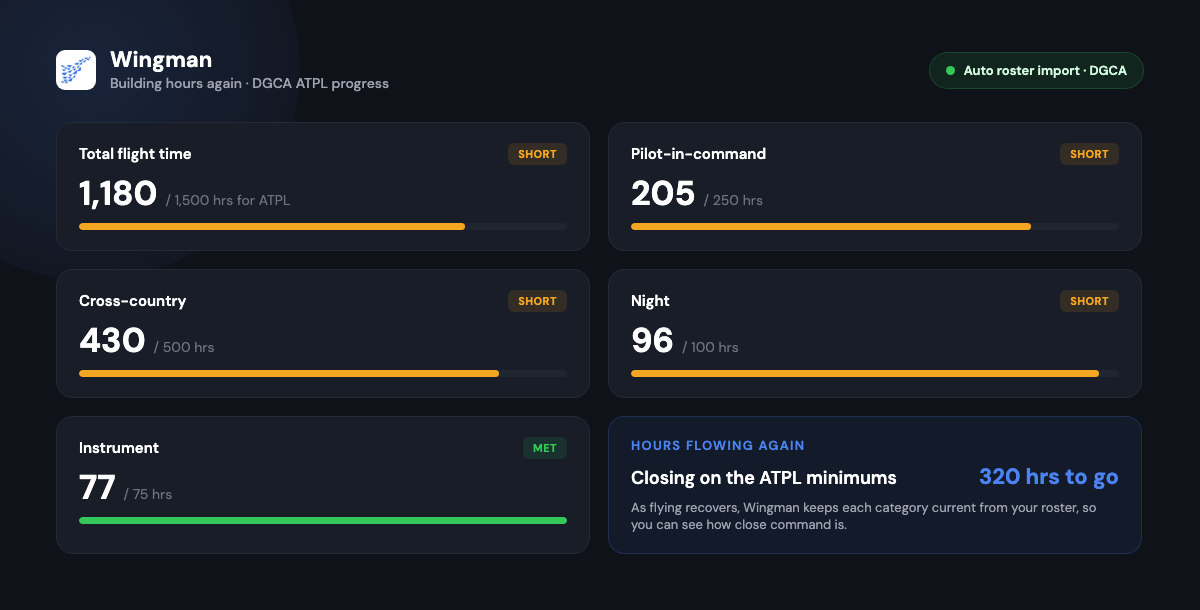
Wingman is a global product rather than an India-only tool, and it produces regulator-compliant exports for the DGCA alongside the FAA, EASA, UK CAA, GCAA, GACA, NZCAA, HKCAD, CASA and CAAS. For India specifically there is a focused walkthrough on keeping a DGCA pilot logbook in India. There is a free tier up to 250 logged hours, so you can start recording while you build toward a licence or rebuild hours after a gap, and Pro is ₹4,499 per year in India when you need the full feature set.
Frequently asked questions
How big was Indian aviation before COVID-19?
In 2019, the last full pre-pandemic year, India carried roughly 344 million air passengers in total and was frequently described as the third-largest domestic market in the world by passengers. The fleet had grown past 650 aircraft. These figures are widely reported from DGCA and airport operator data and should be confirmed against the primary source. [VERIFY]
How badly did COVID-19 hit Indian aviation?
Scheduled domestic flights were suspended from 25 March 2020 and resumed in a capped, phased way from late May 2020, while international scheduled passenger flights were grounded for longer. Traffic fell to a small fraction of normal during the worst of the disruption, and airlines cut jobs and pay to survive. [VERIFY]
Has Indian air travel recovered to pre-pandemic levels?
Yes for domestic traffic. After capacity caps were removed in 2022, domestic passenger numbers returned to and then passed the 2019 baseline, with record highs reported through 2023 and 2024. International traffic also recovered as borders reopened. [VERIFY]
Did the “new normal” of permanently reduced flying happen?
No, not for Indian domestic aviation. The deep fall in 2020 and 2021 was temporary, and traffic recovered and resumed growing. Some operational changes stayed, such as contactless processes and a stronger cargo business, but overall flying did not settle permanently lower. [VERIFY]
What does the recovery mean for pilot hiring?
Recovered traffic and large fleet orders placed in 2023 have driven renewed demand for pilots and cabin crew, reversing the layoffs of the pandemic period. For pilots this means more flying and faster progression, which makes keeping accurate hour records worthwhile. [VERIFY]
← All articles