Heliport registration on eGCA: how the process works and what you need
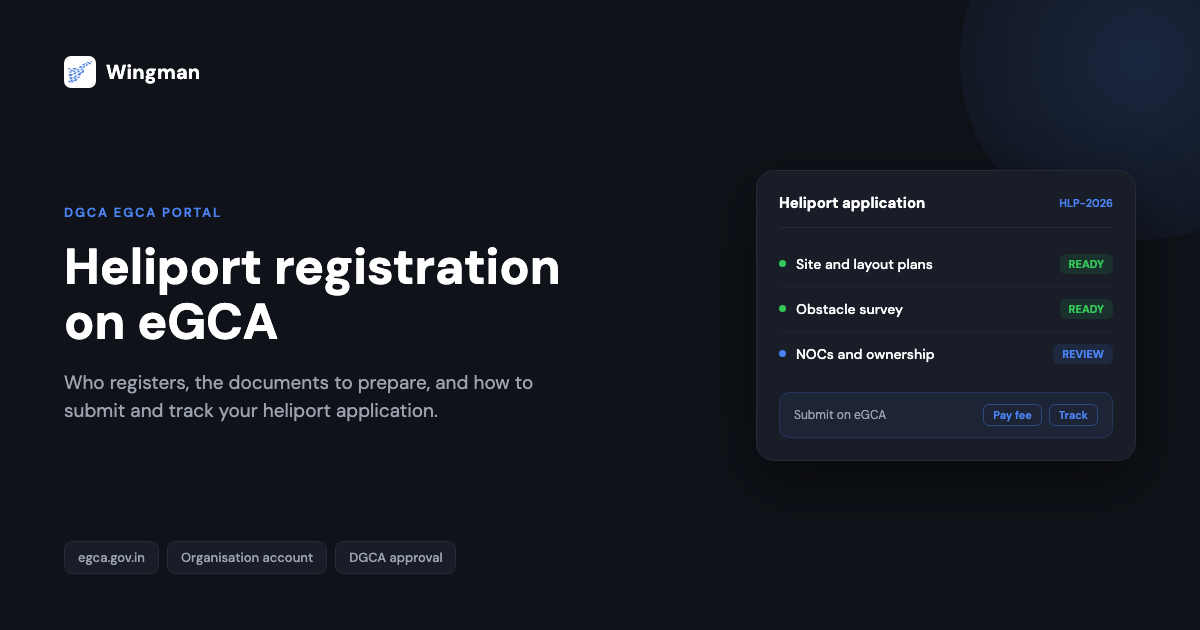
If you own or operate a heliport in India, your dealings with the Directorate General of Civil Aviation (DGCA) now run almost entirely through eGCA, the e-Governance of Civil Aviation portal. Heliport registration is the step that gives your organisation an account on that portal and lets you apply for the approvals a heliport needs to operate. It sits at https://www.egca.gov.in, and most heliport projects touch it early, so it helps to understand what the process involves before you start filling in forms.
This guide gives you a plain overview of heliport registration on eGCA: who needs it, what you should have ready, and the core steps from creating an organisation account through to submitting your application and tracking approval. The original version of this post simply pointed to an attached PDF. Here the steps are written out so you can work through them with the portal open in another tab. Where a specific portal label or requirement should be confirmed against the live system, it is marked clearly so you can check it before relying on it.
What heliport registration on eGCA is for
eGCA is the single digital front door DGCA uses for licensing, approvals, and regulatory services across Indian civil aviation. For a heliport, registration is the organisational equivalent of creating a candidate profile: it establishes your entity on the portal, links your authorised contact person, and unlocks the heliport-related services you then apply for. Without a registered organisation account, you cannot submit a heliport licence or authorisation application online. [VERIFY]
It is worth being clear about what registration is and is not. Registering your organisation on eGCA is the access step. The actual heliport licence or operating authorisation is a separate application you make once you are registered, and it carries its own document requirements, inspection, fee, and approval stages. Treating these as two phases keeps the paperwork manageable and avoids the common mistake of expecting an approval to fall out of the registration step alone.
Before you start: eligibility and who registers
Heliport registration is made by the organisation responsible for the heliport, not by an individual pilot. In practice this is the heliport owner or the operating entity, acting through an authorised signatory who will manage the eGCA account. You should know which legal entity is applying and who within it will hold the login, because the account and its submissions are tied to that person’s credentials. [VERIFY]
A few things are worth settling before you create the account:
- The legal status of the applicant entity, for example a company, trust, government body, or proprietorship, and its registration details.
- The authorised person’s identity documents and contact details, since eGCA uses these to verify the account holder. [VERIFY]
- The site location and basic particulars of the proposed or existing heliport, so the application reflects the correct coordinates and classification.
Settling these first means the registration and the application that follows describe the same entity and site consistently, which reduces back-and-forth later.
The document checklist
The exact set of documents DGCA asks for depends on whether the heliport is new or already operating, and on the surface and surrounding environment. As a planning checklist, gather the following early so you are not chasing paperwork mid-application. Confirm the current required list against the eGCA heliport service page before you submit, because DGCA periodically updates requirements. [VERIFY]
- Proof of ownership or lawful possession of the heliport site. [VERIFY]
- Site and layout plans showing the touchdown and lift-off area, final approach and take-off area, and safety areas. [VERIFY]
- An obstacle and obstruction survey covering the approach and departure paths. [VERIFY]
- No-objection certificates from the relevant local, state, and security authorities. [VERIFY]
- Details of firefighting, rescue, and safety provisions at the site. [VERIFY]
- Identity and authorisation documents for the entity and its authorised signatory. [VERIFY]
Treat this as a starting point rather than the final list. The portal’s heliport service typically presents the authoritative checklist for your specific case once you begin the application, and that on-screen list is the one to follow.
How to register on eGCA for heliport services
Once your entity details and authorised signatory are settled, the registration itself is a short sequence. Follow these steps with the portal open.
-
Open your web browser and go to the eGCA portal at https://www.egca.gov.in. This is the official DGCA e-governance platform for licensing and approvals.
-
Choose the registration option for an organisation or service applicant rather than an individual pilot, and start a new account for your entity. [VERIFY]
-
Enter your organisation and authorised-person details as prompted, including the legal entity particulars and the signatory’s identity and contact information. Use details that match your supporting documents exactly. [VERIFY]
-
Verify your contact details. eGCA confirms the account using the email address and mobile number you provide, so complete any one-time verification it sends before continuing. [VERIFY]
-
Sign in to your new account and locate the heliport service. From the dashboard, open the relevant aerodrome or heliport approval service to begin your application. [VERIFY]
-
Complete the heliport application form, upload the documents from the on-screen checklist, and pay the applicable fee through the portal’s payment option. [VERIFY]
-
Submit the application and note the reference or application number. You use this to track status and to respond to any queries DGCA raises during review. [VERIFY]
After submission, DGCA reviews the application and supporting documents, may arrange a site inspection, and then communicates the outcome through the portal. Keep your login details safe, because all correspondence, queries, and the final decision are handled through the same account.
Heliport registration and application flow

If the heliport service does not appear after you sign in, it is usually because the account is still being verified or the entity type selected during registration does not match the service. In that case, confirm your account status and the entity details rather than creating a second account, since duplicate registrations complicate the record.
Fees, review, and approval
The fee for a heliport application is paid through the portal at the point of submission, and the amount depends on the category of approval you are seeking. Check the current fee on the eGCA heliport service page or the DGCA fee schedule before you pay, as published amounts are revised from time to time. [VERIFY]
Approval is not instant. After submission, your application moves through document scrutiny and, where required, a physical inspection of the site against the applicable heliport design and safety standards. DGCA may return queries that you answer through the portal. Because timelines depend on the completeness of your submission and inspection scheduling, the most reliable way to keep things moving is to submit a clean, complete application the first time and to respond promptly to any queries. [VERIFY]
Keeping flight records once the heliport is operating
Heliport registration is an organisational and regulatory milestone. Once helicopters are operating to and from the site, the pilots flying those movements still need to record their hours accurately, and that is a separate but related discipline. Wingman is a digital pilot logbook used by 30,000+ pilots across 400+ airlines, and it keeps hours, currency, and licence details in one place across iOS, Android, and Web.
Wingman is a global product rather than an India-only tool, and it produces regulator-compliant exports for DGCA alongside the FAA, EASA, UK CAA, GCAA, GACA, NZCAA, HKCAD, CASA, and CAAS. For India specifically, there is a focused walkthrough on keeping a DGCA pilot logbook in India. There is a free tier up to 250 logged hours, so helicopter pilots can start logging without committing anything up front, and you can open the app to set up a profile whenever you are ready.
How heliport registration fits the wider eGCA picture
eGCA is the same portal pilots and operators use for a range of DGCA processes, which is why the registration mechanics feel familiar across different services. If you are also setting up individual access, our guides on how to get your eGCA ID and the pilot registration process with eGCA explain the account flow for pilots and what to expect from the portal. Heliport registration is a distinct organisational procedure with its own documents and approvals, so keep it separate from operator, training-organisation, and pilot registrations even though they share the eGCA front door.
Frequently asked questions
What is heliport registration on eGCA?
It is the step that creates your organisation’s account on the eGCA portal so you can apply online for the heliport approvals DGCA issues. Registration establishes the entity and authorised signatory; the heliport licence or authorisation is a separate application you make once registered. [VERIFY]
Who can register a heliport, the owner or a pilot?
The registration is made by the organisation responsible for the heliport, typically the owner or operating entity, acting through an authorised signatory who holds the eGCA login. It is not an individual pilot registration. [VERIFY]
What documents do I need for heliport registration?
As a planning list, expect to need proof of site ownership or possession, site and layout plans, an obstacle survey, no-objection certificates from relevant authorities, safety and firefighting provisions, and identity and authorisation documents for the entity. The portal presents the authoritative checklist for your case once you begin the application. [VERIFY]
How long does heliport approval take on eGCA?
There is no single fixed timeline. After submission the application goes through document scrutiny and, where required, a site inspection, with any queries handled through the portal. A complete, accurate submission and prompt responses are the most effective way to avoid delays. [VERIFY]
Is heliport registration the same as registering as a pilot on eGCA?
No. Pilot registration creates an individual eGCA identity, while heliport registration creates an organisational account for applying for heliport approvals. They use the same portal but are separate procedures with different requirements.
← All articles