How to maintain accurate flight records: a pilot's guide
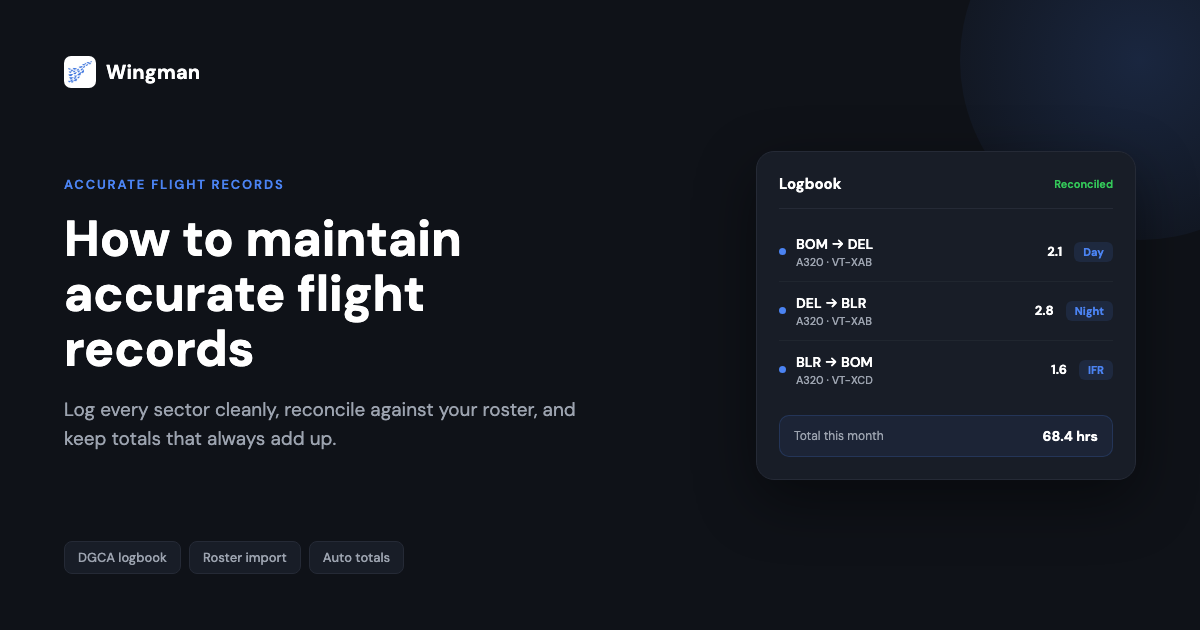
Your flight records are the evidence of everything you have flown. They decide whether you can renew a licence, claim a rating, satisfy currency rules, or move to a new operator. When the numbers are clean, none of that is a problem. When they are not, a single inconsistent entry can hold up a renewal or a job offer until you can prove what actually happened. Maintaining accurate flight records is therefore less about neat handwriting and more about building a log you can stand behind years later.
This guide explains what an accurate flight record looks like, what the Directorate General of Civil Aviation (DGCA) expects from a logbook in India, why records get rejected, and a practical routine you can follow after every flight. The steps work the same whether you fly a training aircraft, a turboprop, or a wide-body jet, and whether you keep a paper book, a spreadsheet, or a digital logbook.
What counts as an accurate flight record
A flight record is accurate when each entry is complete, consistent, and verifiable against an independent source such as a roster, a release, or the aircraft technical log. At a minimum, a single logbook entry usually captures:
- Date of flight
- Aircraft type and registration
- Departure and arrival aerodromes
- Off-block, on-block, or block-to-block times
- Total flight time, split into the capacities you flew in (for example pilot-in-command, co-pilot, or pilot-in-command under supervision)
- Conditions of flight, such as day, night, and instrument time
- Landings, including day and night landings
- Any function relevant to currency, such as instructor or examiner time
Accuracy is not only about the headline total. The breakdown matters just as much, because licensing and currency requirements are written in terms of specific categories: night hours, instrument time, multi-engine time, pilot-in-command time, and recent landings. If your totals are right but your night or instrument split is muddled, the record can still fail to support the claim you need it to make.
What DGCA expects from your logbook in India
In India, the personal flight logbook is a regulatory document, not a personal diary. DGCA sets out how flight crew must record flying experience through its Civil Aviation Requirements (CAR), and the prescribed personal logbook format is commonly referred to as the CA 39 logbook. [VERIFY] The principle behind the rules is straightforward: the logbook must let DGCA, an operator, or an examiner reconstruct your experience and confirm it is genuine.
A few points are worth keeping front of mind for an Indian logbook:
- Entries should be contemporaneous, meaning logged at or close to the time of the flight rather than reconstructed months later.
- Flight time should be recorded on the basis DGCA prescribes, typically block-to-block or chock-to-chock time, and applied consistently. [VERIFY]
- Capacity matters: time logged as pilot-in-command, co-pilot, or pilot-in-command under supervision must reflect the role you actually held on that sector. [VERIFY]
- Entries are certified, and totals are carried forward from page to page so that the running experience is auditable. [VERIFY]
If you want the field-by-field detail, our walkthrough on the DGCA logbook entry format covers how each column is meant to be filled. It is worth reading before you settle into a logging habit, because correcting a consistent mistake across hundreds of entries is far harder than getting the format right from the start.
Why flight records get rejected
Most logbook problems are not dramatic. They are small, repeated inconsistencies that only surface when someone audits the book during a licence renewal, a rating application, or an airline document check. The common ones include:
- Totals that do not add up when columns are summed and carried forward
- Flight time that does not match the operator roster, the journey log, or the aircraft technical log
- Capacity logged incorrectly, for example claiming pilot-in-command time for a sector flown under supervision
- Missing night or instrument splits, so currency cannot be demonstrated
- Gaps where flights were flown but never entered, or duplicates where the same sector was logged twice
- Corrections made in a way that looks like the record was altered after the fact
We have collected the most frequent ones in a dedicated post on CA 39 mistakes that get a DGCA logbook rejected. The pattern across almost all of them is the same: the entry could not be reconciled with an independent source. That is the core idea behind everything in the next section.
How to maintain accurate flight records, step by step
Accuracy comes from a routine you repeat, not from a one-off cleanup. The following steps form a habit you can run after every flight and review at the end of every month.
-
Log immediately after the flight. Enter the sector while the details are still in front of you on the roster, release, or technical log. Reconstructing times from memory days later is the single biggest source of error.
-
Record from the source, not from recall. Take your off-block and on-block times, registration, and route from an authoritative record rather than estimating. If your operator uses a crew system or roster, treat that as the reference and copy the numbers across exactly.
-
Log the full breakdown, not just the total. Split each flight into day, night, and instrument time, record the correct capacity, and note landings. Currency rules are written in these categories, so capturing them at entry time saves you from rebuilding them later.
-
Reconcile against an independent record. Before you consider an entry final, check it against the roster or journey log. The flight time, date, and route should match. If they do not, resolve the difference now while you can still find out why.
-
Carry totals forward correctly. At the end of each page or month, sum the columns and carry the running totals forward. A small arithmetic slip that compounds over years is one of the hardest problems to unwind, so verify the carry-forward each time.
-
Make corrections cleanly. If you need to fix an entry, correct it in a way that leaves the original visible and the change traceable, rather than overwriting it. An auditor needs to see that the record was maintained honestly.
-
Review on a schedule. Once a month, scan for gaps, duplicates, and totals that look off. A short regular review catches problems while they are still one or two entries, not hundreds.
-
Back up your records. A paper logbook can be lost or damaged, so keep a copy. A digital logbook should sync to the cloud so a lost phone never means a lost career record.
A simple monthly logging routine

Paper, spreadsheet, or digital logbook
The method you choose changes how easy the routine above is to keep up, not what the routine is.
- A paper logbook is simple and needs no power, but every total is added by hand, there is no automatic check against your roster, and there is no backup unless you make one. The risk sits entirely with you.
- A spreadsheet adds automatic arithmetic and is searchable, but you build and maintain the structure yourself, formulas can break silently, and it still relies on you to enter every flight from scratch and keep it backed up.
- A digital logbook app is built for the job. It can pull flights in from your roster, calculate the splits and running totals for you, flag entries that do not reconcile, and back everything up automatically.
For background on why crews are moving away from manual methods, see how digital tools are simplifying aviation record-keeping. The direction of travel is clear: the more of the reconciliation and arithmetic the tool handles, the fewer chances there are for the small errors that get records rejected.
Where a digital logbook helps
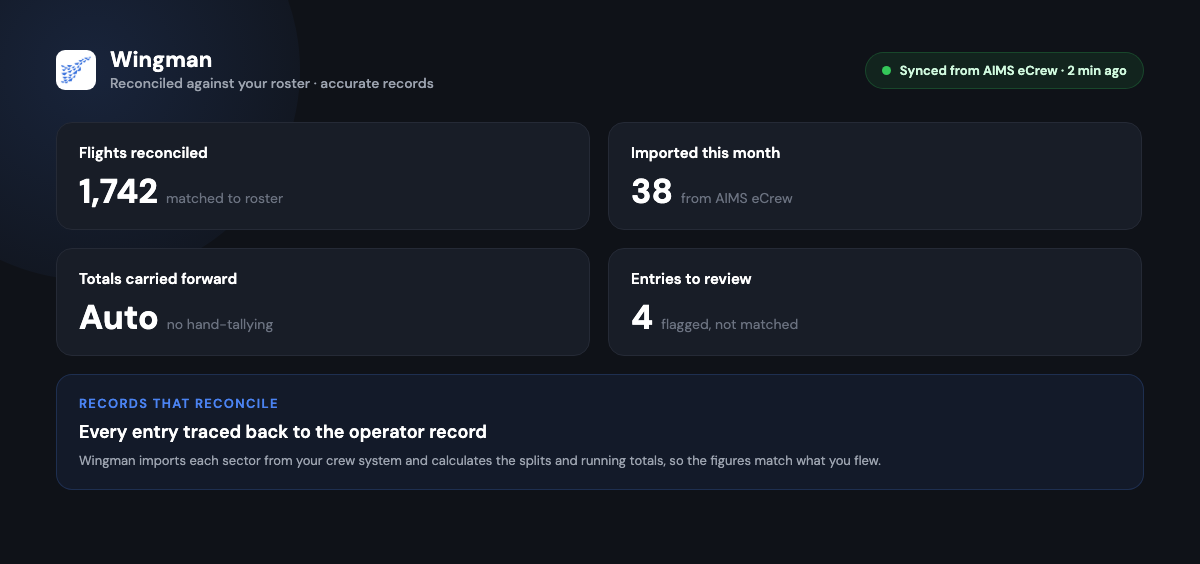
Most of the work in maintaining accurate records is reconciliation: making sure what is in your logbook matches what you actually flew. This is exactly where a purpose-built logbook earns its place. Wingman is a pilot logbook used by 30,000+ pilots across 400+ airlines, and it keeps your hours, currency, and licence details in one place across iOS, Android, and Web.
The part that removes the most errors is automatic roster import. Wingman can bring flights in directly from crew systems including AIMS eCrew, NavBlue RAIDO, CAE Crew Access, ARMS, CESAR, Sabre, FLICA, and PDC CrewConnex, so your entries start from the operator’s own record rather than from memory. From there it calculates your splits and running totals, and produces regulator-compliant exports for DGCA along with the FAA, EASA, UK CAA, GCAA, GACA, NZCAA, HKCAD, CASA, and CAAS. Wingman is a global product rather than an India-only tool, but for Indian pilots specifically there is a focused walkthrough on keeping a DGCA pilot logbook in India.
There is a free tier up to 250 logged hours, so you can start keeping clean records from your training flights without committing anything up front. If you are weighing it against a paper book or a spreadsheet, you can create an account and import a roster to see how much of the routine it handles for you. Pro is $59 per year ($4.99 per month billed annually, or ₹4,499 per year in India) once you pass the free tier.
Frequently asked questions
How do I keep my flight records accurate over a long career?
Build a routine you repeat after every flight rather than relying on periodic cleanups. Log each sector the same day from an authoritative source, record the full breakdown of day, night, instrument, and capacity, reconcile the entry against your roster or journey log, carry totals forward correctly, and back the record up. A short monthly review catches problems while they are still small.
What does DGCA require in a pilot logbook in India?
DGCA prescribes how flight crew record flying experience through its Civil Aviation Requirements, using the personal logbook format commonly known as CA 39. [VERIFY] Entries should be contemporaneous, flight time recorded on the basis DGCA prescribes, capacity logged to reflect the role actually flown, and totals certified and carried forward so the experience is auditable. [VERIFY] See our DGCA logbook entry format guide for the field-by-field detail.
Is a digital or electronic logbook acceptable to regulators?
Electronic logbooks are widely used and accepted, provided the records are complete, accurate, and exportable in the format the regulator expects. The detail varies by authority, so it is worth checking the rules that apply to you. Our guide on whether electronic pilot logbooks are legal under FAA and EASA rules covers the principle that applies across regulators.
Why do logbooks get rejected during a renewal or job check?
Almost always because an entry cannot be reconciled with an independent source. Totals that do not add up, flight time that does not match the roster or technical log, capacity logged incorrectly, missing night or instrument splits, and corrections that look like later alterations are the usual causes. We cover the frequent ones in CA 39 mistakes that get a DGCA logbook rejected.
Should I log flight time from memory if I forgot at the time?
No. Reconstructing times from memory is the largest single source of error. Go back to an authoritative record such as the roster, the journey log, or the aircraft technical log and log from that. If a flight was genuinely missed, enter it from the source and note that it was a later correction rather than guessing the numbers.
← All articles