How to apply and renew RTR(A) in India: issue, renewal, and conversion
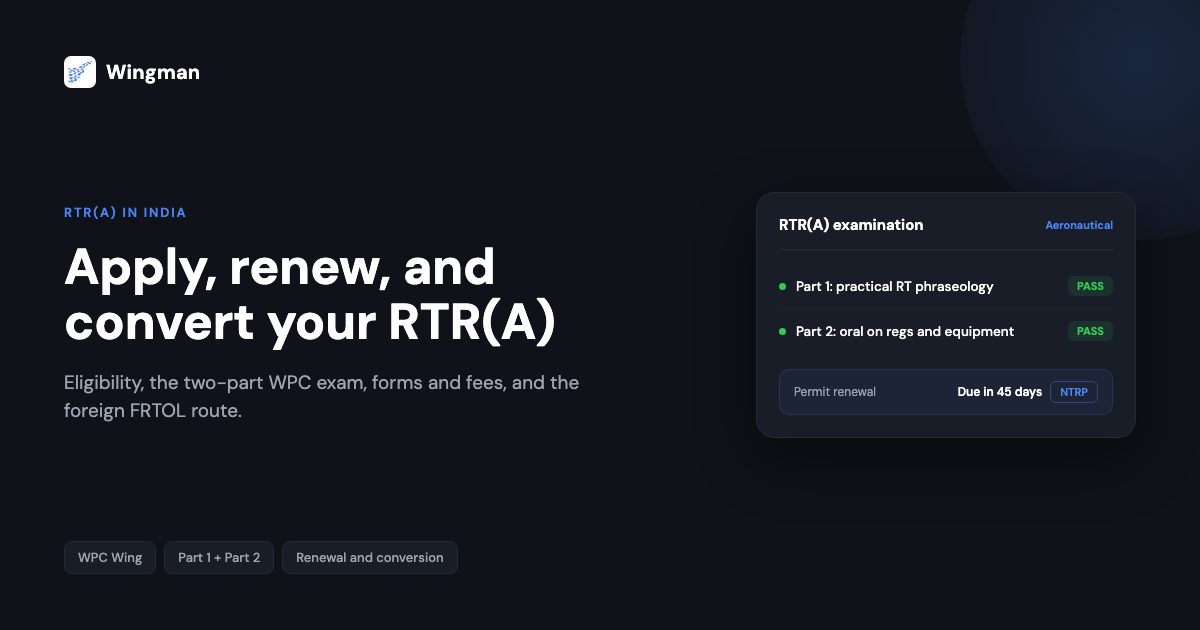
If you fly or plan to fly in Indian airspace, you need a Radio Telephony Restricted (Aeronautical) licence, usually written as RTR(A), to operate the radio communication equipment on board. This guide walks through the practical side of the RTR(A) in India: who is eligible, how to apply, what the examination actually involves, and how to handle renewal and the conversion of a foreign licence. It is written so you can follow it with the relevant forms and portals open in another tab.
The RTR(A) sits alongside your flying licence rather than replacing it. Holding a Commercial Pilot Licence (CPL) or Airline Transport Pilot Licence (ATPL) does not by itself authorise you to transmit on aeronautical frequencies in India, which is why the RTR(A) is a separate certificate with its own examination and its own renewal cycle. Knowing how the pieces fit together saves you from discovering a requirement at the wrong moment.
Which RTR licence you need
The Indian system issues a few related certificates, and it helps to match yourself to the right one before you apply.
- RTR(A), the Radio Telephony Restricted (Aeronautical) licence, is the one most pilots need. It covers the operation of radio transmitting equipment on board aircraft in aeronautical mobile service.
- RTR(C) is issued against a foreign Flight Radio Telephony Operator Licence (FRTOL) once you have cleared the RTR(A) Part 1 examination. [VERIFY]
- RTR(P), sometimes referenced for personnel operating radio equipment in non-aeronautical mobile services, runs on its own validity cycle and is not the pilot certificate. [VERIFY]
If you completed your CPL outside India and want to fly registered Indian aircraft, the route usually points toward an Indian RTR(A), or an RTR(C) issued against your existing foreign FRTOL. The right path depends on the documents you already hold, so confirm the current categories before you pay any fee.
Eligibility for the RTR(A)
Before you apply, check that you meet the basic criteria. [VERIFY]
- Age. You should be at least 18 years old.
- Education. A minimum qualification of 10+2 with Physics and Mathematics is generally expected.
- Language. Proficiency in English, because the examination and aeronautical communication are conducted in English.
These are the common entry conditions rather than an exhaustive list, so read the current notification from the issuing authority before you submit anything.
How to apply for an RTR(A) licence in India
The examination side of the RTR(A) is administered by the Wireless Planning and Coordination (WPC) Wing, which sits under the Ministry of Communications, while licence and related pilot processes run through the Directorate General of Civil Aviation (DGCA). The application flow below covers the examination route.
-
Submit your application. Apply to the WPC Wing using the current application form. The form is available through the WPC portal. Fill it in carefully and make sure every detail matches your supporting documents. [VERIFY]
-
Pay the examination fee. Pay the fee specified by the WPC through the prescribed channel, which is generally an online payment via the government receipt portal. Keep the payment reference. [VERIFY]
-
Prepare for the two-part examination. The RTR(A) examination is made up of Part 1 and Part 2, described in the next section. Plan your preparation around both before you book a slot.
-
Sit and clear both parts. Pass Part 1 and Part 2 to qualify for the licence.
-
Apply for issue of the licence. Once you have cleared the examination, complete the issue paperwork and pay the prescribed issue fee through the government receipt portal. [VERIFY]
What the RTR(A) examination involves
This is the area candidates most often get confused about, so it is worth stating plainly. The RTR(A) examination has two parts, and they test different things.
- Part 1 is a practical assessment. You are expected to hold a conversation using standard radio telephony phraseology, handling routine and non-routine situations the way you would on a live frequency. [VERIFY]
- Part 2 is an oral examination. It tests your knowledge of radio telephony regulations and the radio equipment and instruments used in aeronautical communication. [VERIFY]
The underlying subject knowledge spans aviation meteorology, navigation, the principles of radio communication, and the relevant regulations. Standard phraseology, distress and emergency procedures, and the correct handling of communication failures all come up, so practising simulated exchanges out loud is as important as reading the theory. Candidates often prepare from established radio telephony and aviation regulation references; choose current editions rather than older printings. [VERIFY]
For a deeper walkthrough of the application route and the exam pattern, see the companion guide on the RTR examination, which complements this page rather than repeating it.

Converting a foreign RTR or FRTOL
If you hold a UK FRTOL or a radio telephony licence from a Commonwealth country, you generally go through a validation route rather than starting from scratch. In practice this means producing documentation of your existing licence, completing the prescribed paperwork, and meeting any additional Indian requirements that apply to your case. The exact steps and any examination component depend on the originating authority and the current rules, so confirm them before you book travel or pay fees. [VERIFY]
Issue of an RTR(C) against a foreign FRTOL
Where the route is an RTR(C) issued against a foreign FRTOL, the typical pattern is:
- Qualification. Clear the RTR(A) Part 1 examination. [VERIFY]
- Application. Complete the prescribed forms, commonly cited as Annexure 1-A and Form AF-1. [VERIFY]
- Documents. Provide an attested copy of your valid FRTOL, two passport-size photographs, and an undertaking. [VERIFY]
- Payment. Pay the prescribed fee through the government receipt portal. [VERIFY]
Extension and renewal of an RTR permit
An RTR permit does not run indefinitely, so plan the renewal before it lapses to avoid late fees. The commonly cited renewal pattern is: [VERIFY]
- Application. Complete the renewal forms, commonly referenced as Form COP 23 and Annexure 1-A. [VERIFY]
- Documents. Provide attested copies of your foreign FRTOL, valid flight crew licences, an experience certificate, your passport, and two passport-size photographs. [VERIFY]
- Payment. Pay the renewal fee through the government receipt portal, with any late fee that applies if you have run past the due date. [VERIFY]
Because government forms, fee amounts, and payment channels change from time to time, treat the form numbers and amounts above as a starting checklist and confirm the current versions against the official notification before you submit. Each of these items is tagged for verification for that reason.
Issue of an RTR (Permit)
For the issue of an RTR (Permit) against a foreign FRTOL, the documents commonly requested are an application on the prescribed forms (often cited as AF-1 and Annexure 1-A), attested copies of your foreign FRTOL and your flight crew licences such as CPL, ATPL, or FEL, your passport and visa, and two passport-size photographs, with the prescribed fee paid through the government receipt portal. [VERIFY]
Keeping your hours in order alongside your RTR(A)
Your RTR(A) authorises you to transmit, but your career is recorded in the hours you fly, and those need to be logged accurately from your first dual sortie onward. A digital logbook is the simplest way to keep flight time, currency, and licence details in one place. Wingman is a pilot logbook used by 30,000+ pilots across 400+ airlines, and it runs on iOS, Android, and Web so your record stays in sync wherever you are.
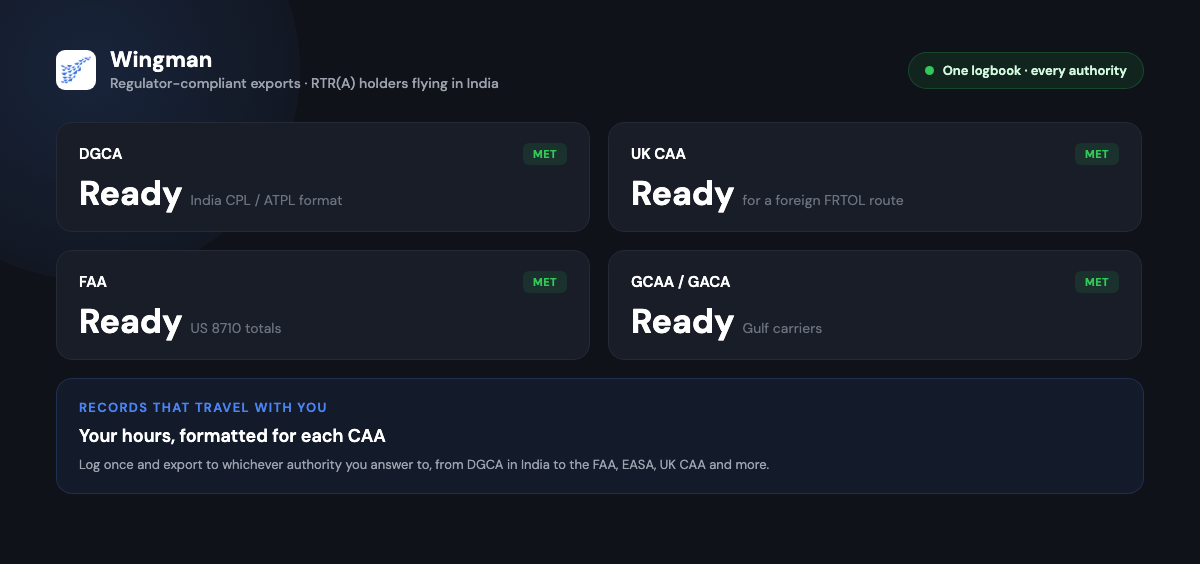
Wingman is a global product rather than an India-only tool, and it produces regulator-compliant exports for DGCA along with the FAA, EASA, UK CAA, GCAA, GACA, NZCAA, HKCAD, CASA, and CAAS. For India specifically, there is a focused walkthrough on keeping a DGCA pilot logbook in India. There is a free tier up to 250 logged hours, so you can start recording while you are still working toward your licences and ratings, and the Pro plan is ₹4,499 per year in India when you need automatic roster import and the full export set.
Frequently asked questions
Which RTR licence should I apply for if I did my CPL outside India?
If you hold a CPL completed outside India and want to operate radio equipment on board aircraft in Indian airspace, the route generally points to an Indian RTR(A), or to an RTR(C) issued against your existing foreign FRTOL. The right option depends on the documents you already hold, so confirm the current categories with the issuing authority before applying. [VERIFY]
How many exams are there for a full Indian RTR(A)?
Two. The RTR(A) examination is made up of Part 1 and Part 2. Part 1 is a practical assessment in which you converse using standard radio telephony phraseology, and Part 2 is an oral examination covering radio telephony regulations and the relevant equipment and instruments. [VERIFY]
How do I prepare for the RTR exams?
Cover both the theory and the spoken practice. The subject knowledge spans aviation meteorology, navigation, the principles of radio communication, and regulations, while the practical side rewards repeated practice of standard phraseology, including distress and emergency procedures. Use current editions of established radio telephony and aviation regulation references, and rehearse exchanges out loud rather than only reading. [VERIFY]
How do I renew or extend an RTR permit?
The commonly cited pattern is to complete the renewal forms (often referenced as Form COP 23 and Annexure 1-A), provide attested copies of your foreign FRTOL, valid flight crew licences, an experience certificate, passport, and two photographs, and pay the renewal fee through the government receipt portal, with a late fee if you have run past the due date. Confirm the current form numbers and fee before you submit, as these change from time to time. [VERIFY]
How can I convert a UK or Commonwealth RT licence to an Indian RTR?
You generally go through a validation route. That means producing documentation of your existing licence, completing the prescribed paperwork, and meeting any additional Indian requirements, which may include an examination component depending on the originating authority. Check the current rules before you commit to travel or fees. [VERIFY]
← All articles