ATPL documentation for NSOP pilots: a simplified guide
If you fly for, or are working toward a job with, a non-scheduled operator in India, the ATPL is usually the licence that opens the captain’s seat. Getting there is less about a single test and more about assembling a complete, accurate set of documents that the Directorate General of Civil Aviation (DGCA) can verify without sending it back to you. This guide explains what an NSOP pilot actually needs for an Airline Transport Pilot Licence, lays out a plain checklist, and walks through how to put the paperwork together so it clears the first time.
The aim here is practical. Rather than describe every regulation, it focuses on the documents most NSOP pilots have to produce, where they tend to go wrong, and how to keep your records in a state that is ready to submit.
What ATPL documentation means for an NSOP pilot
An NSOP, or non-scheduled operator, runs charter and on-demand flights rather than fixed published schedules. Pilots who fly for these operators hold the same DGCA licences as their scheduled-airline counterparts, and the ATPL is issued against the same core requirements. The “documentation” part of the process is the evidence you submit to show that you meet those requirements: proof of flight experience, medical fitness, completed examinations, and the supporting forms that tie it all to your candidate record.
For an NSOP pilot, the documentation usually carries a little extra weight because charter flying produces a varied logbook, with mixed aircraft types, multiple bases, and a wider spread of pilot-in-command and co-pilot time. That variety is an asset, but only if it is recorded cleanly enough for a verifier to follow. A muddled logbook is the single most common reason an application stalls.
Why accurate documentation matters
The ATPL application is checked against your records line by line. DGCA verifies your flight time, cross-references your medical and examination status, and confirms that endorsements and signatures are in order. If any element does not reconcile, the file is returned for correction, and you start the wait again.
The cost of a documentation error is rarely the licence itself; it is time. A missing instructor signature, a logbook total that does not match a summary, or an expired medical can each add weeks. Treating documentation as a discipline from the start, rather than a scramble at the end, is what keeps an ATPL on schedule.
The ATPL documentation checklist
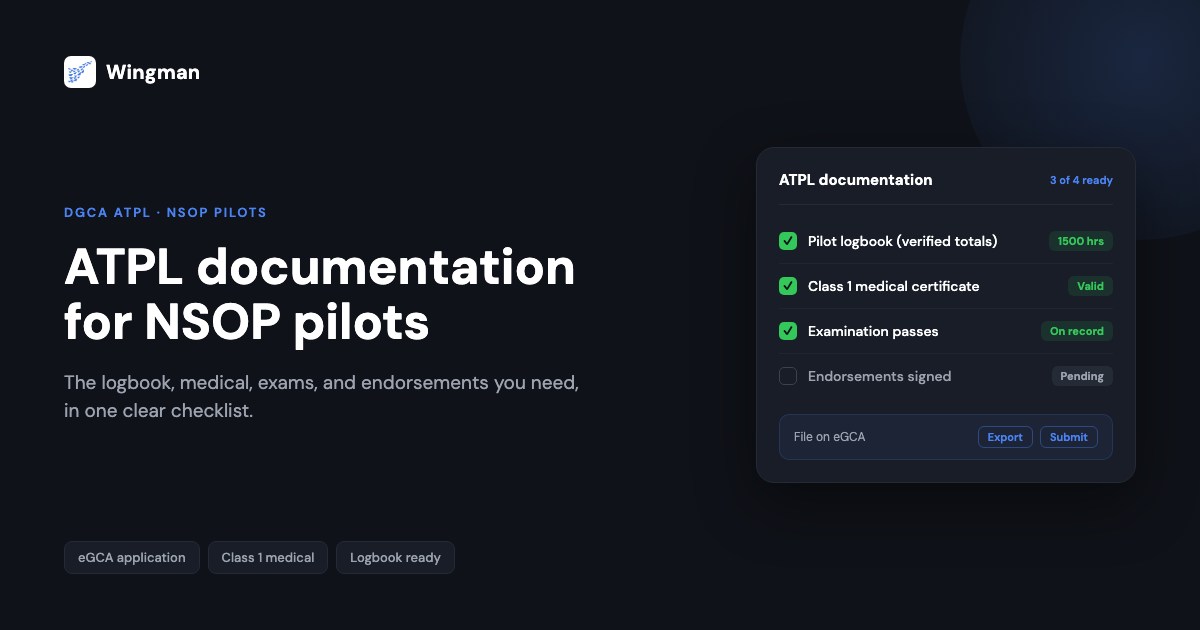
Use the list below as a working checklist. Exact forms and submission routes are set by DGCA and can change, so confirm the current requirements on eGCA before you file. [VERIFY]
-
Pilot logbook with verified flight time. Your logbook is the backbone of the application. It needs to show total time, pilot-in-command time, co-pilot time, instrument time, night time, and cross-country time, with totals that reconcile across pages. The ATPL is typically assessed against a minimum total flying experience, and the breakdown of that experience matters as much as the headline number. Our guide to ATPL hour requirements as per DGCA covers what those minimums look like. [VERIFY]
-
Class 1 medical certificate. You must hold a current Class 1 medical assessment. Check the validity date well before you submit, because an expired or soon-to-expire certificate will hold up the file. If yours is due, our walkthrough on how to apply for a Class 1 medical renewal on eGCA explains the process.
-
Examination passes. The ATPL requires the relevant theoretical examinations to be cleared and on record. Keep your pass documentation accessible, since the application is checked against your examination status. [VERIFY]
-
Radio and licensing credentials. Most ATPL files require supporting credentials such as a valid radio telephony qualification alongside the licence application. Confirm which credentials apply to your route on eGCA. [VERIFY]
-
Endorsements and certifications. Flight time, type experience, and training records often need to be certified by an authorised instructor, examiner, or operator. Each required signature must be present and legible, and the certified figures must match your logbook.
-
Application forms and fees. The ATPL application is filed through DGCA’s eGCA platform with the prescribed forms and fee payment. Make sure every field that links to your candidate record, such as your computer number and personal details, is consistent with what DGCA already holds. [VERIFY]
A useful habit is to assemble all of this into one folder, physical or digital, and check each item against the list before you open the application form. The application itself is much faster when the evidence behind it is already in order.
How to assemble and submit your ATPL documentation
The steps below describe the general order most NSOP pilots follow. Treat them as a sequence for getting organised; the authoritative process and forms are on eGCA. [VERIFY]
-
Reconcile your logbook. Bring your logbook totals up to date and confirm that every category, total time, pilot-in-command, co-pilot, instrument, night, and cross-country, adds up correctly across pages. Fix gaps and miscounts before anything else, because every later step is checked against these numbers.
-
Confirm your medical and credentials. Check that your Class 1 medical is current and will remain valid through the application window, and confirm your radio and licensing credentials are in date. Renew anything that is close to expiry first.
-
Collect your examination and training records. Gather proof of your examination passes and any required training completions, and confirm they are reflected against your candidate record. [VERIFY]
-
Get your endorsements signed. Have the required flight time and experience certified by the authorised instructor, examiner, or operator, and check that the certified figures match your logbook exactly.
-
File on eGCA. Complete the ATPL application on the eGCA platform, attach the supporting documents, confirm your details match DGCA’s records, and pay the prescribed fee. Review every field before you submit. [VERIFY]
Documentation flow

If the file is returned, it is usually for a single fixable reason: a figure that does not reconcile, a missing signature, or an out-of-date credential. Correct the specific item and resubmit rather than rebuilding the whole application.
Keep your records submission-ready with a digital logbook
Most documentation problems trace back to the logbook, so keeping it clean and current is the highest-leverage thing an NSOP pilot can do. A digital logbook helps here because it keeps your totals reconciled automatically and gives you a clear breakdown of pilot-in-command, co-pilot, night, instrument, and cross-country time whenever you need to produce it.
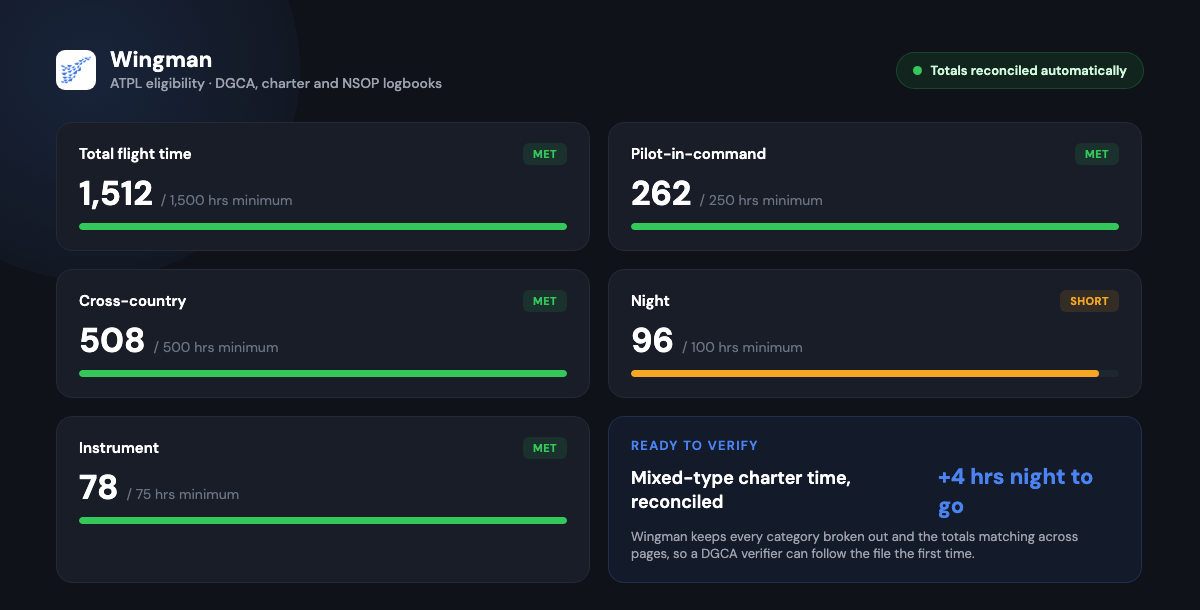
Wingman is a pilot logbook used by 30,000+ pilots across 400+ airlines, and it keeps your hours, currency, and licence details in one place across iOS, Android, and Web. It can import your roster automatically from systems including AIMS eCrew, NavBlue RAIDO, CAE Crew Access, ARMS, CESAR, Sabre, FLICA, and PDC CrewConnex, which reduces the manual entry that introduces errors in the first place.
Wingman is a global product rather than an India-only tool, and it produces regulator-compliant exports for DGCA among regulators including the FAA, EASA, UK CAA, GCAA, GACA, NZCAA, HKCAD, CASA, and CAAS. For the India-specific workflow, there is a focused walkthrough on keeping a DGCA pilot logbook in India. There is a free tier up to 250 logged hours, so you can start keeping your records submission-ready before you reach the ATPL stage, and the Pro plan is $59 per year (₹4,499 per year in India). You can sign in from the Wingman web app to see your totals in one view.
If you would like a hand thinking through your ATPL documentation, you can write to the Wingman team at info@wingmanlog.com and someone will help point you to the right step.
Frequently asked questions
What documents does an NSOP pilot need for an ATPL?
The core set is a verified pilot logbook showing your flight experience and its breakdown, a current Class 1 medical certificate, proof of your examination passes, the required radio and licensing credentials, signed endorsements certifying your flight time, and the completed eGCA application with the prescribed fee. Confirm the exact current requirements on eGCA before filing. [VERIFY]
Is the ATPL documentation different for NSOP pilots compared with scheduled-airline pilots?
The licence requirements are the same. The practical difference is that charter flying tends to produce a more varied logbook, with mixed types, multiple bases, and a wider spread of pilot-in-command and co-pilot time, so the recording needs to be especially clean for a verifier to follow. [VERIFY]
How many flight hours do I need for a DGCA ATPL?
The ATPL is assessed against a minimum total flying experience along with required category breakdowns, rather than a single number alone. Our guide to ATPL hour requirements as per DGCA sets out what those minimums look like, and you should confirm the current figures on eGCA. [VERIFY]
Why do ATPL applications get returned?
Most returns come down to one fixable item: a logbook total that does not reconcile, a missing or illegible endorsement signature, an expired Class 1 medical or credential, or a field on the form that does not match your DGCA record. Correct the specific issue and resubmit rather than starting over.
How does a digital logbook help with ATPL documentation?
A digital logbook keeps your totals reconciled and your time categories broken out, so the evidence behind your application is already in order when you file. Wingman also imports rosters from common crew systems and produces DGCA-compliant exports, which reduces the manual entry that causes most logbook errors.
← All articles