How to become a pilot in India after 12th: the full path, costs, and salary
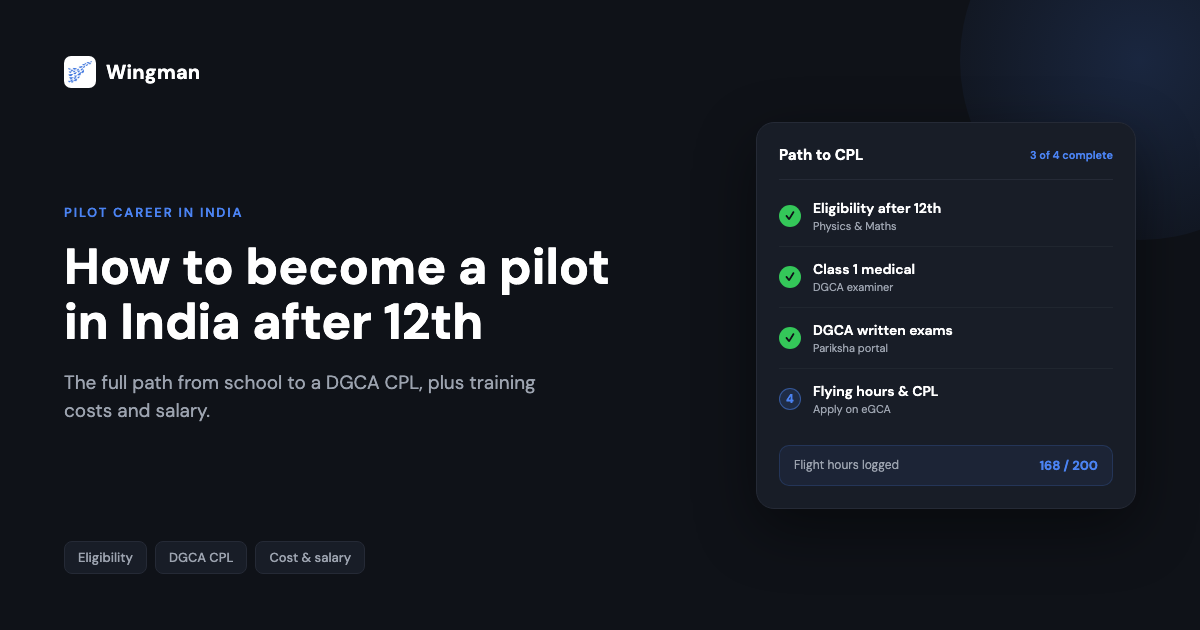
If you have just finished your 12th and want to fly for a living, the path in India is well defined but easy to misread. There is a sequence of eligibility checks, medicals, written examinations, and flying hours that lead to a Commercial Pilot Licence (CPL) issued by the Directorate General of Civil Aviation (DGCA). This guide lays out that path in order, explains roughly what training costs and what pilots earn, and points you to the detailed walkthroughs for each step so you can plan rather than discover requirements one at a time.
Most people searching for how to become a pilot in India after 12th are weighing two things at once: whether they are eligible, and whether the numbers add up. We cover both. The early sections deal with eligibility and the route. The later sections deal with money, both the cost of training and the salary outlook once you are flying.
The types of pilot you can become
Before the steps, it helps to know what you are training toward, because the licence and the route differ by goal.
- Airline transport pilots fly commercial aircraft for scheduled airlines and carry passengers or cargo. This is the path most cadets aim for, and it runs through a CPL and later an Airline Transport Pilot Licence (ATPL).
- Air Force pilots fly military aircraft and are trained through the Indian Air Force, typically entered through the National Defence Academy (NDA) or other defence entry routes rather than civil flying schools.
- Flight instructors hold a CPL plus an instructor rating and train new pilots at a flying school.
- Private pilots hold a Private Pilot Licence (PPL) and fly for personal reasons rather than for hire.
The rest of this guide focuses on the civil route to a CPL, since that is the path for anyone aiming at an airline career out of school.
Eligibility: can you start after 12th
The entry requirements for civil pilot training in India are set by DGCA and the flying school you apply to. The core conditions are these.
- Age. You must be at least 17 years old to be granted a CPL, and most schools let you begin training while you are still building toward that age. [VERIFY]
- Education. You need to have passed 10+2 with Physics and Mathematics. If you studied commerce or another stream without these subjects, you can complete Physics and Maths as a private candidate through the National Institute of Open Schooling (NIOS) or the relevant state board, and then apply. [VERIFY]
- Medical fitness. You need a DGCA medical to fly. Most candidates begin with a Class 2 medical to confirm basic fitness, then obtain a Class 1 medical, which is required for a CPL. Both are issued by DGCA-authorised examiners and medical centres. [VERIFY]
If you are unsure whether you qualify on the academic side, sort the Physics and Maths requirement first, because it gates everything that follows. On the medical side, it is worth getting your Class 2 medical assessment done early, since a medical issue is better discovered before you spend on training. The fuller Class 2 medical application walkthrough and the Class 1 medical for pilots guide explain what each one checks.
The step-by-step path from 12th to a DGCA CPL
Here is the sequence in the order you actually do it.
-
Confirm eligibility. Check the age, 10+2 Physics and Maths, and medical conditions above. Close any gaps, such as completing Physics or Maths through NIOS, before you commit money.
-
Pass a Class 2 medical, then a Class 1 medical. Start with the Class 2 to confirm basic fitness, then move to the Class 1, which a CPL requires. Doing this early protects you from training spend if a condition needs attention.
-
Get your DGCA computer number and register on the portals. DGCA runs candidate records and examinations online. You will need a DGCA computer number as your reference identity, and you will register on the Pariksha examination portal as a new candidate. Licence processes run through the separate eGCA platform.
-
Join a DGCA-approved flying school or a cadet programme. You can train at a DGCA-approved flying school in India, train abroad and convert later, or enter through an airline cadet pilot programme. Airline-specific routes such as the Air India cadet pilot programme and the IndiGo cadet pilot programme package training with a defined airline pathway.
-
Clear the DGCA written examinations. The CPL requires a set of theory papers covering subjects such as air navigation, aviation meteorology, air regulation, and technical general and specific. The full list is set out in exams to be cleared for CPL, PPL, ATPL, and you sit them through the DGCA Pariksha portal, then check your results there. [VERIFY]
-
Build your flying hours. A CPL requires a minimum of flight time logged in your training, including specified solo, cross-country, instrument, and night flying. The detailed breakdown is in CPL flying requirements in India and the wider requirements for CPL in India. The headline minimum is commonly stated as 200 hours of total flight time. [VERIFY]
-
Apply for your CPL. Once your examinations are cleared, your hours are logged, and your Class 1 medical is current, you apply for the licence through eGCA. From there, pilots typically add type ratings and work toward an ATPL as their hours and experience grow.
The path at a glance

What pilot training costs in India
Training is the largest expense on this path, and the figure varies widely depending on where you train, the school, aircraft rates, and how long it takes you to finish. As a broad guide, integrated CPL training in India is commonly quoted in the range of roughly ₹35 to ₹50 lakh, and training abroad followed by conversion can fall in a similar band once living costs are included. [VERIFY] Treat any single number with caution and ask each school for an itemised quote, because hourly aircraft rates and the hours you need can move the total significantly.
There are sensible ways to keep the cost down without cutting corners. We cover practical approaches in tips and tricks to save cost while doing your flight training, and there are funding routes worth checking in pilot scholarships in India. For a clearer view of the CPL component specifically, see CPL cost in India. The point is to budget for the full path, including medicals, examinations, ground school, and the flying hours, rather than the headline course fee alone.
What pilots earn in India
The salary outlook is what makes the training spend worthwhile for most people, but earnings depend heavily on experience, the airline, and whether you are a first officer or a captain. Entry-level first officers earn considerably less than experienced captains, and pay rises as you accumulate hours and move into command. For a grounded view of the numbers across experience levels, read how much do pilots earn in India, and for a sense of the day-to-day, the life of a commercial pilot in India is a useful reality check against common myths. [VERIFY]
The honest framing is this: pilot training is a significant upfront investment that takes time to pay back, and the early years as a junior first officer are not where the large salaries sit. The career rewards patience, accumulated hours, and a clean record, which is exactly why how you keep your records matters from your first flight.
Logging your hours from day one
Everything on the CPL path eventually comes back to flight time. Your hours decide when you can apply for your licence, they support your medical and currency requirements, and they are the first thing an airline checks at interview. Keeping them accurately from your first training flight saves you from reconstructing records later.
This is where a digital logbook earns its place. Wingman is a pilot logbook used by 30,000+ pilots across 400+ airlines, and it keeps your hours, currency, and licence details in one place across iOS, Android, and Web. It is a global product rather than an India-only tool, and it supports DGCA-compliant exports alongside regulators including the FAA, EASA, UK CAA, GCAA, GACA, NZCAA, HKCAD, CASA, and CAAS. There is a free tier up to 250 hours, so you can start logging while you are still a student pilot without paying anything up front, and for India there is a focused walkthrough on keeping a DGCA pilot logbook in India.
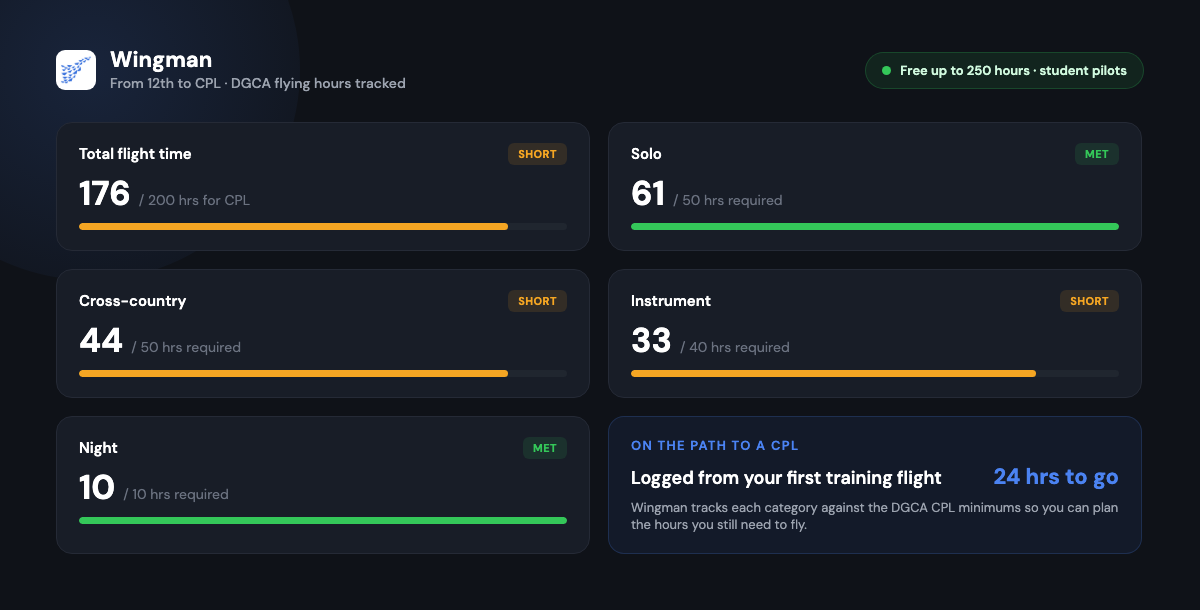
Once you are flying with an airline, Wingman can also import your roster automatically from systems such as AIMS eCrew, NavBlue RAIDO, CAE Crew Access, ARMS, CESAR, Sabre, FLICA, and PDC CrewConnex, so your logbook stays current without manual entry. You can start free at app.wingmanlog.com.
Frequently asked questions
Can I become a pilot after 12th with commerce or arts?
Yes, but you need Physics and Mathematics at the 10+2 level to train for a CPL. If your stream did not include them, you can complete Physics and Maths as a private candidate through the National Institute of Open Schooling or your state board, then apply to a flying school. [VERIFY]
How long does it take to become a pilot in India?
It depends on your pace, the weather, aircraft availability, and how quickly you clear the written examinations. Many students complete CPL training in roughly two to three years from starting, including ground school, examinations, and building the required flying hours. [VERIFY]
What medical do I need to become a pilot?
A CPL requires a DGCA Class 1 medical. Most candidates begin with a Class 2 medical to confirm basic fitness, then obtain the Class 1. Both are issued by DGCA-authorised examiners. Getting the medical early is wise, since a condition is better found before you spend on training. [VERIFY]
How much does pilot training cost in India?
Integrated CPL training in India is commonly quoted in the region of ₹35 to ₹50 lakh, though the figure varies widely by school, aircraft rates, and how long you take. Budget for the full path, including medicals, examinations, and flying hours, and ask each school for an itemised quote. [VERIFY]
What is the difference between a CPL and an ATPL?
A CPL lets you be paid to fly and is the licence new commercial pilots earn first. An ATPL is the higher licence required to act as captain on large commercial aircraft, and it requires substantially more flight time and experience, which pilots build up after the CPL.
← All articles