How to land a pilot job in the Middle East in 2025: what airlines want and how to prepare
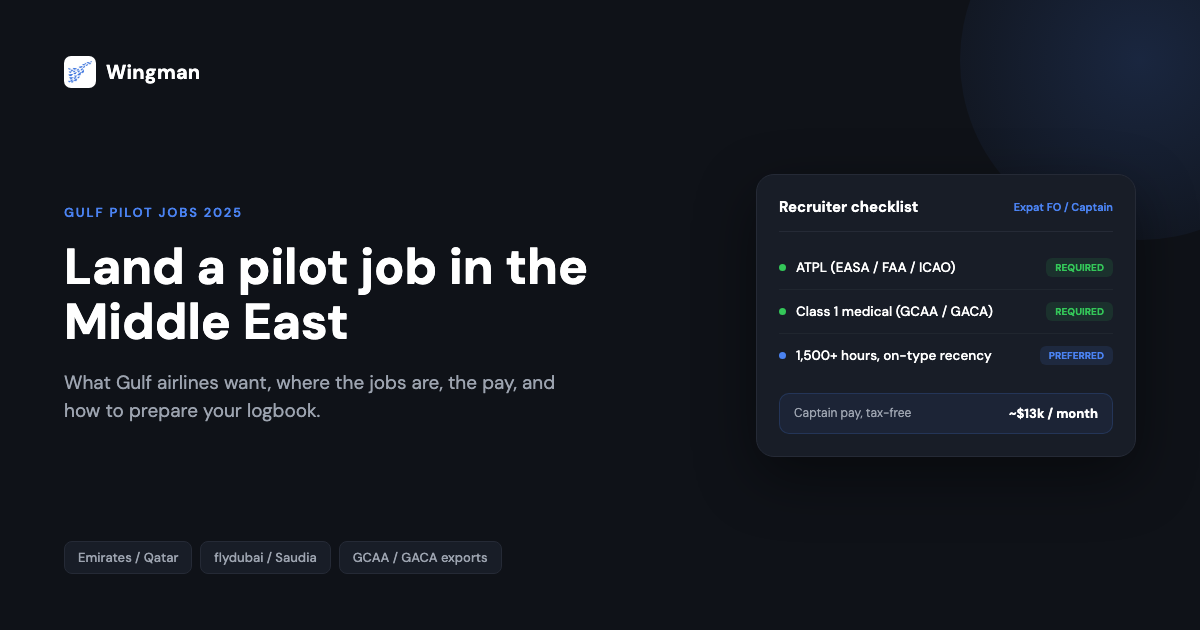
The Gulf carriers are hiring again, and for many commercial pilots the Middle East is one of the most active expat markets in 2025. Emirates, Qatar Airways, flydubai, Saudia, Riyadh Air, Oman Air, and Gulf Air are all recruiting across wide-body and narrow-body fleets. The opportunity is real, but so is the competition. Meeting the minimum hours is rarely enough on its own. Each operator runs its own screening, simulator assessment, and documentation checks, and recruiters move fast through applications that are not presented clearly.
This guide walks through what Gulf airlines actually look for in 2025, where the openings are, what the pay and packages tend to look like, and how to present your flying hours so a recruiter can verify your profile in minutes rather than guessing. It is written as a practical checklist you can work through before you apply, and it stays focused on landing the job rather than ranking one airline against another.
Step 1: Understand what Middle East airlines want in 2025
Gulf carriers are selective, and the bar rose after the pandemic-era hiring freezes unwound. Most operators publish a baseline for expat applicants, and the strongest candidates clear it comfortably rather than scraping the minimum.
Baseline requirements for expat pilots
- A valid ATPL (EASA, FAA, or ICAO, depending on the operator)
- A Class 1 medical issued or accepted by the relevant authority, for example GCAA in the UAE, GACA in Saudi Arabia, or QCAA in Qatar [VERIFY]
- ICAO English Language Proficiency at Level 4 or higher [VERIFY]
- 1,500 or more total hours, with substantially more typically expected for command roles [VERIFY]
- Recent on-type or jet experience, often within the last 6 to 12 months [VERIFY]
What gives you an edge
- A current type rating on a fleet the operator flies, such as A320, B737, B777, A350, or A380
- Multi-crew, international, and long-haul experience
- A clean record in in-house simulator assessments and technical interviews
- A logbook that breaks hours down by role, aircraft, and recency so a recruiter can confirm your claims quickly
The last point is where many qualified pilots lose ground. Recruiters are reconciling your CV against your logbook and your licence. If your totals do not add up, or your on-type and recency figures are hard to find, your file slows down. A clearly structured logbook removes that friction.
Step 2: Know where the jobs are and what each market wants
Demand is not uniform across the region. Here is where the openings are concentrated in 2025 and the profiles each market tends to favour.
United Arab Emirates: Emirates and flydubai
Emirates recruits direct entry captains and first officers for its wide-body A380 and B777 fleets, and continues to expand training and instructor capacity. flydubai hires for its all-Boeing 737 fleet, including the 737 MAX, and looks for candidates who can validate a UAE GCAA licence. Apply through Emirates Group Careers [VERIFY] and flydubai Careers [VERIFY].
Common openings: direct entry captain for B777 and A380, first officer and senior first officer for the 737 family, and training roles tied to expanding simulator facilities.
Qatar: continued wide-body and narrow-body growth
Qatar Airways recruits across narrow-body and wide-body fleets and tends to favour candidates with strong crew resource management and multicultural adaptability. Apply through Qatar Airways Careers [VERIFY].
Preferred profiles: 1,500 or more hours on type, an EASA or ICAO ATPL, and recent jet experience.
Saudi Arabia: Vision 2030 expansion
Saudia continues to recruit, and Riyadh Air, the new Riyadh-based carrier, is building its pilot workforce as it scales. Saudi Arabia is one of the faster-growing markets in the region in 2025. Apply through Saudia Careers [VERIFY] and Riyadh Air Careers [VERIFY].
In demand: first officers for A320 and B777, training captains and examiners, and cadet schemes aimed at Saudi nationals.
Oman, Bahrain, and the wider Gulf
Oman Air and Gulf Air recruit more selectively but remain active, particularly for experienced captains on the A320 and B737. Regional and corporate operators across Bahrain and Kuwait also see periodic demand. Apply through Oman Air Careers [VERIFY] and Gulf Air Careers [VERIFY].
Step 3: Salary expectations in 2025
Pay in the Gulf is usually quoted as a monthly figure and is typically tax-free for expat crew, with housing, schooling, and transport allowances added on top of the base. Actual figures depend on the operator, fleet, seat, and seniority, and packages are negotiated individually, so treat the ranges below as indicative rather than fixed. All figures are approximate monthly take-home in US dollars and should be confirmed against each operator’s current offer.
| Carrier | First officer (approx. USD/month) | Captain (approx. USD/month) |
|---|---|---|
| Emirates | 7,000 to 9,500 [VERIFY] | 13,000 to 16,000 [VERIFY] |
| Qatar Airways | 6,500 to 9,000 [VERIFY] | 12,500 to 15,500 [VERIFY] |
| flydubai | 6,000 to 8,000 [VERIFY] | 11,000 to 14,000 [VERIFY] |
| Saudia and Riyadh Air | 6,000 to 8,500 [VERIFY] | 11,000 to 15,000 [VERIFY] |
| Oman Air and Gulf Air | 5,000 to 7,000 [VERIFY] | 9,500 to 12,500 [VERIFY] |
Beyond the headline figure, look closely at what the package includes. Housing allowance or company accommodation, an education allowance for children, annual leave travel, medical cover, and end-of-service gratuity all change the real value of an offer. Two packages with similar base pay can differ substantially once allowances are factored in.
Step 4: Common mistakes that hurt your application
Recruiters often pass over qualified pilots because of how the paperwork reads, not because of the flying behind it. The recurring problems are:
- Inconsistent totals between the CV, the logbook, and the licence
- A logbook that does not break out PIC, SIC, sim, night, and instrument time clearly
- On-type and recency figures that are buried or missing
- Documentation that is not aligned to the destination regulator, for example GCAA or GACA formatting expectations [VERIFY]
- An out-of-date CV that no longer matches recent flying
Each of these forces a recruiter to do extra work to verify your file, and a file that takes longer to verify is easier to set aside.
Step 5: How to prepare your logbook and CV before you apply
The fix for most of the problems above is a logbook that presents your flying the way a recruiter wants to read it. Before you submit, work through this:
- Reconcile your totals so the CV, logbook, and licence agree exactly
- Surface your on-type hours and recency on the first page, not deep in the records
- Break time down by role, aircraft, and phase of flight
- Tailor the emphasis to each application so the relevant fleet experience is obvious
- Confirm your licence validation path for the destination, for example GCAA or GACA conversions [VERIFY]
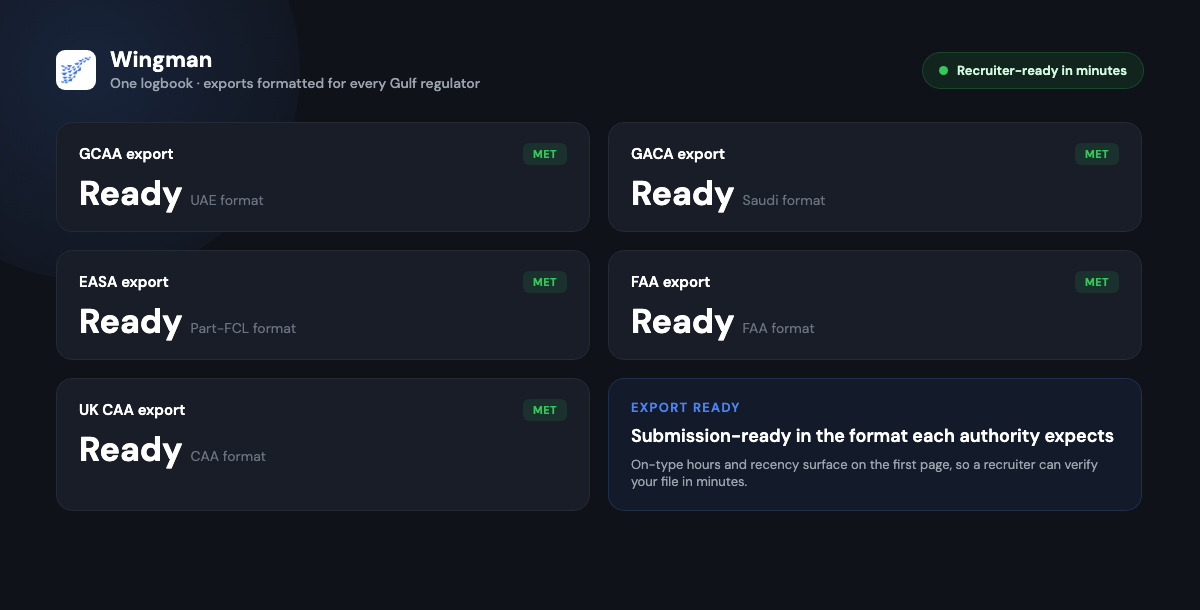
A digital logbook makes this far easier to maintain. Wingman is a pilot logbook used by 30,000+ pilots across 400+ airlines, available on iOS, Android, and Web. It imports rosters automatically from systems including AIMS eCrew, NavBlue RAIDO, CAE Crew Access, ARMS, CESAR, Sabre, FLICA, and PDC CrewConnex, so your hours stay current without manual entry. It produces regulator-compliant exports for authorities including the GCAA, GACA, FAA, EASA, and UK CAA, which is exactly the formatting Gulf recruiters expect to see. There is a free tier up to 250 logged hours, so you can structure your records before you commit anything, and Pro is $59 per year if you need the full feature set.
How the steps fit together

Don’t overlook the medical
Even a strong candidate can stall over a medical rejection or missing paperwork, and each country in the region applies its own Class 1 standards. Prepare for the specific authority before you book:
- UAE: GCAA Class 1 medical: tips to pass first try
- Saudi Arabia: GACA Class 1 medical requirements
These guides explain what to expect, how to prepare, and which documents to bring. It is also worth reading the Middle East pilot logbook requirements by regulator so your records match what each authority expects before you apply.
Final thoughts
The Gulf is once again one of the strongest markets for commercial pilots, but flight hours alone will not carry an application. Clear the baseline, target the operators that fly your type, prepare for the simulator and the medical, and present your flying in a logbook a recruiter can verify at a glance. Do that, and you are already ahead of a large share of the field before the interview begins.
Frequently asked questions
What do Middle East airlines require from expat pilots in 2025?
Most Gulf carriers expect a valid ATPL, an accepted Class 1 medical, ICAO English Language Proficiency at Level 4 or higher, and typically 1,500 or more total hours, with recent jet or on-type experience. Command roles generally require substantially more hours. Each operator sets its own exact thresholds, so check the current vacancy before applying. [VERIFY]
How much do pilots earn in the Gulf?
Pay is usually quoted monthly and is typically tax-free, with housing, schooling, and transport allowances on top. First officer ranges in 2025 are broadly in the region of 5,000 to 9,500 US dollars per month and captain ranges roughly 9,500 to 16,000, depending on the operator, fleet, and seniority. Treat these as indicative and confirm the full package against each operator’s offer. [VERIFY]
Which Middle East airlines are hiring pilots?
Emirates, Qatar Airways, flydubai, Saudia, Riyadh Air, Oman Air, and Gulf Air have all recruited across various fleets in 2025. Demand is concentrated on captains and first officers for the A320, B737, B777, A350, and A380. Apply through each airline’s official careers portal. [VERIFY]
Do I need to convert my licence to fly for a Gulf carrier?
Yes, in most cases you will validate or convert your licence to the destination regulator, such as the GCAA in the UAE or GACA in Saudi Arabia, as part of onboarding. The exact process depends on your existing licence and the operator. Confirm the validation path with the airline and the relevant authority. [VERIFY]
How should I present my logbook for a Gulf airline application?
Keep your totals consistent across your CV, logbook, and licence, surface your on-type hours and recency early, and break time down by role, aircraft, and phase of flight. A digital logbook such as Wingman can import your rosters automatically and produce GCAA- and GACA-compliant exports in the format recruiters expect.
← All articles