IndiGo cabin crew roster explained: iCrew, standby, off days and pay
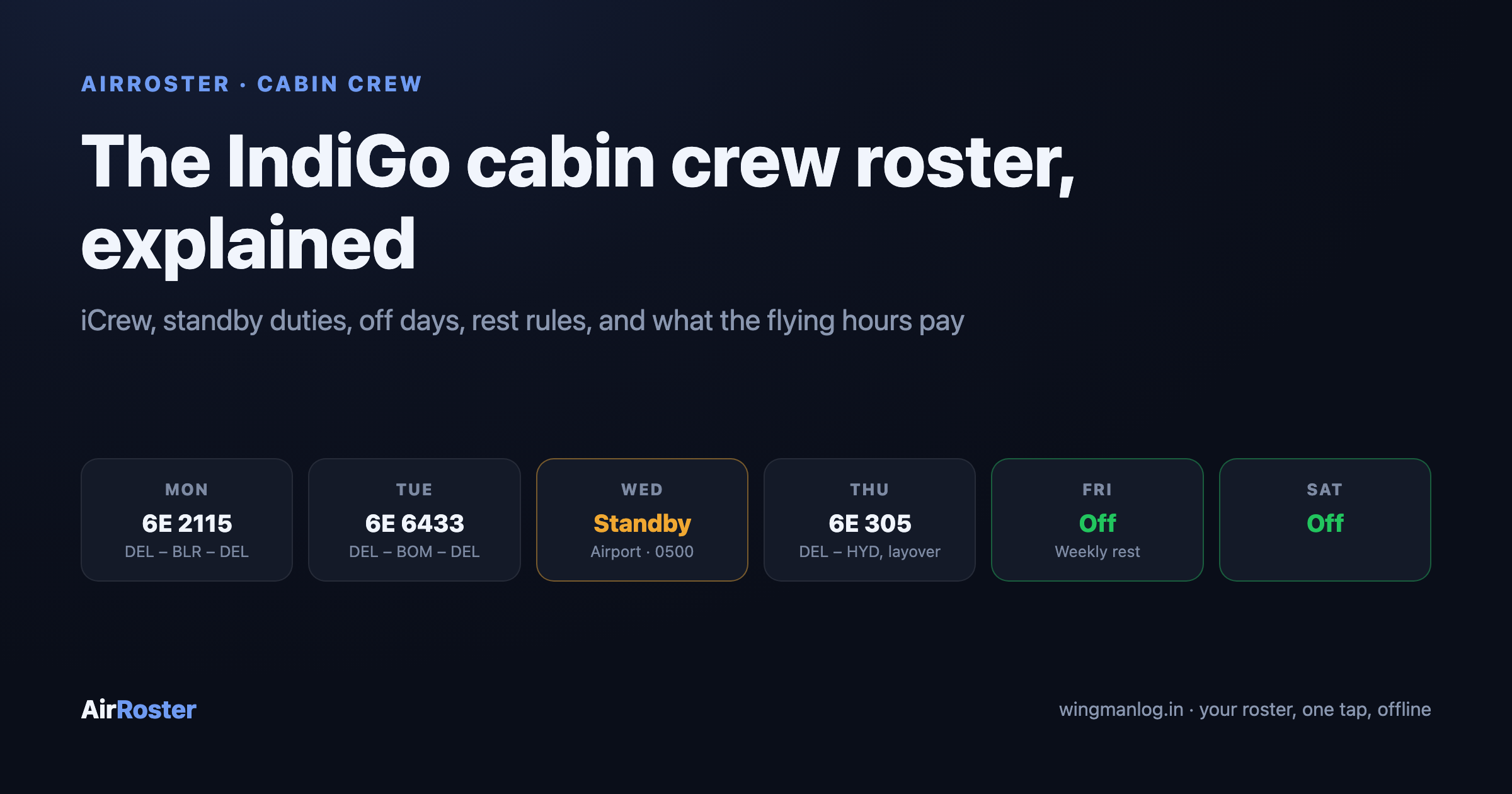
IndiGo cabin crew see their roster in iCrew, the crew portal at icrew.goindigo.in that runs on the AIMS eCrew system behind a Microsoft authenticator login. The roster mixes flying days, airport and home standbys, layovers, and off days, all inside rest limits that the DGCA sets by regulation. Pay follows the roster too: the flying-hour allowance is the biggest variable part of an IndiGo cabin crew salary, so the month you fly is the month you earn.
This guide explains how that roster actually works: reading it in iCrew, what standby really means, how many off days crew report getting, the rest rules that protect you, what the pay ranges look like from public reports, and how crew keep the whole thing in their pocket. Where a figure comes from crew reports rather than an official source, it is labelled that way.
iCrew: where the roster lives
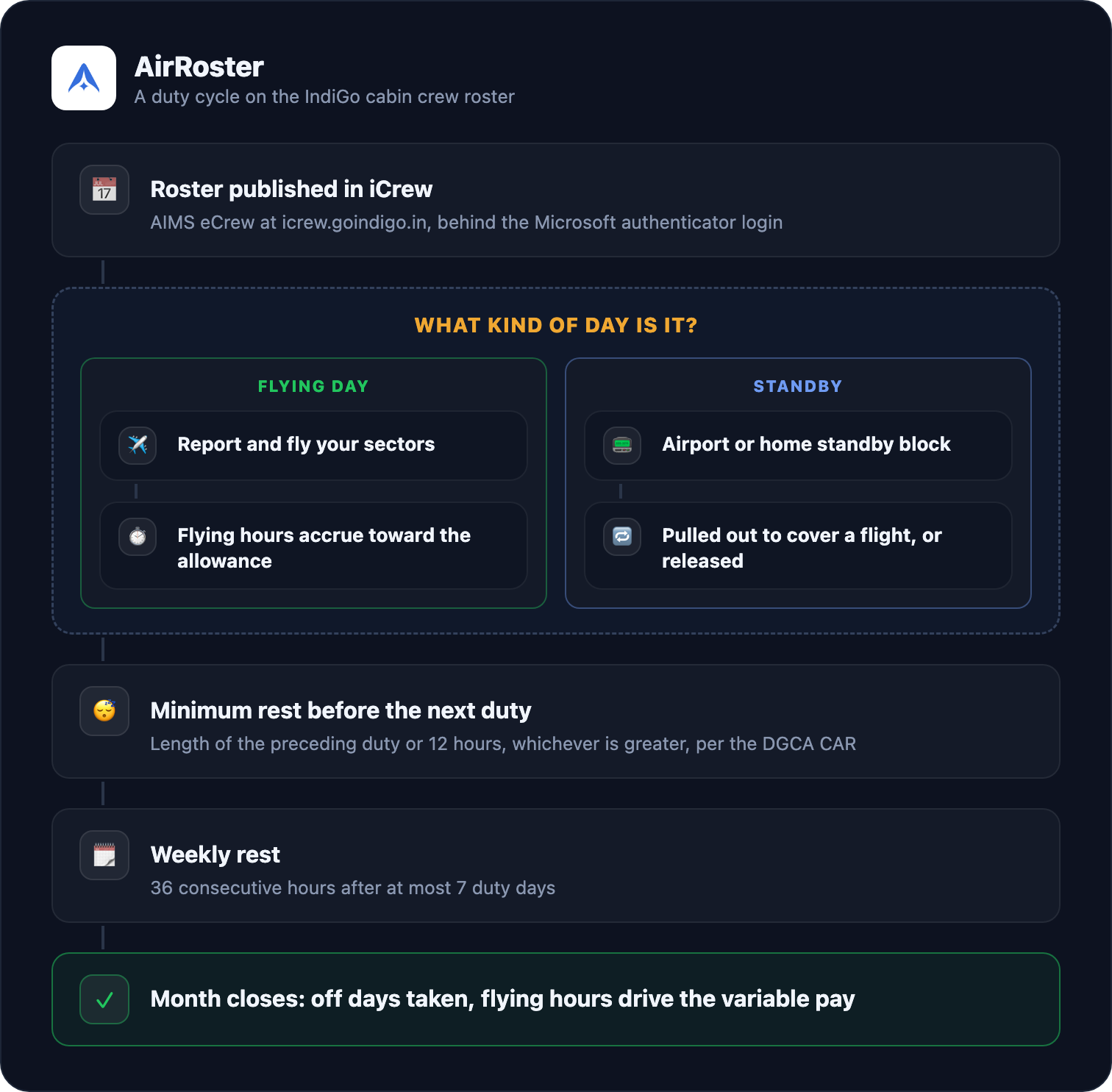
iCrew is IndiGo’s crew-facing portal, built on AIMS eCrew, the same rostering system many airlines use. Sign-in goes through Microsoft with an authenticator step, and sessions log out after around 30 minutes of inactivity, which is why most crew end up checking their roster far more often than they would like on a desktop-era portal.
The roster itself lists your sectors by flight number and pairing, standby blocks with report times, layovers with HOTAC (hotel accommodation) details handled through IndiGo’s layover portal, and your off days. Leave requests run through a separate system, 6E CLMS. Rosters are published monthly and then keep moving: delays, sickness, and operational changes mean the published plan and the flown month rarely match exactly.
A duty cycle on the roster
Standby: the day that might become a flight
A standby block means being ready to operate at short notice. There are two kinds: airport standby, where you report in uniform and wait at the airport, and home standby, where you stay reachable and within reach of the airport. If a rostered crew member goes sick or misses report, standby crew get called out, in crew slang “pulled out”, and operate the flight; otherwise the block expires and you are released.
Crew reports describe standby blocks of several hours rostered every month or two, with the experience varying sharply by base: Delhi-based crew describe busy standbys that frequently turn into flights, while crew at southern bases like Chennai, Bengaluru, and Hyderabad report standbys that rarely activate. Treat those as crew-reported patterns rather than policy.
Off days and the rest rules behind them
Crew-reported off days range from 8 to 15 a month, depending on base and season. Underneath the roster sit the DGCA’s cabin crew duty-time rules, which IndiGo must build every roster around:
- Minimum rest between duties: the length of the preceding duty or 12 hours, whichever is greater (more after long international sectors).
- At most 7 consecutive duty days, followed by at least 36 consecutive hours of weekly rest.
- Cumulative caps, including 40 flying hours in 7 days and 210 duty hours in 28 days.
The full rules, including flight-duty-period tables by sector count, are in our guide to the DGCA cabin crew FDTL regulations. Worth knowing: in October 2025 the DGCA published draft cabin crew fatigue rules that would raise weekly rest to 48 hours and tighten night-duty limits. Airlines have pushed back and the draft is not in force, so the numbers above remain the ones your roster is built on.
When rosters break
December 2025 showed what happens when roster margins run too thin: IndiGo cancelled around 4,500 flights in a week after new pilot duty-time rules collided with tightly optimised crew schedules, and the DGCA later fined the airline Rs 22.2 crore over the episode. For cabin crew it meant rosters changing daily, reassignments at short notice, and difficult days facing stranded passengers. The airline has since rebuilt schedules with more recovery margin, but the lesson for crew stands: the roster you saw last week is not always the roster you fly.
What IndiGo cabin crew earn
IndiGo does not publish cabin crew pay. The figures below are aggregated from public salary reports and aviation-industry coverage during 2025 and 2026, so treat them as reported ranges, not offers:
| Level | Reported monthly pay |
|---|---|
| Trainee (during ~3 months at ifly) | Rs 12,000 to 15,000 stipend |
| Fresher, first year | Rs 40,000 to 55,000 |
| Experienced (2 to 5 years) | Rs 60,000 to 85,000 |
| Lead cabin attendant / inflight supervisor | Rs 90,000 to 1.2 lakh |
The structure matters more than the headline: pay is a basic salary plus a flying-hour allowance, which is the biggest variable component, plus layover allowances (reported at roughly Rs 1,000 to 2,500 a day domestic and 30 to 100 US dollars a day international) and performance elements. Training academies widely quote around Rs 1,000 per flying hour, though IndiGo does not publish the rate. A typical month runs 60 to 90 flying hours, which is exactly why crew track their hours closely: the roster is the payslip. The last clearly reported cabin-crew pay revision was effective October 2023.
Bases and getting in
IndiGo bases cabin crew across its network, with Delhi the largest base alongside Mumbai, Bengaluru, Hyderabad, Chennai, Kolkata, and others, and hiring terms require flexibility to be placed at any base. Recruitment runs through online applications and regular walk-in drives: eligibility is 18 to 27 years, 10+2, minimum height 155 cm for women, 6/6 correctable vision, no visible tattoos in uniform, and fluent English, followed by a group round, interview, and medical. Selected candidates train for about three months at ifly, IndiGo’s training academy in Gurugram. Crew reports mention a training bond recovering roughly Rs 75,000 to 1.5 lakh if you leave within the contractual period; the exact terms are in the appointment letter, so read yours.
Keeping your roster in your pocket
Every pain in this post has the same shape: the roster lives in a portal, and your life lives on your phone. Crew re-log into iCrew through the authenticator, screenshot the month for family, message friends to compare standbys, and tally flying hours by hand at month-end to sanity-check the allowance.
AirRoster, the crew roster app from Wingman, exists for exactly this. It imports eCrew rosters and shows your duties in one tap, offline, on iOS and Android: report times, sectors, layovers, and changes reflected when the roster moves. You can share your roster with family, see friends’ rosters to line up off days, and watch duty and flying-hour statistics build through the month instead of reconstructing them at payday. For IndiGo’s Microsoft-authenticator sign-in, AirRoster connects through the same authenticator flow, and if you also use the Wingman Pilot Logbook with the same email, the on-device IndiGo connection made there carries over automatically.
AirRoster Lite is free forever for your published roster and recent statistics, so you can put your next report time one tap away today. For choosing between crew apps more broadly, our cabin crew roster app guide compares the field.
Frequently asked questions
How do IndiGo cabin crew check their roster?
In iCrew, the crew portal at icrew.goindigo.in, which runs on AIMS eCrew behind a Microsoft authenticator login. Rosters publish there monthly and change through the month, so crew check it often, or let a roster app mirror it.
How many days off do IndiGo cabin crew get?
Crew-reported figures range from 8 to 15 off days a month depending on base and season. Regulation guarantees at least 36 consecutive hours of weekly rest after at most 7 consecutive duty days.
What is standby duty at IndiGo?
A rostered block, at the airport or at home, where you must be ready to operate at short notice if rostered crew become unavailable. Crew describe being “pulled out” when a standby activates; if it does not, the block ends and you are released.
What do IndiGo cabin crew earn?
Reported ranges for 2026: a trainee stipend of roughly Rs 12,000 to 15,000, freshers around Rs 40,000 to 55,000 a month, experienced crew Rs 60,000 to 85,000, and lead grades Rs 90,000 to 1.2 lakh, plus layover allowances. The flying-hour allowance is the biggest variable, and IndiGo does not publish official figures.
Which app shows an IndiGo roster automatically?
AirRoster imports eCrew rosters and shows duties in one tap, offline, with roster sharing and duty statistics. The Lite tier is free forever.
← All articles