IndiGo cadet pilot program: fees at all 6 partner schools, eligibility, and path
The IndiGo cadet pilot program costs between Rs 1.04 crore and roughly Rs 1.2 crore depending on which of the six official partner schools you train with: $132,000 at Skyborne (Florida) or Marigold, $131,000 at Garuda (South Africa), $127,500 at Insight Aviation (South Africa), or Rs 104 lakh at Chimes Aviation Academy, the one route where all flying happens in India. The program takes 20 to 21 months from ground school to an Airbus A320 type rating, and every partner’s cadets join IndiGo as Junior First Officers on completion. As of August 2026, five of the six partners are taking applications; Flight Training Adelaide is closed until November 2026.
This guide leads with the verified fees because that is the question most applicants actually have, then covers what the fees include and exclude, the bond terms partners rarely advertise, eligibility, the selection stages, and the month-by-month path. Every number here was checked against the partner schools’ own program pages in August 2026, and the routes that quietly closed (CAE, L3 Harris, Flight Rule) are called out so you do not chase a dead link.
The fees at all 6 official partners
IndiGo itself charges you nothing directly for training: you contract with a partner flying school, and the fee below is what that school publishes. IndiGo’s official partner list currently has six schools.
| Partner | Published fee | Assessment / registration | Where you fly | Duration | Status (Aug 2026) |
|---|---|---|---|---|---|
| Skyborne | $132,000 | GBP 250 | Vero Beach, Florida, US | ~20 months | Open |
| Marigold Aviation | $132,000 | $360 | Not published on the program page | Not published | Open |
| Garuda Aviation | $131,000 (their page calls it about Rs 1 crore) | Via application | South Africa (SACAA licence, then DGCA conversion) | 21 months | Open |
| Insight Aviation | $127,500 + Rs 30,000 registration plus GST | Included in registration | 43 Air School, Port Alfred, South Africa | ~21 months, plus 1 to 2 for licence processing | Open |
| Chimes Aviation Academy | Rs 104 lakh | Rs 35,000 (ADAPT) | Dhana and Neemuch, Madhya Pradesh (ground school Gurugram) | 20 months | Batches on enquiry |
| Flight Training Adelaide | Via pricing brochure | Via application | Adelaide or Toowoomba, Australia | 46-week Australian phase | Closed until November 2026 |
Dollar fees convert to roughly Rs 1.1 to 1.2 crore at current exchange rates, and since you pay most instalments in USD over a year or more, the rupee’s movement during your training changes your real cost. Budget for the top of the range.
What the headline fee does and does not cover
The published number is closer to all-in than most self-sponsored CPL quotes, but the gaps are consistent across partners and worth budgeting:
- Included (typical, per Garuda’s and Insight’s published breakdowns): ground school, all flying and simulator hours in the syllabus, accommodation and meals during the overseas flying modules, one round-trip airfare and visa, foreign licence exams, DGCA conversion, and the A320 type rating with MCC. Garuda explicitly includes the multi-engine instrument rating on the DGCA licence, a new requirement for IndiGo cadets.
- Excluded (typical): accommodation and transport during ground school and the India conversion phase, personal expenses during type rating, RTR preparation and exam fees, and remedial flying. Garuda’s page is unusually honest here: previous cadets averaged “an average of 10% overshoot of flying hours by way of remedial training”, which at these hourly rates is a lakh-plus contingency, not a rounding error.
Fees are paid in milestone instalments, not upfront: Insight splits $127,500 across 8 instalments, Garuda’s 8 instalments run $13,000 to $20,000 each from agreement signing to type rating. Most partners have education-loan tie-ups; compare those against your own bank before signing.
The fine print: bonds, cheques, and commitments
The cadet agreement, not the brochure, is where the real obligations live. Insight Aviation publishes the clearest terms, and they are a fair proxy for what to ask every partner about:
- a minimum 5-year employment commitment with IndiGo after joining, and
- an undated cheque of Rs 30 lakh handed over when you sign the letter of intent, which IndiGo can encash if you violate the agreement’s terms.
None of this is hidden from cadets who ask, but it rarely appears in fee comparisons. Before paying instalment one anywhere, get the bond duration, the exit penalty, and the conditions under which training can be terminated, in writing.
If you were looking for the CAE, L3 Harris, or Flight Rule routes
They are gone. CAE’s pilot-training site no longer lists an IndiGo programme (its India offering is now a generic integrated CPL at Gondia), and IndiGo’s official page names only the six partners above. The CAE route’s widely quoted Rs 97.7 lakh fee is history, so treat any site still advertising it as out of date. Older partner lists, including earlier versions of this post, also named L3 Harris and Flight Rule Aviation; neither appears on IndiGo’s current list.
Eligibility
The criteria are set by IndiGo and mirrored on partner pages; Skyborne’s current published version:
- Age: “aged 18-40 on the first day of the selection process” (Skyborne’s wording; the band was 18 to 32 in earlier cycles, so confirm with your partner).
- Academics: 10+2 with a minimum of 51 percent individually in Physics, Maths, and English (Grade Point 6 / CBSE Grade C1 equivalents accepted).
- English: fluent written and spoken, benchmarked at roughly IELTS 5.5 or equivalent TOEFL/TOEIC.
- Medical: able to obtain and hold a DGCA Class 1 medical, plus an FAA Class 1 for the US route. A BMI of 18 to 25 and no visible tattoos or piercings.
- Funding: a recent bank statement or affidavit showing access to the full fee. This is checked at selection, not after.
The DGCA Class 1 is the hard gate of the entire pathway, and you can clear it before you apply. Our DGCA Class 1 medical guide covers the process and the tests involved.
The selection process
Chimes publishes the clearest three-stage structure, and the other partners run close variants:
- Aptitude assessment: computer-based pilot aptitude testing (ADAPT at Chimes, Rs 35,000; Skyborne’s GBP 250 assessment; Marigold’s $360). Cognitive ability, motor skills, spatial awareness, performance under pressure.
- Group task assessment, with IndiGo panellists in the room.
- Personal interview, again with IndiGo panellists.
Clearing selection gets you a letter of intent and the training agreement, which is where the fee schedule, bond terms, and medical requirements bind. IndiGo’s involvement at the panel stage means you are effectively interviewing with the airline two years before you fly for it.
The path, month by month
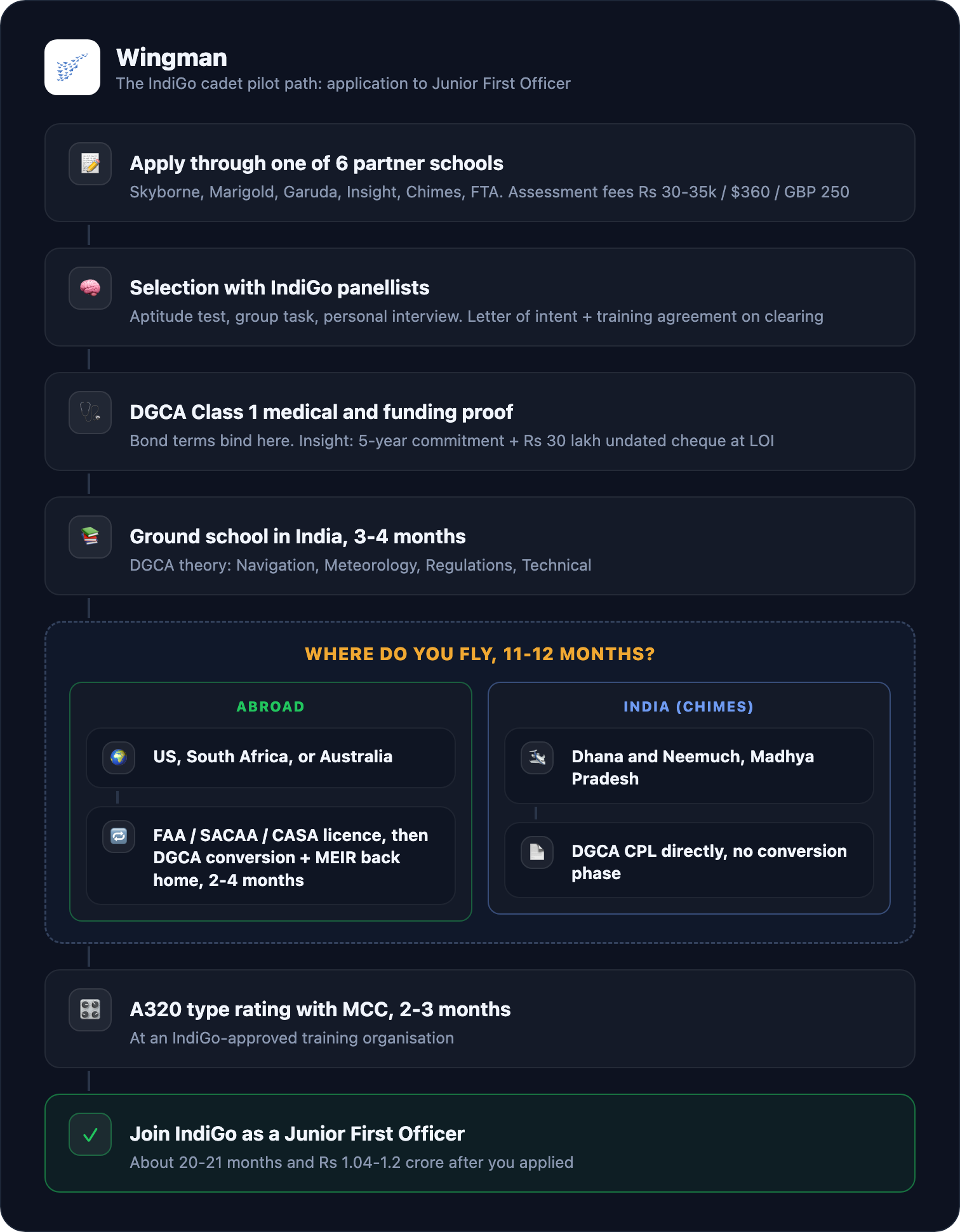
- Ground school in India, 3 to 4 months: DGCA theory (Navigation, Meteorology, Regulations, Technical) in Gurugram or Delhi depending on partner. Our study-material guides for Technical General, Meteorology, Navigation, and Regulations cover these papers.
- Flight training, 11 to 12 months: around 200 hours (Insight’s syllabus: 168 single-engine, 15 multi-engine, 46 simulator) in Florida, South Africa, Australia, or Madhya Pradesh, ending in a CPL: FAA, SACAA, CASA, or DGCA depending on route.
- DGCA conversion, 2 to 4 months: foreign-CPL holders convert back home, including the theory and skill-test requirements in our foreign CPL conversion guide, now including the multi-engine instrument rating. Chimes cadets skip this phase entirely, which is part of how its 20 months stays competitive despite Indian weather windows.
- A320 type rating with MCC, 2 to 3 months: at an IndiGo-approved training organisation, jointly coordinated by the school and the airline.
- Join IndiGo as a Junior First Officer: line training under supervision, then the right-hand seat. Marigold’s page states the guarantee plainly: all cadets who successfully complete the course are offered Junior First Officer positions per the cadet agreement.
Cadet program or self-sponsored CPL?
The cadet route costs roughly double a bare self-sponsored CPL, and what you buy for the difference is the airline seat: assessment by IndiGo before training, a type rating included, and a Junior First Officer offer at the end instead of a job hunt with 200 hours. If you are weighing the self-funded path, our guides to flying school costs in the USA and IGRUA are the comparison points, and the Air India cadet program is the other airline-backed route at a similar price.
Whichever partner you choose, every hour you fly from day one belongs in a logbook that survives a decade of licence applications, conversions, and airline interviews. Wingman keeps your training hours DGCA-ready from your first sortie.
← All articles