FDTL in aviation: DGCA cabin crew duty and rest limits explained (2026)

FDTL stands for Flight Duty Time Limitations: the rules that cap how long crew can be on duty and guarantee rest between duties. For Indian cabin crew, the rules in force as of August 2026 are in DGCA CAR Section 7, Series J, Part I, Issue IV, effective 1 November 2018. The headline numbers: maximum flight duty period of 12 to 22 hours depending on flight time, minimum rest of 12 hours or the length of the preceding duty, whichever is greater, and weekly rest of 36 consecutive hours including two local nights. The much discussed 2025 FDTL revision changed the rules for pilots; cabin crew have only a draft revision (Issue V, October 2025) that is not yet in force.
This guide sets out the limits your roster is legally built on, how each one works, and exactly where the 2025 to 2026 rule changes do and do not touch cabin crew.
The cabin crew FDTL limits at a glance
These are the operative limits under CAR 7-J-I Issue IV, the CAR your airline’s approved FDTL scheme must sit inside:
| Max FDP | Flight Time | No. of Landings | Reference |
|---|---|---|---|
| 12:00 | Up to 8:00 | Up to 6 | Issue IV, para 6.1 |
| 15:00 | 8:00 to 11:00 | Up to 3 | Issue IV, para 6.1 |
| 18:00 | 11:00 to 14:00 | 1 | Issue IV, para 6.1 |
| 22:00 | ULR, above 14:00 | 1, case by case DGCA approval | Issue IV, para 6.1 |
The rest, weekly rest, cumulative, and standby limits that sit alongside these FDP caps:
| Limit | Value | Reference |
|---|---|---|
| Minimum rest before a flight duty | Length of preceding duty or 12:00, whichever is greater | Issue IV, para 7.1 |
| Rest after crossing more than 3 time zones | 14:00 or preceding duty, whichever is greater | Issue IV, para 7.1 |
| Rest after crossing more than 7 time zones | 36:00 or preceding duty, whichever is greater | Issue IV, para 7.1 |
| Weekly rest | 36 consecutive hours including two local nights, at most 168 hours apart | Issue IV, para 7.4 |
| Cumulative flight time | 40:00 in 7 days, 115:00 in 28 days, 300:00 in 90 days, 1000:00 in 365 days | Issue IV, para 6.2 |
| Cumulative duty time | 65:00 in 7 days, 210:00 in 28 days | Issue IV, para 6.3 |
| Standby | Maximum 12 hours, of which at most 8 at the airport | Issue IV, para 8.2 |
What FDTL means and who it covers
Flight Duty Time Limitations specify duty time, flight duty time, flight time limits, and rest period requirements. The framework exists because fatigue degrades alertness, and cabin crew alertness is a safety system: evacuation, medical events, and fire response all assume a crew that can think clearly. India’s rules flow from ICAO Annex 6, which requires states to set prescriptive fatigue limits, and they apply to cabin crew on scheduled, non-scheduled, and commuter air transport services.
Three parties share responsibility for staying inside the limits: the operator, which must have an FDTL scheme approved by the DGCA and built into its Operations Manual; crew scheduling, which must roster within that scheme; and you, because a cabin crew member may not accept an assignment that exceeds the prescribed limitation. That last point is why knowing these numbers yourself, rather than trusting the roster to be right, matters.
The daily limits: flight time, FDP, and landings
Your flight duty period runs from report time until the last aircraft is parked, plus post-flight duties. Issue IV caps it on a sliding scale: the longer the flight time, the longer the permitted FDP but the fewer landings allowed, because sectors add workload. A 6 sector domestic day fits inside a 12 hour FDP; an 18 hour FDP is only legal with a single landing.
Night duty tightens everything. Issue IV defines the Window of Circadian Low as 02:00 to 05:59. When an FDP starts inside that window, the maximum FDP is reduced by 100 percent of the encroachment, up to 2 hours. When it ends in or fully covers the window, the reduction is 50 percent of the encroachment. There is also a consecutive night rule: no flight duty in the period embracing 00:00 to 05:00 on two consecutive nights, except once in any 168 hours.
Rest: the rules that protect your recovery
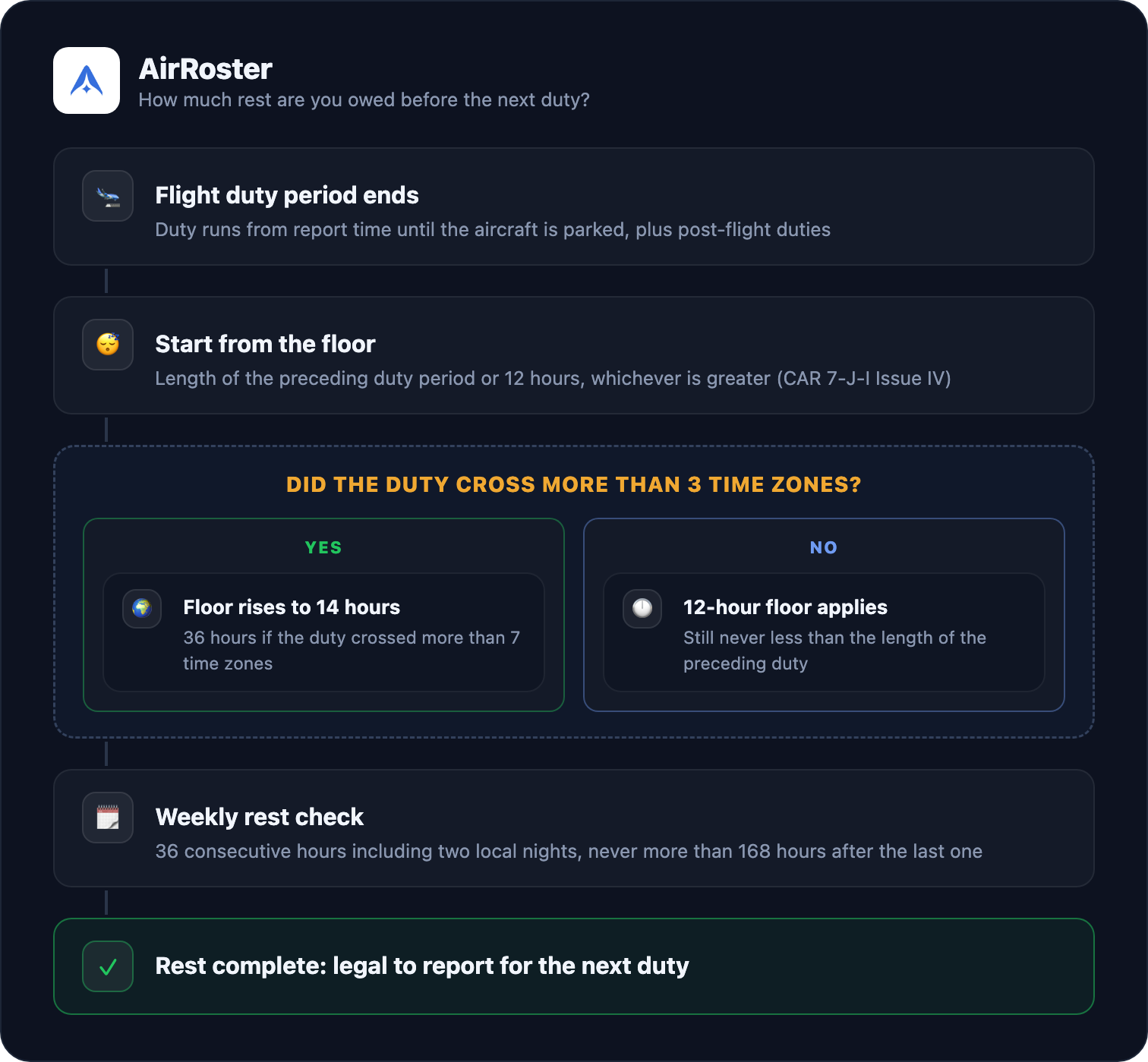
Minimum rest before a flight duty is the length of the preceding duty period or 12 hours, whichever is greater. Cross more than 3 time zones and the floor becomes 14 hours; cross more than 7 and it becomes 36 hours. The logic is simple: a 13 hour duty owes you at least 13 hours of rest, and long time zone shifts owe you recovery time for the body clock, not just the duty length.
Weekly rest under Issue IV is 36 consecutive hours including two local nights, and there can never be more than 168 hours between the end of one weekly rest and the start of the next. On the roster this shows up as the protected off block your airline must schedule every week, normally at home base.
Standby and split duty
Standby counts. A standby period may not exceed 12 hours, and airport standby specifically may not exceed 8 hours. If airport standby turns into a flight, half of the standby time counts toward your flight duty period. Home standby that activates after 6 hours also reduces the FDP available, and even a standby that never activates feeds your cumulative duty totals. Standby is not a free day, and the CAR treats it that way.
Split duty allows a long day to be stretched when there is a proper break in the middle: a break of 3 to 10 consecutive hours extends the allowable FDP by half the length of the break, while breaks over 10 hours give no extension because at that point you should be on rest instead.
How airlines actually roster around FDTL
Every Indian operator files its FDTL scheme with the DGCA, and the approved scheme becomes part of the Operations Manual, so the working limits you fly to are the scheme limits read against the CAR. In practice rosters are built with buffer against the caps, standby blocks are placed inside the 12 hour limit, multi-sector days are kept clear of the WOCL where possible, and weekly rest is positioned to reset the 168 hour clock. Duty and rest records must be kept for 18 months and are open to DGCA audit.
What that looks like on a real roster, including standby patterns and how published plans shift through the month, is covered in our IndiGo cabin crew roster explained guide.
Did the 2025 FDTL revision change cabin crew rules? Not yet
This is the point most 2026 confusion comes from, so here it is plainly.
Pilots: the revised flight crew CAR (Section 7, Series J, Part III, Rev 2, notified in early 2024) was implemented in two phases, on 1 July 2025 and 1 November 2025, and is now fully in force. It raised pilot weekly rest to 48 hours and widened the night period, among other changes; the detail is in our DGCA FDTL rules for pilots guide.
Cabin crew: on 15 October 2025 the DGCA published a draft CAR Section 7, Series J, Part I, Issue V, with comments invited until 14 November 2025. As of August 2026 it has not been notified as final, and airlines have formally pushed back on parts of it through the Federation of Indian Airlines. Cabin crew therefore remain under Issue IV of 2018. The December 2025 disruption at IndiGo, after which the DGCA withdrew a separate instruction on leave and weekly rest, showed how carefully the regulator is sequencing these changes.
The draft is still worth knowing, because it signals where the rules are heading:
| Provision | Issue IV (in force) | Draft Issue V (proposed) |
|---|---|---|
| Weekly rest | 36 hours, two local nights | 48 hours, two local nights; 60 hours after more than 3 night encroaching FDPs in a week |
| Max FDP, standard crew | 12:00 with 6 landings at up to 8:00 flight time | 11:00 with 6 landings at 8 hours flight time, stepping to 15:00 with 1 landing at 10 hours |
| Rest crossing 3 to 7 time zones | 14 hours | 18 hours |
| Cumulative caps in 7 days | 40:00 flight, 65:00 duty | 35:00 flight, 60:00 duty |
| Airport standby into a flight | 50 percent counts toward FDP | 100 percent counts toward FDP |
| Rest after ULR flight | Not separately specified | 120 hours free of all duties on return to base |
Until a final Issue V is notified with an effective date, treat every number in the right column as provisional. Our companion piece on the new DGCA FDTL CAR for pilots and cabin crew tracks both instruments side by side.
Know your numbers, then check your roster against them
FDTL only protects you if you can see it working. The limits above are the regulator’s floor; your airline’s approved scheme may be tighter, and the roster is where both become real. The practical habit is simple: know your minimum rest, know where your weekly rest block sits, and watch your cumulative hours build across the rolling 7 and 28 day windows instead of discovering them at month end.
AirRoster, the crew roster app from Wingman, keeps your roster and duty statistics in your pocket so you always know the rest you are owed before your next report. For choosing a crew app more broadly, see our cabin crew roster app comparison.
Frequently asked questions
What is FDTL in aviation?
Flight Duty Time Limitations: the regulatory caps on flight time, duty time, and flight duty periods, paired with minimum rest requirements. The DGCA prescribes them in Civil Aviation Requirements, and every Indian operator must roster crew inside a DGCA approved FDTL scheme.
Which DGCA CAR governs cabin crew FDTL?
CAR Section 7 (Cabin Crew Standards, Training and Licensing), Series J, Part I, Issue IV, effective 1 November 2018. The draft Issue V published on 15 October 2025 is not yet in force as of August 2026.
What is the maximum flight duty period for cabin crew?
It scales with flight time: 12 hours of FDP with up to 6 landings for flight time up to 8 hours, 15 hours with 3 landings up to 11 hours, 18 hours with 1 landing up to 14 hours, and 22 hours for approved ULR operations. FDPs touching the 02:00 to 05:59 window are reduced by up to 2 hours.
What is the minimum rest between duties?
The length of the preceding duty period or 12 hours, whichever is greater; 14 hours after crossing more than 3 time zones and 36 hours after crossing more than 7.
Did the 2025 FDTL revision apply to cabin crew?
No. The phased 2025 implementation was the revised pilot CAR. Cabin crew have a separate draft revision from October 2025 that remains unfinalised, so Issue IV of 2018 still governs cabin crew rosters.
How can I track my own FDTL compliance?
Keep your roster, duty times, and rest visible in one place and compare them against the limits in this post. AirRoster imports your airline roster automatically and shows duties, report times, and duty statistics offline, so the rest you are owed is one tap away.
← All articles