RTR full form in aviation and RTR validity in India: the 2025 DGCA rules explained
RTR stands for Radio Telephony Restricted. In India its full name is the Radio Telephone Operator (Restricted) Certificate and Licence, and it is the licence that lets a pilot operate an aircraft’s radio and talk to air traffic control. Since the Radio Telephone Operator (Restricted) Certificate and Licence Rules, 2025 (G.S.R. 413(E), 25 June 2025), the DGCA examines candidates and issues the licence instead of the WPC Wing of the Department of Telecommunications. A licence issued under these rules is valid until the holder turns 80, unless it is suspended or cancelled, and it can be extended beyond 80. Older WPC certificates are a separate case, covered below.
If you learned that “RTR is valid for life and WPC runs the exam”, that was true of the old system. Here is what the rules say now, verified against the gazette notification and DGCA’s own exam notices in October 2026.
RTR at a glance (October 2026)
| Question | Answer under the 2025 Rules | Source |
|---|---|---|
| Full form | Radio Telephony Restricted; legally the Radio Telephone Operator (Restricted) Certificate and Licence | Rules, 2025, rule 1 |
| Who issues it | Central Government, with the DGCA running applications and exams | Rules, 2025, rules 4, 7, 8 |
| Validity | Until the holder turns 80, unless suspended or cancelled; extendable beyond 80 | Rules, 2025, rule 11(1) |
| Old WPC certificates | Valid until their own expiry, but DGCA reportedly stopped accepting them after 15 July 2026 | Rule 11(2); DGCA notification of 1 July 2026 |
| Minimum age | 16 years | Rules, 2025, rule 6 |
| Education | Class X or equivalent | Rules, 2025, rule 6 |
| Exam | Written exam, then a practical exam in a simulated radio environment | Rules, 2025, rule 8 |
| Fees | Rs 2,000 written, Rs 500 practical, Rs 5,000 issue, Rs 500 duplicate | Rules, 2025, rule 9 |
What RTR means in aviation
The rules are blunt about why the licence exists. Rule 3 says no person may operate the radiotelephone of an aircraft station, on frequencies allocated to the aeronautical mobile service, unless they hold a valid Radio Telephone Operator (Restricted) Certificate and Licence issued or recognised by the Central Government. Your CPL or ATPL lets you fly the aircraft. The RTR is what lets you press the transmit button.
“Restricted” refers to the scope of the licence. Rule 12 limits it to aircraft radio equipment that needs only simple external switching, with no manual adjustment of the transmitter’s frequency.
You will see a few versions of the name:
- RTR(A), Radio Telephony Restricted (Aeronautical), is the name WPC used for the pilot certificate under the Indian Wireless Telegraphy Rules, 1954.
- RTR(C) was the WPC certificate issued against a foreign FRTOL. RTR(P) is another WPC category named in DGCA’s 2026 notification.
- RTR (Restricted) is how DGCA’s Pariksha portal lists the exam today.
- FRTOL, the Flight Radio Telephone Operator’s Licence, is the term used by authorities such as the UK. Our FRTOL guide covers the eGCA side.
How long RTR is valid: the rule 11 answer
Rule 11(1) of the 2025 Rules settles the validity question for any certificate issued under them: it remains valid until the holder attains the age of eighty years, unless suspended or cancelled. The proviso allows an extension beyond 80 if the holder meets the requirements the DGCA specifies.
So there is no five-year or ten-year renewal cycle for a DGCA-issued RTR. The licence can still be lost early. Rules 15 and 16 let the authority disqualify a holder, or suspend or cancel the licence, for things like impersonation, tampering with the certificate, lending it to someone else, or using unfair means in the exam.
What happens to an old WPC RTR(A)
This is where most pilots get caught out, because two rules point in slightly different directions.
- Rule 11(2) says a certificate that existed on the day the 2025 Rules came into force continues to be valid until its expiry, and the holder may be granted the new DGCA certificate by passing the practical exam.
- Rule 20, the saving clause, protects certificates granted under the 1954 WPC rules “till a date is notified by the Central Government”.
- That date appears to have arrived. A DGCA notification dated 1 July 2026 (reference 1-8/53/94-L-II/RTR/Exam), as summarised by TeamLease RegTech, says RTR(A), RTR(C) and RTR(P) certificates issued or renewed by WPC are accepted by DGCA only until 15 July 2026.
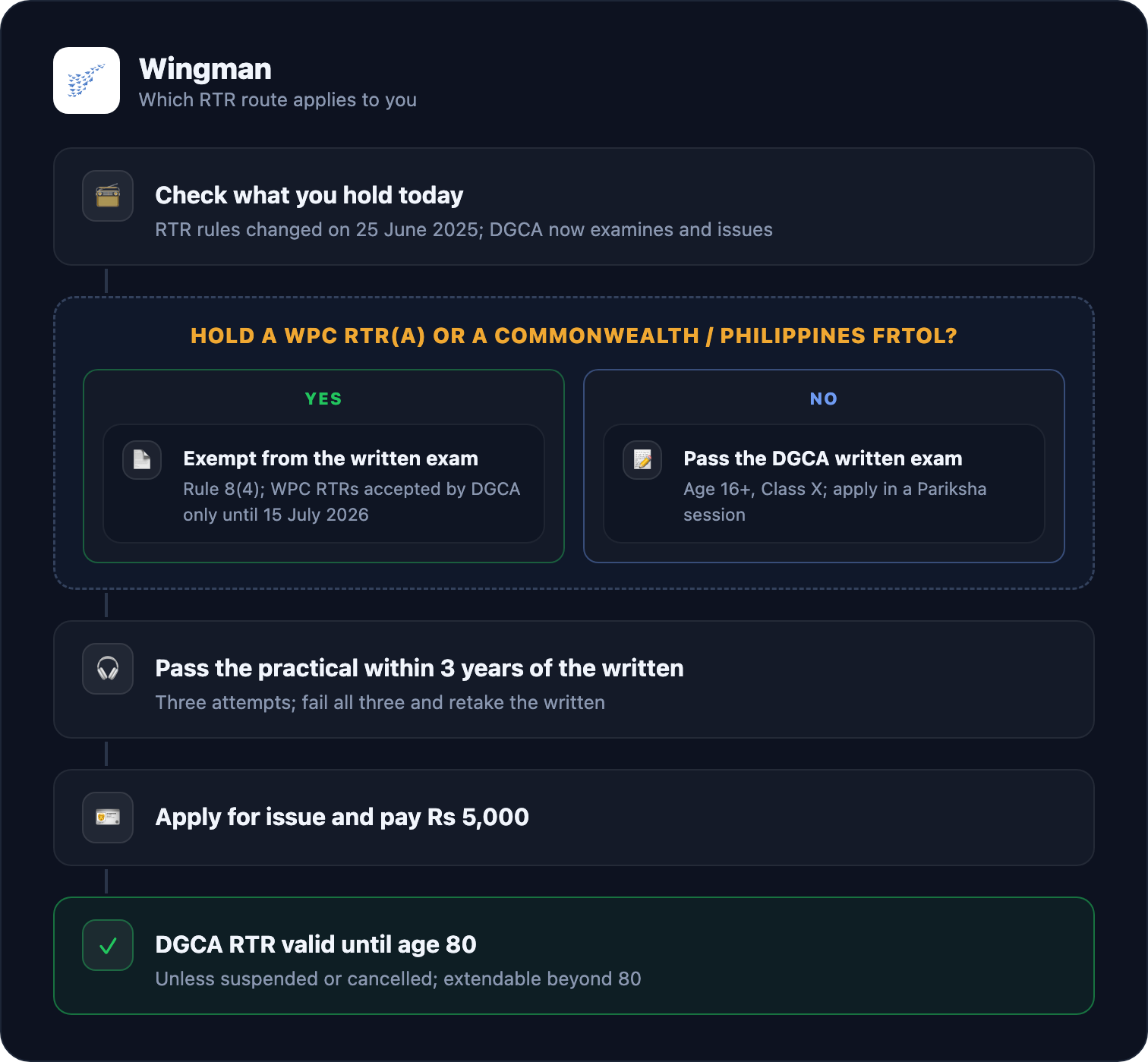
In practice, if you hold a WPC certificate and have a licence application, conversion, or other DGCA action coming up, plan to move to the DGCA certificate. You do not start from zero: rule 8(4) exempts WPC RTR holders from the written exam, so you only need to pass the practical. Check the current procedure on eGCA or with DGCA before you apply, because the notification text itself was not available on a government site when we checked.
The DGCA RTR exam in brief
The exam itself has its own validity clock, which is separate from the licence:
- Two parts. A written exam covering regulations and procedure, radio principles and practice, and radiotelephony, then a practical test of radio telephony in a simulated environment (rule 8(4) and 8(5)).
- Written first. You cannot sit the practical until you have passed the written exam.
- Three years. You must pass the practical within three years of passing the written exam (rule 8(6)).
- Three attempts. You get three attempts at the practical. If you fail all three, you have to pass the written exam again before trying the practical once more.
- Six weeks. After failing an exam, you cannot reappear within six weeks.
- Foreign nationals need security clearance from the Government of India before they can appear.
Exam windows run on DGCA’s Pariksha portal. A DGCA public notice dated 22 September 2026 lists RTR (Restricted) papers on 28 to 30 October 2026 and 18 to 20 November 2026 in the on-demand sessions, and 15 to 19 December 2026 (tentative) in Regular Session 04. For the exam pattern and preparation, see our RTR examination guide.
Who skips the written exam
Rule 8(4) exempts three groups from the written exam. They still take the practical.
- Qualified pilots from the Indian Air Force, Navy, Army, or Coast Guard with the flying experience and competency the DGCA specifies.
- Holders of a valid WPC-issued RTR under the 1954 rules.
- Holders of a valid Flight Radio Telephone Operator’s Licence, or equivalent, issued by a Commonwealth country or the Philippines.
RTR next to your other validities
RTR is the long-lived document in a pilot’s wallet. Everything around it expires sooner, which is why “my RTR is fine” rarely means “I am legal to fly”.
| Document | Validity in India | More detail |
|---|---|---|
| RTR (DGCA, 2025 Rules) | Until age 80 | This page |
| CPL | 10 years, since the October 2023 amendment to the Aircraft Rules | CPL validity |
| ATPL | 10 years, since the same amendment | ATPL validity |
| SPL | 10 years from issue, since the April 2022 amendment to Rule 39C | SPL validity |
| English Language Proficiency | Depends on the level achieved | ELP for Indian pilots |
| Class 1 medical | Depends on age and operation | Class 1 medical |
The CPL and ATPL change is in the Ministry of Civil Aviation’s press release on the 2023 Aircraft Rules amendment, which raised licence validity from five to ten years.
Fines for operating without a valid RTR
Rule 19 sets the penalty for breaching rule 3, which means operating an aircraft radio without a valid certificate: a fine of up to Rs 1 crore. The offence can be compounded by the DGCA for Rs 1 lakh. It is an expensive way to find out that a WPC certificate was no longer accepted.
Keep the expiries that do lapse in one place
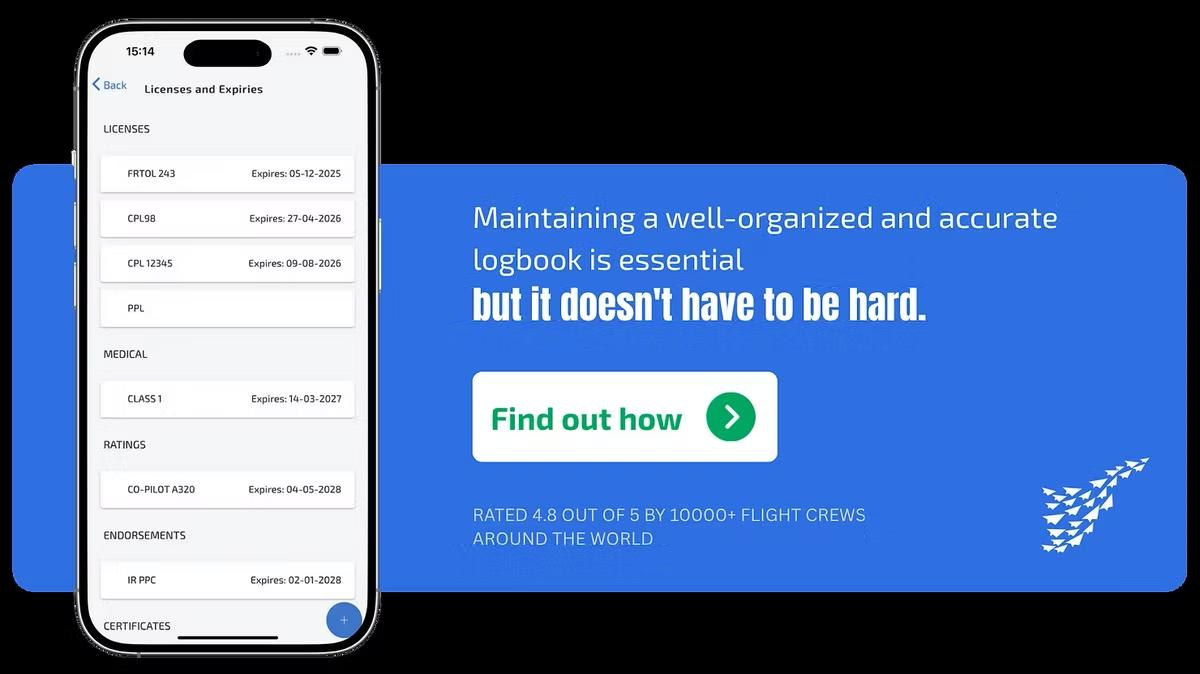
Your RTR may outlast most of your flying career, but your medical, licence, ratings and ELP will not. Wingman, the pilot logbook app, has an expiry tracker that holds each document with its validity date and reminds you before it lapses, next to the flight hours you log in Wingman.
Sources
- Ministry of Civil Aviation, Radio Telephone Operator (Restricted) Certificate and Licence Rules, 2025, G.S.R. 413(E), 25 June 2025.
- DGCA, public notice on OLODE Sessions 07 and 08 and Regular Session 04 of 2026 for AME, FC and RTR (Restricted), 22 September 2026.
- DGCA notification 1-8/53/94-L-II/RTR/Exam, 1 July 2026, as summarised by TeamLease RegTech.
- Press Information Bureau, Amendment to Aircraft Rules, 1937, October 2023.
Frequently asked questions
What is the full form of RTR in aviation?
RTR stands for Radio Telephony Restricted. Its full legal name in India is the Radio Telephone Operator (Restricted) Certificate and Licence. It is the licence a pilot needs to operate the radio on board an aircraft and talk to air traffic control. The older WPC version was written RTR(A), with the A for aeronautical.
How long is an RTR licence valid in India?
An RTR certificate and licence issued under the Radio Telephone Operator (Restricted) Certificate and Licence Rules, 2025 stays valid until the holder turns 80, unless it is suspended or cancelled. It can be extended beyond 80 if the holder meets requirements set by the DGCA. There is no periodic renewal before that.
Is my old WPC-issued RTR(A) still valid?
Under rule 11(2) of the 2025 Rules, a certificate that existed when the rules came into force stays valid until its own expiry date. However, a DGCA notification of 1 July 2026, as reported by TeamLease RegTech, says WPC-issued RTR(A), RTR(C) and RTR(P) documents are accepted by DGCA only until 15 July 2026. WPC holders are exempt from the written exam and can get the new DGCA licence by passing the practical exam.
Who conducts the RTR exam now, WPC or DGCA?
The DGCA. The 2025 Rules made the DGCA responsible for the examination and the licence, and WPC handed over at the end of 2025. In 2026 the RTR (Restricted) written exam runs in DGCA’s Pariksha sessions alongside the AME and flight crew papers.
What is the difference between RTR and FRTOL?
RTR is India’s radio telephony licence for aircraft stations. FRTOL, the Flight Radio Telephone Operator’s Licence, is the name many other authorities, such as the UK, use for the same privilege. Under the 2025 Rules, a holder of a valid FRTOL issued by a Commonwealth country or the Philippines is exempt from the Indian RTR written exam but still takes the practical.
How much does the RTR exam and licence cost?
The 2025 Rules set the fees at Rs 2,000 per written exam attempt, Rs 500 per practical exam attempt, Rs 5,000 for issue of the certificate and licence, and Rs 500 for a duplicate. Fees are paid electronically as the DGCA specifies.
← All articles