GCAA license conversion: how to switch your pilot licence to work in the Middle East
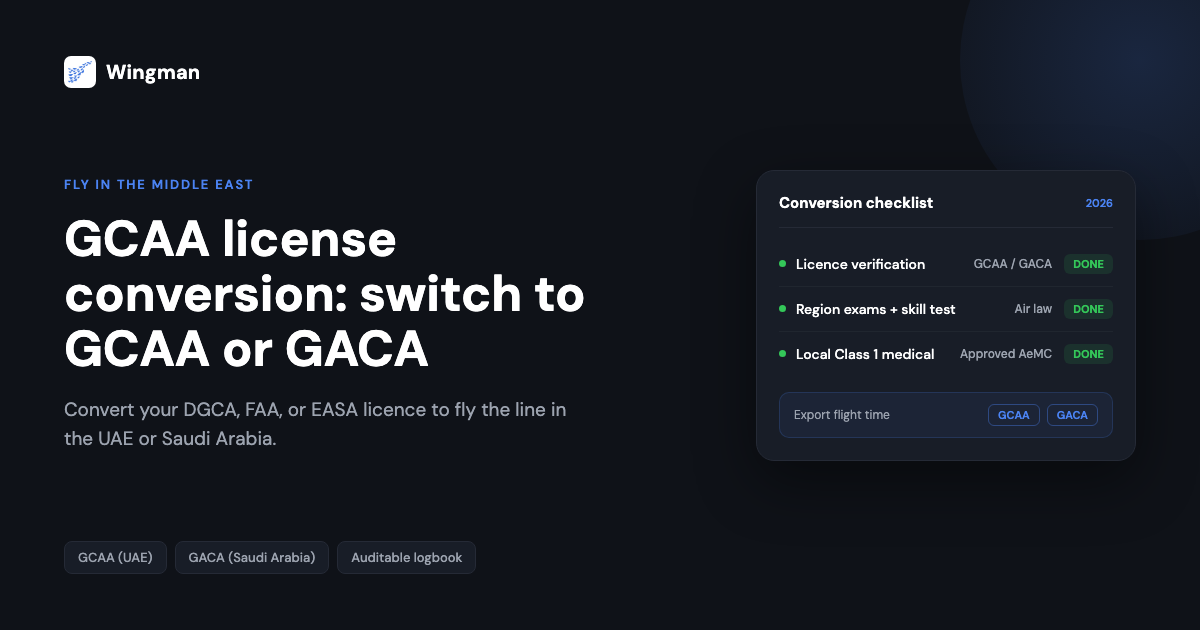
If you hold a DGCA, FAA, or EASA pilot licence and you are looking at airlines in the Gulf, you will need to convert your credentials to a local licence before you can fly the line. In the UAE that means a licence issued by the General Civil Aviation Authority (GCAA). In Saudi Arabia it means a licence issued by the General Authority of Civil Aviation (GACA). This guide explains who needs to convert, what the GCAA and GACA processes look like in 2026, the documents you will be asked for, and the common mistakes that slow applications down.
The conversion itself is administrative rather than a full retraining. You are validating an existing licence, not starting from zero. But both authorities verify your foreign licence, require region-specific exams and a local medical, and expect a clean, auditable record of your flight time. That last point is where most candidates lose time, so it is worth getting your logbook in order before you submit anything.
Why pilots convert to GCAA or GACA
Carriers such as Emirates, Etihad, flydubai, Saudia, and flynas continue to recruit experienced first officers and captains, and the Gulf remains one of the larger growth markets for airline pilots. To fly for an operator certified in the UAE or Saudi Arabia, you generally need to hold the licence issued by that country’s authority, because air operator certificates are tied to the national regulator. A foreign licence on its own is usually not enough to be rostered on revenue flights. [VERIFY]
The two authorities you will most often deal with are:
- The UAE’s GCAA (General Civil Aviation Authority), which oversees licensing under its Civil Aviation Regulations (CARs).
- Saudi Arabia’s GACA (General Authority of Civil Aviation), which oversees licensing under the GACA Regulations (GACARs), including GACAR Part 61 for flight crew licensing. [VERIFY]
Which one applies to you depends entirely on the airline you are joining and the country it is certified in. Many pilots start the conversation with an airline first and let the recruiting carrier’s licensing department guide which authority to apply to.
Who can convert their licence
Conversion is open to holders of an ICAO-compliant licence in good standing. The exact requirements differ slightly between GCAA and GACA, but the baseline is broadly the same.
For DGCA (India) pilots
- A valid CPL or ATPL issued by DGCA India.
- An ICAO English Language Proficiency endorsement at Level 4 or higher.
- Total and category flight-time minimums that meet the receiving authority’s standard for the licence you are converting to. [VERIFY]
- A current medical that can be converted to a GCAA or GACA Class 1.
For FAA (United States) pilots
- A current and valid FAA commercial or airline transport certificate.
- The region-specific theoretical exams set by the receiving authority, since FAA written exams are not normally accepted in lieu of GCAA or GACA papers. [VERIFY]
- Verified flight experience supported by endorsed logbook records.
- A medical that meets the receiving authority’s Class 1 standard.
For EASA and UK CAA pilots
EASA and UK CAA licence holders follow a comparable validation route. Because the underlying syllabus is closer to the framework both Gulf authorities draw on, the theoretical load can be lighter, but you should still expect an air-law paper and a local medical. [VERIFY]
How to convert your licence to GCAA (UAE)
The GCAA process runs largely through its e-services portal. Treat the steps below as the typical sequence and confirm the current detail against the GCAA site before you submit, because portal labels and fee schedules are updated periodically. [VERIFY]
-
Verify your foreign licence. Submit a licence-verification request so the GCAA can confirm your issuing authority’s records directly. Conversion cannot proceed until your originating authority has confirmed the licence is valid. [VERIFY]
-
Create your application on the GCAA e-services portal. Upload a copy of your foreign licence, your medical certificate, passport, and your flight-time records or logbook.
-
Sit the GCAA theoretical exams. Expect papers on Air Law and operational procedures specific to UAE regulations. The exact subject list depends on the licence and ratings you are converting. [VERIFY]
-
Complete a skill test or proficiency check. This is conducted by a GCAA-approved examiner, often through your sponsoring airline or an approved training organisation.
-
Obtain a GCAA Class 1 medical. The medical must be issued by a GCAA-approved aeromedical centre or examiner. A foreign medical on its own is not normally sufficient. [VERIFY]
-
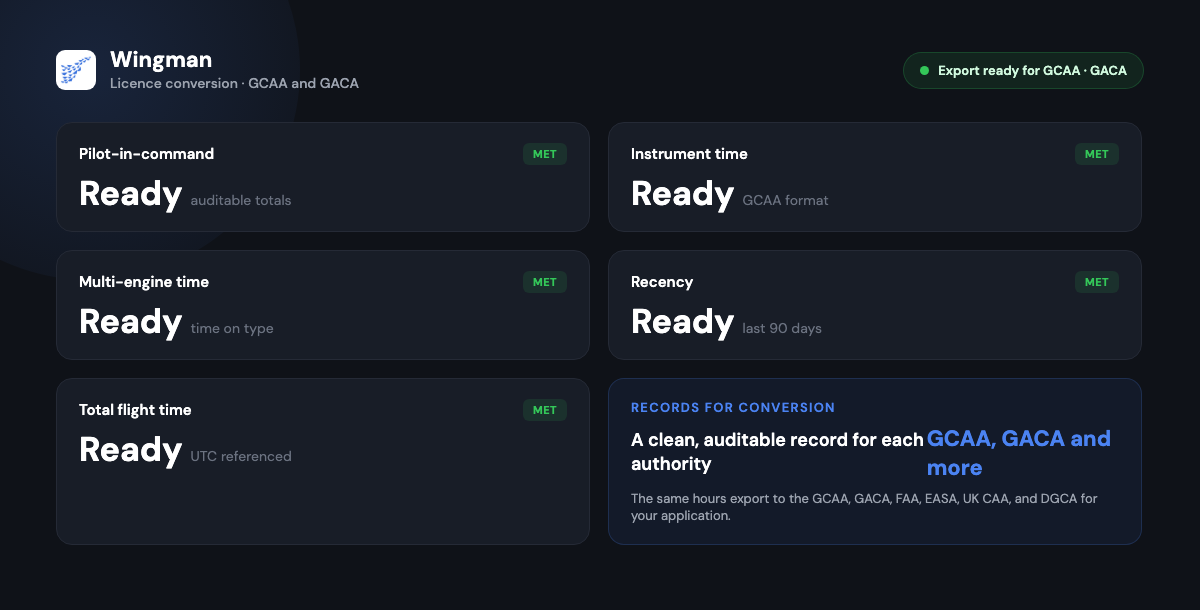
Provide verified flight-time records. Your logbook needs to show pilot-in-command time, instrument time, multi-engine time, and recency in a form the authority can audit. Hand-written gaps and unverifiable totals are a common reason applications stall.
Fees for verification, examinations, the skill test, and licence issue are published on the GCAA fee schedule and are charged per stage rather than as a single payment. Check the current schedule on the portal before you budget, as the amounts are revised from time to time. [VERIFY]
How to convert your licence to GACA (Saudi Arabia)
The GACA route is similar in shape but governed by the GACARs, with flight crew licensing under GACAR Part 61. As with the UAE, confirm current detail on the GACA portal before applying. [VERIFY]
-
Submit your application. Apply through the GACA e-services portal and attach your foreign licence, medical, passport, and flight-time records.
-
Sit the knowledge and oral exams. GACA requires written and, in many cases, oral examinations based on GACAR Part 61 and Saudi operational rules. [VERIFY]
-
Complete a simulator check or skill test. This is conducted at a GACA-approved training organisation or through the sponsoring airline.
-
Obtain a GACA medical. A medical certificate under the GACA medical standard (GACAR Part 67) must be issued by an approved centre. [VERIFY]
-
Submit endorsed logbook records. Your records must clearly show total flight time, time on type, categories of time, and recency in an auditable format.
As with the GCAA, GACA charges fees by stage and updates them periodically, so confirm the live fee schedule rather than relying on figures quoted in older guides. [VERIFY]
Conversion flow at a glance

Documents you will be asked for
- A valid foreign CPL or ATPL.
- An ICAO English Language Proficiency certificate or endorsement.
- A complete, endorsed flight logbook or verified flight-time summary.
- A medical certificate that can be converted to the local Class 1 standard.
- Passport and, where relevant, visa or residency documents.
- A recent photograph to the authority’s specification.
- Simulator or training records, where the conversion requires a check.
Common pitfalls that slow conversions down
- Submitting incomplete or hand-written logbooks. Both authorities expect totals they can audit, and gaps or unverifiable entries trigger requests for clarification.
- Treating a foreign medical as sufficient. A local Class 1 from an approved centre is almost always required.
- Assuming FAA or DGCA written exams will be accepted in place of GCAA or GACA papers. They generally are not. [VERIFY]
- Inconsistent time recording. Gulf authorities and airlines often expect times referenced to UTC, and mixing local and UTC entries makes a record harder to reconcile. [VERIFY]
- Leaving licence verification to last. Because the receiving authority confirms your licence with your originating authority, a slow verification can hold up everything downstream.
How your logbook supports a GCAA or GACA conversion
The part of a conversion you control most directly is the quality of your flight-time record. Examiners and licensing officers want a clean breakdown of pilot-in-command, instrument, night, cross-country, and multi-engine time, plus recency, in a format they can check. A well-kept digital logbook turns that from a scramble into an export.
Wingman is a pilot logbook used by 30,000+ pilots across 400+ airlines, and it keeps your hours, currency, and licence details in one place across iOS, Android, and Web. It produces regulator-compliant exports for authorities including the GCAA and GACA, alongside the FAA, EASA, UK CAA, DGCA, NZCAA, HKCAD, CASA, and CAAS, so the same record can serve your current authority and your conversion application.
It also takes the manual work out of keeping the record current. Wingman imports rosters automatically from systems including AIMS eCrew, NavBlue RAIDO, CAE Crew Access, ARMS, CESAR, Sabre, FLICA, and PDC CrewConnex, which keeps your totals accurate while you are still flying for your current operator. There is a free tier up to 250 logged hours, so you can digitise your history and see the summaries before deciding on Pro at $59 a year. You can start in the Wingman web app and have your time categories ready to export when the licensing paperwork begins.
Frequently asked questions
Do I need to convert my licence to fly in the UAE or Saudi Arabia?
In almost all cases, yes. To be rostered on revenue flights for an operator certified in the UAE or Saudi Arabia, you generally need a licence issued by that country’s authority, the GCAA or GACA respectively. Your sponsoring airline’s licensing department usually guides you through the specific route. [VERIFY]
Is GCAA or GACA conversion a full retraining?
No. Conversion validates an existing ICAO-compliant licence rather than starting your training again. You should expect licence verification, region-specific theoretical exams, a skill test or simulator check, and a local Class 1 medical, but not a full ab-initio course. [VERIFY]
Will my FAA or DGCA written exams be accepted?
Generally not. Both GCAA and GACA expect you to sit their own theoretical papers, particularly air law and local operational procedures. Treat the region-specific exams as a standard part of the process rather than something you can carry over. [VERIFY]
How long does a GCAA or GACA conversion take?
It varies with how quickly your originating authority confirms your licence, how soon you can book exams and a skill test, and how complete your records are. Applications most often stall on licence verification and on logbook records that cannot be audited, so getting both in order early is the most reliable way to keep the timeline short.
What flight-time records will I be asked for?
A breakdown of total time, pilot-in-command time, instrument time, multi-engine time, time on type, and recency, in an auditable format. A digital logbook that exports a clean, regulator-formatted summary, such as Wingman’s GCAA and GACA exports, makes this stage far easier than reconciling hand-written pages.
← All articles