GCAA Class 1 medical: requirements and how to pass your UAE pilot medical first time
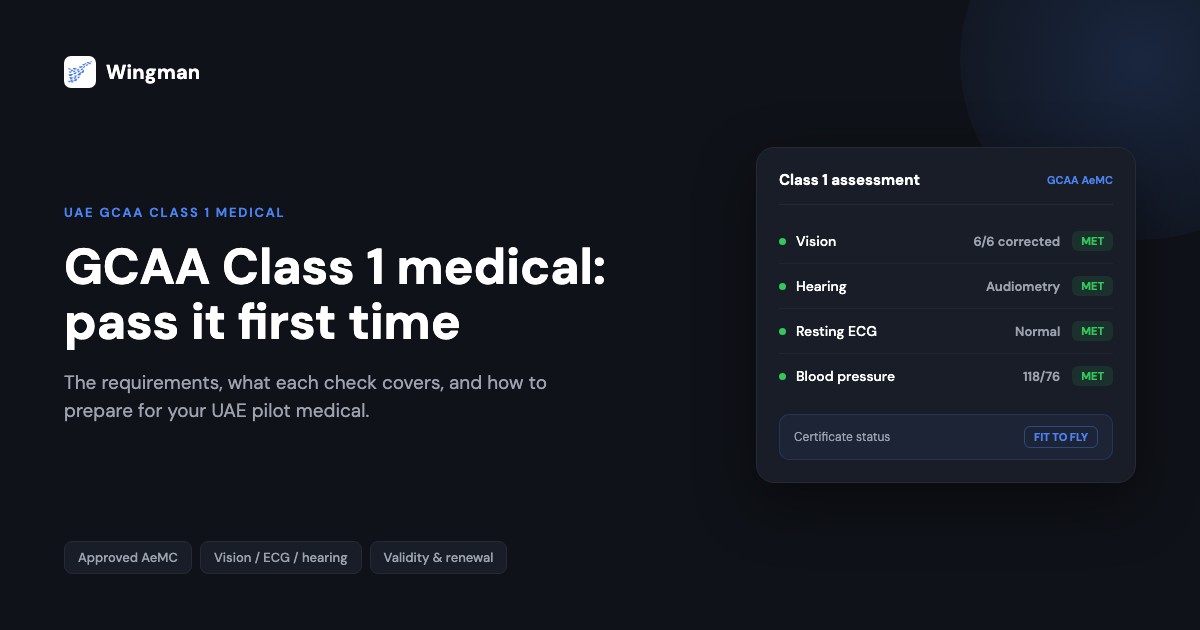
Before you can fly as a commercial pilot in the UAE, you need a valid GCAA Class 1 medical certificate. It is issued by an aeromedical centre approved by the General Civil Aviation Authority (GCAA), and it confirms you are physically and mentally fit to operate an aircraft. The assessment follows the medical standards set out in the GCAA Civil Aviation Regulations, which are closely aligned with the international Part-MED framework.
This guide explains what the GCAA Class 1 medical involves, the requirements you are measured against, and the practical steps that help candidates pass on the first attempt. Where a specific clinical threshold is quoted, treat it as a planning guide and confirm the current figure against the official GCAA regulation, because medical limits are reviewed and updated over time.
Who needs a GCAA Class 1 medical
You need a valid Class 1 medical certificate if you hold, or are applying for, any of the following:
- Commercial Pilot Licence (CPL)
- Airline Transport Pilot Licence (ATPL)
- Multi-Crew Pilot Licence (MPL)
- Flight Instructor Rating, where the instruction is commercial or remunerated [VERIFY]
Student pilots beginning training can often start on a Class 2 medical, but a Class 1 certificate is required before a CPL is issued. If you are early in training, getting the Class 1 assessment done sooner rather than later is sensible, because it confirms there are no medical barriers before you invest in flight hours.
GCAA Class 1 medical requirements
The Class 1 standard exists to confirm that you can safely operate a commercial aircraft and that no condition is likely to make you suddenly unfit in flight. The examination covers your eyes, ears, heart, nervous system, mental health, and general physical condition, and it reviews your medical history. The headline requirements candidates ask about most are below. Each numeric limit is tagged for verification against the current GCAA regulation.
- Vision: distant visual acuity is assessed in each eye separately and together, and any refractive correction must bring you to the required standard. Many frameworks of this type require distant acuity correctable to 6/6 binocularly, with each eye reaching at least 6/9. [VERIFY]
- Colour perception: you must be able to identify the colours used in aviation, usually screened with Ishihara plates, with further testing available if the screening result is borderline. [VERIFY]
- Hearing: tested by pure-tone audiometry. A common standard limits hearing loss to no more than 35 dB at the lower frequencies, with a higher allowance at 3000 Hz. [VERIFY]
- Cardiovascular: blood pressure is measured, and a resting electrocardiogram (ECG) is recorded. Blood pressure that is persistently high, for example above roughly 160/95 mmHg, typically triggers further assessment. [VERIFY]
- Body mass and general fitness: a high body mass index can prompt additional checks for related conditions such as sleep apnoea, rather than being an automatic fail on its own. [VERIFY]
- Mental health and neurology: history of significant psychiatric or neurological conditions, and any current medication, is reviewed.
- Metabolic and other: blood and urine tests screen for conditions such as diabetes and kidney problems.
The point of listing these is not to self-diagnose, but to know what is being looked at so you can prepare your records and raise anything relevant with the examiner in advance.
Where to take the GCAA medical in the UAE
The examination must be carried out at a GCAA-approved aeromedical centre (AeMC). Only an approved centre and an authorised aeromedical examiner can issue or recommend a Class 1 certificate. The GCAA publishes the current list of approved centres, and it is worth booking two to four weeks ahead, especially around peak licensing periods when slots fill quickly. [VERIFY]
When you book, confirm three things with the centre: whether any fasting is required before blood work, what documents to bring, and whether your age means additional tests such as an exercise ECG apply on this visit.
What the exam includes, section by section
Vision testing
Expect near and distant visual acuity, colour vision screening, depth perception, and a field-of-vision check. If you wear glasses or contact lenses, bring your current prescription and the lenses themselves, because the examiner assesses your corrected vision and records the prescription. If you have had refractive surgery, bring the operative report.
Hearing and ENT
Hearing is checked with an audiogram across the speech and higher frequencies, and the examiner inspects the ears, nose, and throat. A recent cold or blocked ear can affect results, so mention any current congestion rather than pushing through it.
Cardiovascular assessment
Blood pressure is taken, and a resting ECG is recorded for applicants. An exercise (stress) ECG is generally required from a certain age and at set intervals afterwards, so confirm whether it applies to you before the visit. [VERIFY] If you have previous ECGs or a cardiology report, bring them, as they give the examiner useful context.
Neurological and mental health screening
This covers reflexes, coordination, and a review of your history for neurological or psychiatric conditions. Be straightforward about past diagnoses and any medication. Declared, well-managed conditions are far easier to handle than something discovered later that was not disclosed.
Blood and urine tests
Typical tests include fasting blood sugar, a lipid profile, and a urine analysis. If blood work is scheduled, you may be asked to fast beforehand, so confirm the fasting window with the centre when you book.
General physical examination
The examiner checks height, weight, and body mass index, listens to your chest, and assesses your musculoskeletal system and general condition. A history of drug or alcohol misuse is taken seriously and can lead to further assessment.
How to prepare and pass first time
Most first-attempt problems come from preventable issues such as raised blood pressure on the day or missing paperwork, rather than from a genuine disqualifying condition. These steps reduce avoidable failures.
- Sleep properly the night before. Rest helps normalise blood pressure and improves your performance on the vision tests.
- Avoid caffeine, alcohol, and tobacco for the day before. These can raise heart rate and blood pressure and affect ECG readings.
- Gather your records. Bring past ECGs and medical reports, any specialist letters, your spectacles or contact lenses with the prescription, and your identification and licence copy where relevant.
- Fast if blood work is scheduled. Confirm the exact fasting window with the aeromedical centre rather than assuming.
- Declare conditions in advance. If you have an existing condition or take medication, raise it with the centre before the appointment so any extra reports can be arranged ahead of time.
Where preparation fits in the process

What happens if you do not pass
If a finding falls outside the standard, you may be assessed as temporarily unfit rather than permanently disqualified. You are usually asked for additional tests or a specialist report, for example from an ophthalmologist or a cardiologist, before a decision is finalised. Certification then depends on review under the GCAA medical standards. Many conditions are manageable with the right evidence, so being declared unfit on the day is often the start of a process rather than the end of a career.
Validity and renewal timeline
Class 1 medical validity is shorter as you get older, and ATPL holders at senior ages are reassessed more frequently. As a general guide, the certificate is valid for twelve months for younger pilots and is reduced to six months once you pass a defined age threshold. [VERIFY] Renewals can usually be completed in the weeks before expiry, and timing the renewal so the new certificate runs on from the old one avoids any gap in validity. [VERIFY] Confirm the exact validity periods and the renewal window that apply to your age and licence with your aeromedical centre.
Keeping your medical and your logbook in order
A lapsed medical grounds you until it is renewed, so the expiry date matters as much as the exam itself. Wingman is a pilot logbook used by 30,000+ pilots across 400+ airlines, and it keeps your licence and medical expiry dates, currency, and flight hours in one place across iOS, Android, and Web. You can set reminders ahead of your Class 1 expiry so a renewal is never a surprise, and your hours stay backed up if records are ever reviewed.
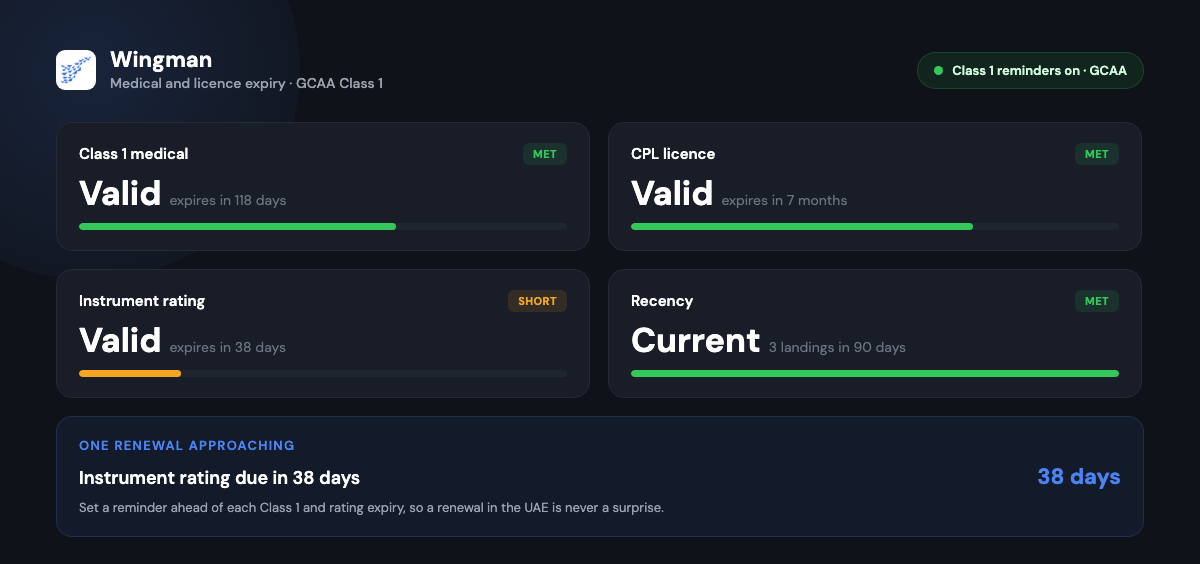
Wingman is a global product rather than a single-country tool, and it supports GCAA among regulators including the FAA, EASA, UK CAA, DGCA, GACA, NZCAA, HKCAD, CASA, and CAAS, with regulator-compliant exports for each. Rosters import automatically from systems such as AIMS eCrew, NavBlue RAIDO, CAE Crew Access, and others, so your duty and flight records build themselves. There is a free tier up to 250 logged hours, so you can start before you commit anything.
Frequently asked questions
What is a GCAA Class 1 medical certificate?
It is the medical certificate required to fly as a commercial pilot in the UAE. It confirms you meet the GCAA Class 1 medical standards for vision, hearing, cardiovascular health, mental health, and general fitness, and it must be issued through a GCAA-approved aeromedical centre.
Where can I take the GCAA Class 1 medical in the UAE?
At a GCAA-approved aeromedical centre, with an authorised aeromedical examiner. The GCAA publishes the current list of approved centres, and booking two to four weeks ahead is sensible during peak licensing periods. [VERIFY]
How long is a GCAA Class 1 medical valid?
Validity depends on your age and licence. As a general guide it is twelve months for younger pilots and reduces to six months above a defined age threshold, with more frequent assessment for senior ATPL holders. Confirm the exact period for your situation with your aeromedical centre. [VERIFY]
What are the main reasons people fail the Class 1 medical first time?
Most avoidable failures come from raised blood pressure on the day, poor rest, caffeine or alcohol before the exam, or missing documents, rather than a genuine disqualifying condition. Resting well, avoiding stimulants, and bringing complete records reduce that risk.
What happens if I do not meet a standard?
You are usually assessed as temporarily unfit and asked for further tests or a specialist report before a final decision under the GCAA medical standards. Many conditions are manageable with the right evidence, so it is often a process rather than an outright disqualification.
← All articles